• TalkBass has been independent since 1998. Add your voice.
    Create a free account to reply to discussions, view embedded media, and browse with fewer display ads.
    Join freeLog in
    Want zero display ads or expanded classifieds tools? Compare plans.

Double Bass Colors..

It would be fairly simple to feed a microphone into a spectrum analyzer and get a definite idea of the audio signature for a given instrument.

then you'd need a plucking or bowing machine to eliminate any variable due to the player's technique or "playability". You'd need a standard method of applying a known quantity of rosin so that variable is eliminated.

Then you'd find you have several different audio spectra to compare and they'd almost certainly be different, due to the fact they're different basses made by different makers of different woods of different ages.

Then you'd need to work out what part of the spectrum is responsible for the oily "color", if that's what you're identifying. And even whether that "color" is detectable in an instrument played by a machine....

Then you'd have to book Ken and Mike to come over and test your hypotheses independently ...

etc

I think its a little more than a high school experiment.

Anyway ... which schoolboy has access to a reasonable sample of fine origin-authentic basses to compare? :)
 
Forget about all the measurement stuff. I want to talk about how the instrument feels in your hands. How it sounds in different rooms. The tactile sense. I travel around the world playing and I'll likely never be able ( at least in this lifetime ) to buy a Gilkes, Hart, Vincenzo Panormo, Amati, etc. But I try to visit bass shops, dealers and just players because to me, the rush of playing a real Panormo or Montagnana at Tom Martin's, or an Amati at Versari's in Bologna, or playing Franco Petracci's Gaetano Rossi is an experience that is unforgettable. If you're a bass geek like me it's all about the love of the instrument. Like I said, if I see a Mirecourt bass with a 14mm top, I can reasonably expect a stiff response and nasal tone. This is just simple physics. I'd like to see a discussion of various wood types. I think that there is a reason that many of the best sounding basses ( English and Italian ) use slab cut tops and backs. It's funny that ( I think) that the Italians unknowingly created a model sound for bass by using the cheaper woods that they would never consider for a cello. There is a lot of speculation that the slab cut pine and spruce was more flexible and yielded a darker more responsive top. And that the Lombardi poplar ( cheap and plentiful ) yielded a more responsive back. Of course as soon as you make this generalization, you play a bass with a tight grain quarter sawn top and highly flamed maple back that sounds fantastic and blows this theory out of the water.
 
Well, I expect more posts like what Mike posted about Basses and sounds rather then wine and some other posts where i was left clueless what the actual topic was.

Oh Mike, on the supposed Amati Bass, there are no confirmed Amati Basses period. Not a single one by any member of the family. When 3 or 4 major world wide authorities on Violin Family instruments (including on Amati) agree that a Bass was made by one of the Amati's, then that will be the first one.

Like Strad, it is assumed that he/they never made anything bigger then a Cello or at least not a Double Bass.

In Amati's time from Andrea and his sons, d'Salo and Maggini were the kings of the few bass instruments that were made in their time. The demand was quite low then for anything larger than a Cello. In Strad's time (and somewhat with his Cellos) makers like Montagnana, Goffriller and Busan all working in Venice made the best Bass instruments of their time.

Early Cremona Basses are quite rare but there were some made there. Just not as many as made in Venice or Brescia. I suppose that the top Cremona makers like the Amati's and Strad were too busy making Violins to bother with a Double Bass.

On the woods, I have seen both Italian and English Basses made with American wood either on the Back and Ribs or even the Top. Not all on the same Bass but they used what they could get.
 
Most of the time when a name is attributed to an Italian bass over 200 years of age, the attributions are most likely arbitrary. Have you ever seen Petracci's Rossi? 1847 bass, but completely astounding. Franco plays largely solo work, but this bass has a 120 cm table and a 110cm string length!!! 72 mm lower bout! You play this bass and it's so amazing that you initially don't even realize that the string length is over 43 inches! And not sluggish. Perfectly balanced. Another prized bass is Versari's Monterumici. Early 20th century Bolognese. Not a big bass but amazing sound. Pupil of Fiorini I think, but much better than a Fiorini. I just mention it because it is highly praised and very high priced, but you wouldn't know it from looking at it. Dark, big sounding, a joy to play. Tom Martin told me stories about how he, Gagnon and others were going to Italy in the 60's. Tom can weave a bit of a yarn, but I belitve it. He said that they would have a pallet with 9 basses tied up in rope. 3 basses on the bottom, 3 basses high. Just tied up in rope and shipped back. And they would have multiple pallets. These are many of the top Italian basses in North America today. I visited David Perlman ( former principal of Cleveland, now deceased ) and he had probably 6 of these in his appartment. Of course as we were saying most of theses names are arbitrary, but these were basses generally accepted ( however erroneously ) as Maggini, Montagnana, and others of similar value. All shipped from Italy in the 60's tied to pallets in the bowels of a ship.
 
I am glad you are aware of this. On Pearlman, I had met him in the 70s thru Biase. I sold him a bunch of French Bows, real makers..lol

Without mentioning specific Basses and bursting any more bubbles than we already have. On Gagnon, he was the one that brought my Hart over but it was thought to be a Fendt. Now 40 years later, Tom Martin wants to take it back to London and sell it for me fwiw.

With prices the way they are and the exchange rates, it is more profitable to sell it in Europe now. The other side of the coin is that it will be too expensive in our lifetime to bring it back to USA.
 
Forget about all the measurement stuff. I want to talk about how the instrument feels in your hands. How it sounds in different rooms. The tactile sense.

Ah, subjectivity! Yes please.

I recently moved the soundpost quite radically in my bass and am intrigued with the effect, and have been struggling to describe the change in words. Last week it sounded powerful and complex yet a bit nasal from G' upwards and it felt tight and scratchy under the bow ... but after the soundpost was moved (about 30mm south and 30mm east, more than standard but then again this bass has really widely spaced ffs) the feel is looser, darker, more responsive under the bow, the lower register is more "breathy" ... maybe the E has lost some volume and growl, but gained in depth and sweetness when played in my best (still painful) arco.

But then I go to it again and the words don't really describe what is going on very adequately

However the exercise in describing the change in sound in the one bass has been interesting.

Mike ... you have a nice way with words; can you describe the bass YOU play now?
 
Matt - I think you could get pretty good readings using standard audio recording gear in a studio. Set the mic at a standard distance/orientation relative to the bass, have a single player make honest attempts at using the same technique for each instrument.

Basses are boxes of wood that make sound, sound is recordable and measurable. I’m not saying I’m really all that interested in taking on this project, thought I’d throw it out there…

Anyways I always love to hear enthusiasts swapping war stories; my gramps could talk a blue streak about yachts’…

Ken – I have a hard time believing a guy who puts bread on the table making electric slabs doesn’t know what a spectrum analyzer is :spit:
 
Matt - I think you could get pretty good readings using standard audio recording gear in a studio. Set the mic at a standard distance/orientation relative to the bass, have a single player make honest attempts at using the same technique for each instrument.

Basses are boxes of wood that make sound, sound is recordable and measurable. I’m not saying I’m really all that interested in taking on this project, thought I’d throw it out there…

Anyways I always love to hear enthusiasts swapping war stories; my gramps could talk a blue streak about yachts’…

Ken – I have a hard time believing a guy who puts bread on the table making electric slabs doesn’t know what a spectrum analyzer is :spit:

I do. Used it while testing my pickup proto-types in 1982. My Ear did a better job helping to find what I wanted. After all, it's what you hear, not what you see that counts.
 
Ken-

I know where you are coming from and let me add my $.02...

Italian
I have played Italian basses, and yes I agree that IN GENERAL they are THE all around best bass. I have played several different shapes, sizes, etc... they are all smooth, deep, resonant, and round sound that has the ability to either blend in a section or rise above it. If I was a top level professional bassist in a major orchestra- This would be the ultimate solo/orchestral instrument.

English
In my opinion, the ultimate orchestral instrument. It has just the right amount of spread combined with the smooth, refined, and beautiful sound of the Italian basses. Usually they have a little more "punch" than the Italian basses.

These basses are similar. In my opinion, due to the fact that most of these instruments were made on Italian patterns. I played a Fendt this weekend, Ron Sach's Violins in ATL, that is on the Maginni pattern. Very good sound-even after a year on the restoration table. Deep ribs, but very playable. Great wood and it will make someone an incredible orchestral instrument.

French
I played my master's recital on a Jaquet. It was one of the sweetest sounding basses I ever played. Unfortunately, I could barely reach the upper notes of the pieces. This bass was not the "typical" french bass. No Nasal here.

I usually feel that French basses are slower to respond. Thick tops take some "encouragement" to get the notes out on time, especially with the larger "cello-like" proportions.

The smaller basses can make great solo instruments and chamber basses if the tops aren't too thick. Those are usually better to the ear as well. Projecting- not nasal.

German
I own the exception to the rule here. Also, Klotz basses can not fall in this category. There are some great German basses, just most of them don't make it out of Germany. I think what most people associate with German is factory.

German factory basses are the workhorses. Great Jazz basses. Thick tops on some, but easy to play. Very accesible to players.

Yankee

The powerhouse bass. Most of these old Prescott's etc... are absolute organs. Spread for days, unfortunately not much focus. Dark, big, and power. Not the best basses to take an audition on, but once you get the gig the really fun ones to play. If dialed in, these basses can be the "new" english bass. Good for jazz, but better for orchestra, especially as they are getting older.

Those are the main schools to me. I have played Austrian/Czech/Tyrolean, but they are all over the road. Some more German, some more French, some just "out there" with qualities from the best schools. Hard to make a category out of these.

Just my experience. I would say I have played at least 10 of each of these schools, so take it for what it is worth.

IMHO,
Brian
 
Drurb I'm not saying you are wrong but my understanding of the term Psychoacoustics was based only on what the venerable wiki said

Ah, the venerable wiki! This is one of those times where you should not trust a non-authoritative source.

and this thesis Invalid Link Removed
“Psychoacoustics explains the subjective response to everything we hear. It is the ultimate arbitrator in acoustical concerns because it is only our response to sound that fundamentally matters."

That thesis, or whatever it is, is filled with errors! Trust me. Just about every sentence is wrong! If you would like more information regarding why you should believe me over wiki or that awful thesis, send me a PM. I'm being quite sincere. I can guide you to much better sources.


Maybe I'm misunderstanding your angle but seems that subjectivity is an important element in the field for at least a few other thinkers and scientists.

Yes, you misunderstood. I tried to clarify in a later post. You seemed to be using the term "psychoacoustics" to refer to perceptions that were somehow to be contrasted with what was "real." My point is that psychoacoustics is the study of the relation between auditory processing/perception and the physical stimuli. Subjectivity certainly does enter into the picture. The truth is that the vast majority of psychoacoustic studies are aimed at eschewing subjectivity.


What I meant, in laymens terms, is that different people may describe the same sound in different ways. They may even hear them differently. They may even think they can hear sounds that may not be there.

I agree completely!

But if they believe they can, there is no way nor reason to refute that, except through rigorous science, which as we know when applied to musical instruments is notoriously difficult due to the number of variables, and the importance of subjectivity in musical appreciation.

Anyway I'll get off your territory :|

Again, no fundamental disagreement. With proper scientific methods, we can, certainly, demonstrate objectively what a listener can and cannot distinguish. I literally do it every working day. You are completely correct that it would be a daunting, if not impossible, task to accomplish with musical instruments. In fact, that is much of what I described in my first point. I hope you can see why I would not refer to someone's claim regarding what he can hear as "psychoacoustics." Rather, I'd call that a report of his subjective perception.
 
Ken-

I know where you are coming from and let me add my $.02...

Italian
I have played Italian basses, and yes I agree that IN GENERAL they are THE all around best bass. I have played several different shapes, sizes, etc... they are all smooth, deep, resonant, and round sound that has the ability to either blend in a section or rise above it. If I was a top level professional bassist in a major orchestra- This would be the ultimate solo/orchestral instrument.

English
In my opinion, the ultimate orchestral instrument. It has just the right amount of spread combined with the smooth, refined, and beautiful sound of the Italian basses. Usually they have a little more "punch" than the Italian basses.

These basses are similar. In my opinion, due to the fact that most of these instruments were made on Italian patterns. I played a Fendt this weekend, Ron Sach's Violins in ATL, that is on the Maginni pattern. Very good sound-even after a year on the restoration table. Deep ribs, but very playable. Great wood and it will make someone an incredible orchestral instrument.

French
I played my master's recital on a Jaquet. It was one of the sweetest sounding basses I ever played. Unfortunately, I could barely reach the upper notes of the pieces. This bass was not the "typical" french bass. No Nasal here.

I usually feel that French basses are slower to respond. Thick tops take some "encouragement" to get the notes out on time, especially with the larger "cello-like" proportions.

The smaller basses can make great solo instruments and chamber basses if the tops aren't too thick. Those are usually better to the ear as well. Projecting- not nasal.

German
I own the exception to the rule here. Also, Klotz basses can not fall in this category. There are some great German basses, just most of them don't make it out of Germany. I think what most people associate with German is factory.

German factory basses are the workhorses. Great Jazz basses. Thick tops on some, but easy to play. Very accesible to players.

Yankee

The powerhouse bass. Most of these old Prescott's etc... are absolute organs. Spread for days, unfortunately not much focus. Dark, big, and power. Not the best basses to take an audition on, but once you get the gig the really fun ones to play. If dialed in, these basses can be the "new" english bass. Good for jazz, but better for orchestra, especially as they are getting older.

Those are the main schools to me. I have played Austrian/Czech/Tyrolean, but they are all over the road. Some more German, some more French, some just "out there" with qualities from the best schools. Hard to make a category out of these.

Just my experience. I would say I have played at least 10 of each of these schools, so take it for what it is worth.

IMHO,
Brian
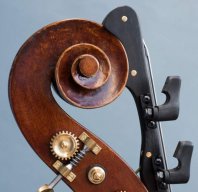
On the colors I see variation in the types of tone as well. Yes, the Italians have that silky smooth tone but depending on the Bass, it can be a thinner or thicker tone. My Candi is a smaller 3/4 and id deeper and darker sounding than my larger Loveri. The ribs are deeper on the Candi and the shoulders are broader within its design. The Loveri is much longer, narrower Ribs and sloped shoulders with a wider lower bout. The Storioni is a regular sized Bass but cornerless and with average Rib depth only buy the sound is like it's the size of a house. Why is that? My Martini is typical Italian model and sound with a classic design and tone to match. I have 4 Italian Basses with 4 completely different sounds. The common denominator is Smooth Silk in 4 flavors..

On the English I had a Dodd (sold it) and currently have the one and only made Samuel Gilkes (Jilkes) and an early John Hart Bass. Again, all of these have a different flavor of sound. The loudest on the low side was the Dodd. The Gilkes is the overall loudest wall shaker and the Hart is loud thru the floor. Common denominator, clear focused cutting sound in all registers with no weaknesses noticed. A slightly woody tone to each of them noticed more when played fff but never annoying.

On the Yankee's I agree with the above statements about the tone and how they are similar to the English. My Prescott was like all 3 of my English Basses rolled up in one. The Batchelder being a smaller Bass is a similar percentage of sound and tone to the Prescott. Common denominator, clear focused sound but slightly less cutting than the English but more woody sounding. This might be due to the Pine Tops, Blocks and Crossbars. The Prescott having a hard maple Back and the Batchelder with a white Pine Back. The Gemunder I just acquired though in a state of dis-repair has a combined Italian/French sound. It can't really be judged until it's restored but the Varnish quality is definitely European rather than typical Yankee.

On the German and others as mentioned it can be anything as Germany borders the Tirol which was Italian influenced with makers crossing the border over time as well as having its French neighbors. We have all seen tons of French looking Basses that sound German but look French in design, to a degree. On the Klotz (Kloz) thing, again this is another name that is thrown around loosely. I don't think there are many real Klotz Basses period or at least made by their own hands. A big family over several generations. Beware of a famous name on a famous players Bass. More often it's just wishful thinking as many players have been sold their 'Dream Bass' only to find out in reality it WAS a Dream.

It is true though that by percentage that most of the Germanic Basses seen in the States are those made commercially and for export. The good Orchestra quality handmade Basses from Germany, Bohemia, Austria and Hungry (basically the old Austro-Hungry region) have a nice warm home in it's native land with no plans to travel anytime soon.

To see some of these either look at a German website and take note of basses that do not look familiar or visit the region and walk up to the Bass sections and take some pictures. They have English, Italian and French Basses in there as well but they also have comparable home grown Basses as well.

On the French, I have owned 3 Basses that I know of. One a Bernadel (Violin Cello model), one a Barbe (Gamba model) and one a Quenoil shop/Bisch Bass (Pear model). All different slices of the same Pie but varied widely. The Bernadel was the best and the Barbe close to it. The Pear shaped bass was thinner under the ear but carried in the distance. Clarity, slightly winey string sound under the Bow and sustain is what I heard. All were heavily wooded Basses with good Varnish and solid construction. None of them sounded like the Italian or English Basses.

Any one Bass at anytime can break the mold. After all, it's just wood, glue and varnish, right?
 
On the colors I see variation in the types of tone as well. Yes, the Italians have that silky smooth tone but depending on the Bass, it can be a thinner or thicker tone. ...I have 4 Italian Basses with 4 completely different sounds. The common denominator is Smooth Silk in 4 flavors..

On the English...all of these have a different flavor of sound. ...Common denominator, clear focused cutting sound in all registers with no weaknesses noticed. A slightly woody tone ...

On the Yankee's ...Common denominator, clear focused sound but slightly less cutting than the English but more woody sounding.

On the German and others as mentioned it can be anything...


On the French, I have owned 3 Basses that I know of. One a Bernadel (Violin Cello model), one a Barbe (Gamba model) and one a Quenoil shop/Bisch Bass (Pear model). All different slices of the same Pie but varied widely...

Different but "silky," "woody," "clear," "focused," "anything"...

So now we know the adjectives that you may or may not apply to your own collection of basses, several of which you described once more.

I rest my case. :)
 
Words are only words. Those who have played Basses like these seem to understand the Lingo. Others, well it's like describing something like a new food. Until you taste it, the words mean very little.

Exactly. That's why there is little point to this exercise! The adjectives are used differently by different people. Even then, as evidenced by your own plethora of words, there is little consistency. I reject the notion that, somehow, the "in club" of those who have played a large array of these basses will somehow use the terms consistently. That is, there is no support for the assertion that once you've tasted the food, then the adjectives take on meanings that are somehow consistent across observers. Sure, some broad generalizations probably can be made. Your own long posting demonstrates how little information can be gleaned.