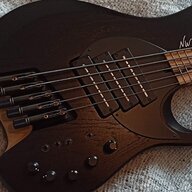
Byte Heaven Sugar Britches or KMA Tyler / Tyler Deluxe is the closest to analog mass production you will get.
The problem with Sugar Britches is that it's been out-of-stock for some time...

TalkBass has been independent since 1998. Add your voice.
Create a free account to reply to discussions, view embedded media, and browse with fewer display ads.
Join free Log in
Want zero display ads or expanded classifieds tools? Compare plans.
Byte Heaven Sugar Britches or KMA Tyler / Tyler Deluxe is the closest to analog mass production you will get.
I already have a simple splitter to build the parallelism and a Radial JDI DI Box, which can be set into "merge" mode so that it combines both at the end (and at the same time would provide a DI, how awesome is that!).
I just recieved a Byte Heaven single cross and have not tried it out yet. Will report back.
I just ordered one of these.
I've been thinking about crossover pedals for a long time. ...The Singlecross seems perfect for me.
The problem with Sugar Britches is that it's been out-of-stock for some time...
 !
!
There seem to be internal switches to select between affected highs or lows (current version only does high), and also to turn it into a standard full range blender pedal.
Not sure why there are two sets of switches for that crossover / blend thing, but we will see !

So what do you think about the Singlecross?
Have you experienced the second issue pointed out in post No. 127 in this thread? (i.e., the lack volume controls/lower gain) Thank you.

Digital is a very good option, I don't have a dual output bass but I use a Quad Cortex and I split my signal right after the tuner: one split is my mono pedals, the other is clean (with an optional OC-5). Then on the QC I can apply any HPF/LPF (with adjustable slopes) I want to the signals to combine them.I'm investigating a crossover-type setup, but with an added wrinkle: I want it to be compatible with dual-output basses, such as a Rickenbacker 4003's Ric-O-Sound output. I've looked at crossover circuits from Musikding such as the Pro-Cessor, in which the crossover is basically LPF and HPF running in parallel; both fed by a single input as supplied, but which shouldn't be too hard to separate. I could use normalled jacks, so that plugging in a single jack feeds both circuits.
(The Pro-Cessor circuit uses 24dB/Oct filters, which might be too steep for a "simple" application such as the bass, and the crossover frequency is fixed, so it's not quite right for my application.)
I know the Line 6 Helix Stomp can do that, and I could get one of those for an easier life, I suppose!

Can you explain what you are trying to do? Cut all the highs from the neck pickup and all the lows from the bridge pickup?I'm investigating a crossover-type setup, but with an added wrinkle: I want it to be compatible with dual-output basses, such as a Rickenbacker 4003's Ric-O-Sound output. I've looked at crossover circuits from Musikding such as the Pro-Cessor, in which the crossover is basically LPF and HPF running in parallel; both fed by a single input as supplied, but which shouldn't be too hard to separate. I could use normalled jacks, so that plugging in a single jack feeds both circuits.
(The Pro-Cessor circuit uses 24dB/Oct filters, which might be too steep for a "simple" application such as the bass, and the crossover frequency is fixed, so it's not quite right for my application.)
I know the Line 6 Helix Stomp can do that, and I could get one of those for an easier life, I suppose!
I'm not trying to anything drastically different to what's already been discussed in this thread, except for the dual input idea, which isn't supported by any of the options mentioned. Nearly all of them are no longer available anyway, including the OmniLooper you mentioned. I think low dB/octave filters in the crossover are important because I don't want to cut all the highs or lows, which was my point. Other posters have said similar things too.Can you explain what you are trying to do? Cut all the highs from the neck pickup and all the lows from the bridge pickup?

In a sense you already have mild LPF/HPF with a Rick because you can use the vintage tone cap to remove bass from the treble pickup and the neck pickup tone control to remove treble from the neck pickup and these two signal paths remain independent unless you blend them back passively later (at which point the two pickups and controls will load each-other down just as in a mono bass). Doing all this outside the bass with active filters or EQ seems far more tweakable and useful on paper but also comes with lots of other potential strange interactions as always happens when blending independently manipulated signals of the same sound source.I'm not trying to anything drastically different to what's already been discussed in this thread, except for the dual input idea, which isn't supported by any of the options mentioned. Nearly all of them are no longer available anyway, including the OmniLooper you mentioned. I think low dB/octave filters in the crossover are important because I don't want to cut all the highs or lows, which was my point. Other posters have said similar things too.
Another possibility is the DSM & Humboldt Simplifier Bass Station, which has crossover-like features, by first splitting a single signal in to two: a main channel with EQ and gain stage, and a parallel channel with a LPF and phase control. Both have FX loops, and so it would support dual pickups if I use the parallel return for the low (neck) pickup (after something like a compressor). Then it has a blend control if you want a single output. There's a block diagram in the manual on their website.

I don't have it anymore, but it sounds like you want something like a custom pedal I had, albeit with two inputs instead of one.I'm not trying to anything drastically different to what's already been discussed in this thread, except for the dual input idea, which isn't supported by any of the options mentioned. Nearly all of them are no longer available anyway, including the OmniLooper you mentioned. I think low dB/octave filters in the crossover are important because I don't want to cut all the highs or lows, which was my point. Other posters have said similar things too.
Another possibility is the DSM & Humboldt Simplifier Bass Station, which has crossover-like features, by first splitting a single signal in to two: a main channel with EQ and gain stage, and a parallel channel with a LPF and phase control. Both have FX loops, and so it would support dual pickups if I use the parallel return for the low (neck) pickup (after something like a compressor). Then it has a blend control if you want a single output. There's a block diagram in the manual on their website.
I thought I replied to this before, but yeah essentially a typical hardware crossover is doing exactly the same as the Omnilooper except only allowing a single frequency point for the filters to do their thing (of course a passive crossover like used in a speaker is a different thing). Something like the Omnilooper allows you to create (or eliminate) a degree of overlap between the two signals as needed which in my experience can help with weird artifacts between the two signals (as I was trying to point out earlier, there is always some overlap at the cutoff of a crossover dependent on the type of filters used that can cause weird phase inconsistencies). I dig that extra flexibility that having individual filter controls for each signal allows. I also have an old Peavey rackmount crossover with 4 different frequency regions and it allows for some cool experimentation but ultimately isn't that useful for me for making a single cohesive signal like the Omnilooper (of course the Peavey was designed for use with multi-driver/amplifier speaker systems and not for effects blending!)Systems like the OmniLooper, or the Simplifier I mentioned above, don't call themselves crossovers as such: they split a signal in two and can EQ them separately. But if I look at circuit diagrams of crossover circuits, that is basically what they do: split a signal in two and EQ the two halves separately. I want to do that with a standard bass - conventional crossover - and I also want the option of doing that with a split output bass: instead of splitting one signal, feed in two signals at that point, before the HPF and LPF as if they were two halves of one signal.
Of course you can do that without something like the Simplifier, just use two separate signal chains, with EQ, even two amps like e.g. Chris Squire did. I've already done it digitally by feeding both signals in to Apple MainStage, and the results can sound huge. So I know it works, but I'm thinking about ease of use in a live situation, and consistency of tone, when swapping between mono and "stereo" basses through a pedalboard. That's what I was trying to get at above: I'm in no doubt that it can be done, since I've done it already, just not through a pedalboard.
I¨ve got Broughton FFXL recently. Looking forward to add it to my pedalboard...
There seem to be internal switches to select between affected highs or lows (current version only does high), and also to turn it into a standard full range blender pedal.
Not sure why there are two sets of switches for that crossover / blend thing, but we will see !