
Enjoy the benefits of a premium membership!
Upgrade Account
-
TalkBass has been independent since 1998. Add your voice.
Create a free account to reply to discussions, view embedded media, and browse with fewer display ads.
Join free Log in
Want zero display ads or expanded classifieds tools? Compare plans.
You are using an out of date browser. It may not display this or other websites correctly.
You should upgrade or use an alternative browser.
You should upgrade or use an alternative browser.
de afwerking mk3-6 - A build diary.
- Thread starter blablas
- Start date
More options
Who Replied?


I see I forgot to mention that in the specs. in my first post, however as far as building is concerned it doesn't matter if it's a lefty or a righty.
You're right. I didn't even notice. It's a very symmetrical build aside from the tip of the headstock and the control cavity placement, which now I notice are both made to be on a lefty. 
Leveling and straightening the sides of the neck.
Shaping the headstock and headstock-neck transition.
And the final result for todays work.
Last edited:
This may have been already answered, or an obvious answer to the luthiers, but why do you have those two segments cut out on the neck? Do they help when it comes to shaping? Is it to help the wood settle and keep from shifting before shaping? Just curious. Looks great though! Cant wait to see it take further form!
I don't know if it is obvious for luthiers but for me as a metal machinist they are, I made these segments while leveling the area for the neck heel, they give me a level and parallel surface in relation to the front of the neck, and that makes life a lot easier when clamping the neck down for further work on it, once I start shaping the back of the neck they will sawed of with the other abundance wood.
Drilling the position markers with the use of a drilling template.
And glued in the markers, normally I use aluminum rod for these but for this bass I wanted wooden ones, I used toothpicks for them because they have the right diameter.
Last edited:

Position markers are in place.
I've been busy sanding the body today, but it's a bit useless to place pictures of that.
Last edited:
Machined two radiuses at the end of the neck.
Machined the neckpocket and pickup holes.
And the coming together of the two (not yet glued), the neck has a perfect fit in the body and needs to be pushed in with a reasonable amount of force and already stays in place by the way it fits.
Last edited:
Sanded the fingerboard up to grain 600.
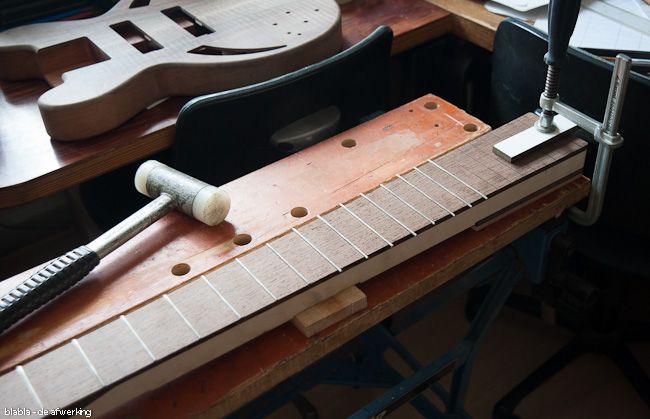
Hammering in the frets.
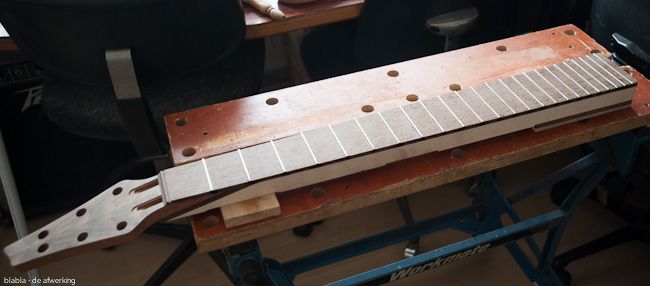
And done.
Now I still need to glue the fret ends, then finish the sides and level the frets, crowning and polishing will be done after the neck is fully shaped.
Hammering in the frets.
And done.
Now I still need to glue the fret ends, then finish the sides and level the frets, crowning and polishing will be done after the neck is fully shaped.
Last edited:


