• TalkBass has been independent since 1998. Add your voice.
    Create a free account to reply to discussions, view embedded media, and browse with fewer display ads.
    Join freeLog in
    Want zero display ads or expanded classifieds tools? Compare plans.

Dingwall Owners Club

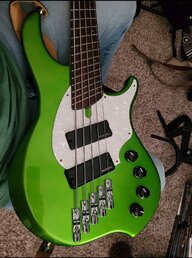
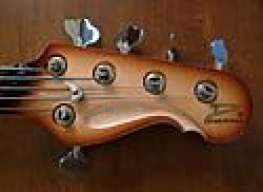
Arrived, very happy. Opinions: should I play it until the strings start loosing their crispness and then set it up F#BEAD, or jump right in?
Do what makes sense to you!

Personally, I would want to play it as-is initially, and let it speak to me.

Instead of trying to impose my will on a new instrument, I prefer to take the time to appreciate it’s natural voice. Approached with an open mind, any needed mods will make themselves known.

That way, I don’t end up having to reverse as many mods that turn out to be dead ends.
 
Hey All,
Hoping for some help! I’m wondering if anyone has info on bridge upgrades for the Combustion 4. I’m looking for one of those Payson replacement bridges (not the mono-rail type) but have had no luck thus far...

Have they stopped making these?

If so, do you know if (#1) Dingwall sells their Bridges, and more importantly (#2) would they be a direct fit on the combustion’s?

Thanks in advance; and I do apologize if these questions have been answered somewhere in this thread. I started researching, but with a 2 year old tugging at my legs I felt guilty spending all this time on my phone!

P.S. Here’s my Combustion...it’s the most incredible bass I’ve ever owned! I added the 3rd pickup, a D-Roc rotary switch & Dingwall Knobs. The bridge is my last “upgrade”, If I can find one!
51011E03-8648-4DDF-9D01-2A1FFEAF1009.jpeg
 
Hey All,
Hoping for some help! I’m wondering if anyone has info on bridge upgrades for the Combustion 4. I’m looking for one of those Payson replacement bridges (not the mono-rail type) but have had no luck thus far...

Have they stopped making these?

If so, do you know if (#1) Dingwall sells their Bridges, and more importantly (#2) would they be a direct fit on the combustion’s?

Thanks in advance; and I do apologize if these questions have been answered somewhere in this thread. I started researching, but with a 2 year old tugging at my legs I felt guilty spending all this time on my phone!

P.S. Here’s my Combustion...it’s the most incredible bass I’ve ever owned! I added the 3rd pickup, a D-Roc rotary switch & Dingwall Knobs. The bridge is my last “upgrade”, If I can find one!
View attachment 4270467

That's a pretty bass there. :) I snagged one of his last black one-piece 4-string bridges and dig it. Have you tried contacting Payson about what you're looking for?
 
I guess this is not necessarily a Dingwall specific question as it would apply to other multi-scale basses but as I'm asking it specifically about Dingwall basses I figured I'd ask it here. How is the nut width measured (don't say "with a ruler")? Is it measured along the nut itself (which is at an angle to the neck) or is it measured perpendicular to the neck (where the nut would be on a single-scale bass)? I'm trying to get a sense for how thick the neck is and I was originally just comparing the nut width on a Dingwall to other single-scale basses but then I realized that it may not be an apples-to-apples comparison.
 
I guess this is not necessarily a Dingwall specific question as it would apply to other multi-scale basses but as I'm asking it specifically about Dingwall basses I figured I'd ask it here. How is the nut width measured (don't say "with a ruler")? Is it measured along the nut itself (which is at an angle to the neck) or is it measured perpendicular to the neck (where the nut would be on a single-scale bass)? I'm trying to get a sense for how thick the neck is and I was originally just comparing the nut width on a Dingwall to other single-scale basses but then I realized that it may not be an apples-to-apples comparison.

To give a good comparison to "normal" 5 strings, I would guess you would want to use neck width instead of nut width. Probably measured perpendicular to the D string where the nut ends on the fretboard of the G string. I think fretboard or neck width would tell you more than needing to break out trigonometry if only given true nut width.
 
  • Like
Reactions: mateoloco