

Enjoy the benefits of a premium membership!
Upgrade Account
-
TalkBass has been independent since 1998. Add your voice.
Create a free account to reply to discussions, view embedded media, and browse with fewer display ads.
Join free Log in
Want zero display ads or expanded classifieds tools? Compare plans.
You are using an out of date browser. It may not display this or other websites correctly.
You should upgrade or use an alternative browser.
You should upgrade or use an alternative browser.
Dingwall Owners Club
- Thread starter FroggyOne2
- Start date
More options
Who Replied?

Had an idea today: what if Dingwall used a zero fret, and did away with the nut entirely? Instead of a nut, use the single “string trees” for all the strings like those from their NG-6’s that are on the EADG strings, but move them just a little closer to the zero fret. That would eliminate the finger scrape incurred during 1st fret fingering on the low string(s) due to the nut at high string, yes?


Had an idea today: what if Dingwall used a zero fret, and did away with the nut entirely? Instead of a nut, use the single “string trees” for all the strings like those from their NG-6’s that are on the EADG strings, but move them just a little closer to the zero fret. That would eliminate the finger scrape incurred during 1st fret fingering on the low string(s) due to the nut at high string, yes?
but the nut retains the strings in an exact, precise position. You could have all kinds of issue if the strings were left to slide free Accross the zero fret however minimal that may be.
I’d say test it on a prototypebut the nut retains the strings in an exact, precise position. You could have all kinds of issue if the strings were left to slide free Accross the zero fret however minimal that may be.
Exactly. That’s why people get alternate nuts made for different gauges of strings.Just thinking... you have a similar issue with .95’s on a nut cut for .110’s don’t you?
I hear what your saying, and there maybe be some kind of new idea you can get at but I don’t think your quite there yet. Ie, maybe the “Zero fret” is notched out for the strings..... but then your just back to a nut.
at that then your potentially increasing price points on “entry level” dingwalls.
I dunno? I’m just rolling with you on this

Setup for BEAD already with extra Dingwall nut in case you want to change it. I know there’s folks on both sides of the Dingwall and Spector clubs, hoping someone here wants a Dingwall d roc ready to ship. Then I can balance out the collection on the other side. Reasonable Offers welcome.
For Sale/Trade - Dingwall D Roc Standard with free goodies! Trade for Spector?
For Sale/Trade - Dingwall D Roc Standard with free goodies! Trade for Spector?
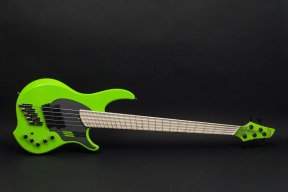
Had an idea today: what if Dingwall used a zero fret, and did away with the nut entirely? Instead of a nut, use the single “string trees” for all the strings like those from their NG-6’s that are on the EADG strings, but move them just a little closer to the zero fret. That would eliminate the finger scrape incurred during 1st fret fingering on the low string(s) due to the nut at high string, yes?
My guess is that the string would wear the zero fret quickly if held from that distance but this is a very cool idea. Cool enough to try on a prototype. Thanks


My guess is that the string would wear the zero fret quickly if held from that distance but this is a very cool idea. Cool enough to try on a prototype. Thanks
Would you be able to make that zero fret from a harder metal to solve that issue?
Would you be able to make that zero fret from a harder metal to solve that issue?
That's what I was wondering. Though different metals or fret sizes might impart particular tones, I guess it would be similar to a nut. However much that comes into play.
It seems to me that side-to-side movement of the strings would be minimal. Much less than picking hard near a regular bent-plate bridge. Been there, done that. 

BurningSkies
CRAZY BALDHEAD
- Feb 20, 2005
- 27,956
- 20,348
- Disclosures
- Endorsing artist: Dingwall Guitars
Would you be able to make that zero fret from a harder metal to solve that issue?
I know a guy fabricating in titanium and a variety of other rare metals.

There has to be a headless Dingwall in the works, right?

Kiesel ran into this issue on their early Vader guitars. Even with stainless steel frets, the string would wear a small dent or notch into the zero fret that would make noise when the open string was played.My guess is that the string would wear the zero fret quickly if held from that distance but this is a very cool idea. Cool enough to try on a prototype. Thanks
But if I remember correctly, this was happening on the unwound strings. Wound bass strings might take much longer to wear the zero fret to the point that it would become noisy.

Officially in the club. My AB1 arrived today and it had very little adaption time. The only thing that threw me off is playing a C at the 17th fret on the G string and I played a C# because I looked only at the side dots. Oh, and I keep forgetting that the A tuner is on the bottom side.
View attachment 4266735[/QUOTE
What you said about someone liking the Dingwall in a 4 string only model, thats me and my 4 string Combustion, wouldnt have it any other way. So now that your playing yours and noticed little differences here and there, have you noticed anything, anything at all when you 1st went to play the G# or A on the G-String? You know, with the angle of the 1st fret there and the angle of the nut. I still have a little trouble fretting that G#/1st fret sometimes, so I try to avoid it and grab that note 6th fret D string.
What you said about someone liking the Dingwall in a 4 string only model, thats me and my 4 string Combustion, wouldnt have it any other way. So now that your playing yours and noticed little differences here and there, have you noticed anything, anything at all when you 1st went to play the G# or A on the G-String? You know, with the angle of the 1st fret there and the angle of the nut. I still have a little trouble fretting that G#/1st fret sometimes, so I try to avoid it and grab that note 6th fret D string.
What you said about someone liking the Dingwall in a 4 string only model, thats me and my 4 string Combustion, wouldnt have it any other way. So now that your playing yours and noticed little differences here and there, have you noticed anything, anything at all when you 1st went to play the G# or A on the G-String? You know, with the angle of the 1st fret there and the angle of the nut. I still have a little trouble fretting that G#/1st fret sometimes, so I try to avoid it and grab that note 6th fret D string.
No, I haven't had any issues with that particular note/fret/string. I have had issues like when I was playing the intro diddy in "Money". The B power chord shape was a bit more of a stretch. Also, playing up around 9-12th position. Feels weird sometimes, almost as if the fretboard is curved or something.

- Apr 15, 2010
- 3,914
- 7,324
- Disclosures
- Spector Artist
All Sandberg basses come with zero fret and it is always thicker/higher than the other frets and always has little filed groves in it to settle the strings making it more like a metal nut.That's what I was wondering. Though different metals or fret sizes might impart particular tones, I guess it would be similar to a nut. However much that comes into play.


