• TalkBass has been independent since 1998. Add your voice.
    Create a free account to reply to discussions, view embedded media, and browse with fewer display ads.
    Join freeLog in
    Want zero display ads or expanded classifieds tools? Compare plans.

Dingwall Owners Club

...in case anyone wants to see a really great bass player demonstrate the true floating thumb technique, here is the link! Enjoy.:bassist:

http://www.youtube.com/watch?v=PPVMBPmrblU

The only thing I take exception to in Todd's video, is when he suggests that the difficulty of muting goes up exponentially with each added string.

I've never experienced it that way.

Perhaps that's related to string spacing. I like 5-string basses with relatively narrow spacing at the bridge, like the Dingwall ABZ.

In my mind, the B string isn't tacked on to the side of a "normal" 4-string neck- they just have things squeezed together a bit, to make room for an extra string in the middle.

Looking at it that way, it shouldn't be a problem to damp the outer strings, regardless of whether they're tuned to B and G, or E and G.

Similarly, it seems natural to me that if I can damp the D and A strings on a four-banger, it shouldn't be any harder to damp the D, A and E strings on a fiver...
 
Well done on your explanation/description of the "floating" thumb technique!

Todd Johnson's link (above) is spot on and less than a 3-minute watch.

I found another link with a slight variation/alteration to Todd's technique. This one (below) is described by Adam Nitti. (just over 9-min.)


Actually, I was experimenting with this technique before going to floating thumb. I think Todd referred to this as a floating anchor.

The problem with this technique is that with a 6 string, as many as 3 strings will be unmuted (B, E and A) while playing on the high C string. Two when playing on the G of a five string, and one on a 4 string.

While this technique cuts down on sympathetic vibration, it is eliminated only for the two closest strings to the one being played. There will still be sympathetic vibration of the unmuted lower strings

This is a compromise for thumb anchorors who are reluctant to give up an anchor, so I get that. But is a compromise in that it sacrifices complete muting of all lower strings to maintain the anchor feel.
 
^ Agreed.

Perhaps a new thread should be started entitled "Thumb Evolution." :D

Although I've made the transition to the "floating" thumb technique, I find myself at times using the "floating anchor" thumb technique without realizing it. Apparently my thumb has decided what's needed for the pattern. Scary right?!

Now I just gotta get the brain to lock the pattern in and remember it! :D
 
I tried the floating thumb and it doesn't work for me, i prefer the move able anchor. I find it allows me to get a more punchy sound.

I almost gave up on the FT technique for that very reason, but I remember Todd Johnson posting in his thread that if you stick with it, your fingers will strengthen enough to get as much punch as any other technique, and he was right . I can pull and pluck just as strongly as I ever could anchoring my thumb.

It's just that your fingers are used to getting support from the anchor to create force, and also being more straight. If you stick with FT long enough, your fingers will strengthen and will be able to generate that force on their own, even while bent or curled.
 
^ Agreed.

Perhaps a new thread should be started entitled "Thumb Evolution." :D

Although I've made the transition to the "floating" thumb technique, I find myself at times using the "floating anchor" thumb technique without realizing it. Apparently my thumb has decided what's needed for the pattern. Scary right?!

Now I just gotta get the brain to lock the pattern in and remember it! :D

Ironically, there is one in the technique forum, although not labeled "EVolution of." I found that thread like 6 or 7 years ago, when it first started, and was an early participant. Lot's of discussion about what to call which technique. Hard to believe so much time has passed since then! Here's the thread. It's even been stickied! http://www.talkbass.com/forum/f21/floating-thumb-techniqe-230685/
 
I almost gave up on the FT technique for that very reason, but I remember Todd Johnson posting in his thread that if you stick with it, your fingers will strengthen enough to get as much punch as any other technique, and he was right . I can pull and pluck just as strongly as I ever could anchoring my thumb.

It's just that your fingers are used to getting support from the anchor to create force, and also being more straight. If you stick with FT long enough, your fingers will strengthen and will be able to generate that force on their own, even while bent or curled.

I don't doubt it. For me i don't see an advantage, but for other players it could certainly be helpful. Just playing devil's advocate.
 
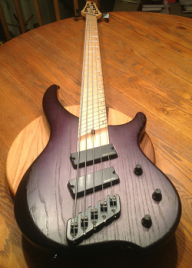
I'm in with a new-to-me 2002 AB1.
Can I get a number?

I'm going to show you two sets of photos.
The 1st set was posted on the Dingwall forum in Burning Skys "Show Your Dingwall" thread...

Afterburner003_zps75f714af.jpg

Afterburner005_zps5d681eac.jpg


The second set is from my new AB1.

6a127afc-305c-4327-b60a-40e4702d5b6c_zpse77833de.jpg

Ding1019_zpsbc64f4a0.jpg


IT'S THE SAME BASS.

Look at the grain on the back....same bass.

Afterburner005_zps5d681eac.jpg

Ding1018_zps6c3cb7a9.jpg


Too damn cool...
Dingwall AB1 #3404...November 2002.
 
Sweet tiger stripes! And another fEarful guy joins the Dingwall crowd!
Congrats on the new bass.

Anybody tried the Gruv Gear mute? I spent a couple hours messing around with PVC foam, some webbing and Velcro to make a band that could slide over the nut. The Dingwall headstock doesn't really work for what I made, but I could see the advantage, since all the extra string noise and muting problems learning the six string was a bother.

I think an elastic band would be better than plain webbing and Velcro. Lots of guys use hair scrunchies of some kind. Having all the strings silent unless fretted was cool, but I missed the open strings too much. Tappers and stick style players would love this kind of thing.

I found the six string to be exponentially more difficult to mute, and I still hear lots of extra noise on my recordings.
 
Anybody tried the Gruv Gear mute?

I've got a few of those mutes, and I do use one on my Z3 sometimes. They take a bit of time to set up properly. Too tight and it won't slide back over the nut when you don't want it in place. Too loose and it's not doing anything. You're right about it working well for chords or tapping, or recording finger style lines (without using open strings). I don't usually have problems with my muting technique, so I mainly use the wraps for chording stuff up high.

I also play a couple songs with one band that call for a dull upright-ish tone. I use the neck p-up, heavy palm muting, and the fret wrap slid up the neck to the 5th fret. The shorter scale lenght of playing higher up the neck, combined with the heavy muting on both sides of my fretting/plucking hands gives it a pretty thick/dead tone that works for folk/country songs. I don't do a lot of it but its nice to have available.
 
My Combustion has been paid for and is on the way - sweet! I am really excited.

For those of you that still have standard fretted basses as well, is there every any issue going back and forth between them and the fanned frets?

No, I go from an ABII5 to an XB75PF 35.25" fretless. The only adjustments, as Kody mentioned, is noodling or chording up high on the fanned fret board.
 

Latest posts