
Enjoy the benefits of a premium membership!
Upgrade Account
-
TalkBass has been independent since 1998. Add your voice.
Create a free account to reply to discussions, view embedded media, and browse with fewer display ads.
Join free Log in
Want zero display ads or expanded classifieds tools? Compare plans.
You are using an out of date browser. It may not display this or other websites correctly.
You should upgrade or use an alternative browser.
You should upgrade or use an alternative browser.
Dingwall Owners Club
- Thread starter FroggyOne2
- Start date
More options
Who Replied?

In just sent a pedal from Georgia to Ontario via UPS this week and it only sat at the border for 2 days.
No issues with pedals etc. and no issues coming from the US to Canada (I've just received a bass in 2 days) it's specifically wood products entering the US


The low end is definitely different on the Supers.Having a look at their product range and some of your suggestions, I'm thinking a Super J would be right up my ally as I do love a Fender J bass. With the scale of it being 2" shorter, does that affect the quality of the low B on a 5-string?
Still in the Dingwall family, though- there's that clarity and extra pitch definition that always shines through on close examination. Sheldon points out that the shorter scales speak more quickly- he hears it as a difference in the attack envelope.
What I noticed during a memorable owner hang at a stocking dealer a few years ago (Long & McQuade Markham, if you're ever in that neck of the woods), was this:
- Sheldon dropped in on his way to NAMM with some demo basses, so there was a lot of trading back and forth.
- Not just people trying out The Boss' new toys, but owners tripping at the opportunity to try out each others' Z's, AB's, etc. as well.
- I don't remember anyone actively commenting or complaining about string spacing, the reach to the first fret, etc.
Regardless of whether they actually expressed a preference for one style or the other, I could see and hear in their playing that they were more at ease on the Supers. They played more expressively and seemed to groove harder when they were holding something with 19mm spacing, a more familiar neck taper, etc.
That's the trouble.Na man, you could totally rock it, it is all in the attitude.
My attitude comes through loud and clear, and it's not "does my strap match my shoes?"
It's more like "don't get between me and the snack table", or maybe "is it OK if I loosen my belt while I'm playing?"

...
there were a few "Dingwall-curious", obviously highly experienced working Fender players there.
Regardless of whether they actually expressed a preference for one style or the other, I could see and hear in their playing that they were more at ease on the Supers. They played more expressively and seemed to groove harder when they were holding something with 19mm spacing, a more familiar neck taper, etc.
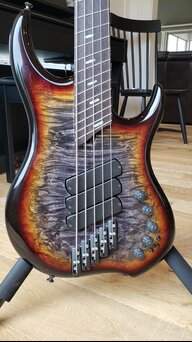
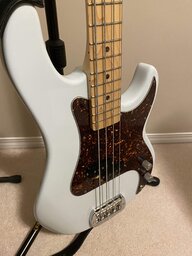
As a ~20 year Fender-spec player, I do feel right at home on the Super P5.
You're right on. They're bypassable and I use mine at times in church. I think the big reason people mention it is they do give a slightly more aggressive (I hear it as upper mids) sound.I never get why people say that a darkglass preamp colours the tone in a specific way. The bass can be set to passive. Am i missing something about the pots or something? I assumed bypass was full bypass of the preamp. Does a preamp colour the passive tone when not active? (Just minus eq control?). I ask as a newb to active bases. My ng2 and now ab1 are my only active bases. To my ear they sound identical active or passive when the eq is in neutral.

So the dg preamp lacks a true bypass? Or do you mean people avoiding paying for one if there is no intention to use it… given the tones it is known to produce?You're right on. They're bypassable and I use mine at times in church. I think the big reason people mention it is they do give a slightly more aggressive (I hear it as upper mids) sound.
what i am trying to learn is if the dg preamp colours the tone when in passive (bypass) mode? If it does, i interpret that as not a true bypass.
Last edited:
The low end is definitely different on the Supers.
Still in the Dingwall family, though- there's that clarity and extra pitch definition that always shines through on close examination. Sheldon points out that the shorter scales speak more quickly- he hears it as a difference in the attack envelope.
What I noticed during a memorable owner hang at a stocking dealer a few years ago (Long & McQuade Markham, if you're ever in that neck of the woods), was this:
However: there were a few "Dingwall-curious", obviously highly experienced working Fender players there.
- Sheldon dropped in on his way to NAMM with some demo basses, so there was a lot of trading back and forth.
- Not just people trying out The Boss' new toys, but owners tripping at the opportunity to try out each others' Z's, AB's, etc. as well.
- I don't remember anyone actively commenting or complaining about string spacing, the reach to the first fret, etc.
Regardless of whether they actually expressed a preference for one style or the other, I could see and hear in their playing that they were more at ease on the Supers. They played more expressively and seemed to groove harder when they were holding something with 19mm spacing, a more familiar neck taper, etc.
That is good to know. Im in Edmonton and they occasionally have a Dingwall in stock at L&M so I will have to play around with it. I love a 4 string bass, but I feel like if I get a Dingwall, it would be a waste not to get the 5.

I agree with him entirely. My Super J has a very percussive feel to the attack and decay envelope of a note. My other single scale Jazz basses (one Warmoth, the other Warmoth/Status) have much more even envelopes, and both sustain for longer than my Super J. Both of these basses have more pleasant bedroom tone, but the Super J slots itself into a band mix more readily which I’ve always attributed to the more percussive envelope.Sheldon points out that the shorter scales speak more quickly- he hears it as a difference in the attack envelope.
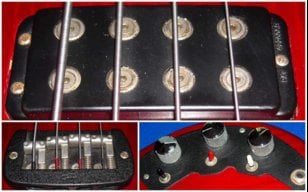
Does anyone set up their Dingwall with a little fret clank? I love my jazz basses set up low with that little bit of rattle/buzz especially whe you dig in. I haven't tried it with my Z yet but may. It's just so good that it already has ridiculously low action with no buzz. I think it also has to do with the slighty higher string tension.
Anyone have a recommendation for strings that have slightly lower tension than the Dingwalls? Bonus points if they aren't really light gauge.
SITs "Dingwall Style" nickel set. But medium light gauge (A kinda light).
And I setup for some fret buzz when I dig in.
It's a true bypass as far as I understand. And some people would like a more traditional tone control like a glock.So the dg preamp lacks a true bypass? Or do you mean people avoiding paying for one if there is no intention to use it… given the tones it is known to produce?
what i am trying to learn is if the dg preamp colours the tone when in passive (bypass) mode? If it does, i interpret that as not a true bypass.

About 3 years too late. Bugger.

So the dg preamp lacks a true bypass? Or do you mean people avoiding paying for one if there is no intention to use it… given the tones it is known to produce?
what i am trying to learn is if the dg preamp colours the tone when in passive (bypass) mode? If it does, i interpret that as not a true bypass.
I use an ABZ in church almost exclusively (prior to that was a Combustion) with a Darkglass pre. I did swap out the neck for a P-tone pickup. My sweet spot is to bump the low mids and bass a bit.
You can bypass and play in passive but then you lose any tone controls.
That's not accurate, Reverbs fees are up to 15% if you count the full fees to sell on the platform including the fees they take on your payment. My last sale was $4544 and I netted $3886 that was Sept 2021, some quick maths tells you that's net of 85% give or take a couple decimals.
I'd love to see that broken down, because nothing I see in the fee listings would indicate that. Did you include shipping or was that separate/paid in addition? Both Reverb and E-Bay will charge you the 7.7% total on the shipping costs, even if they are separated. I've listed and sold on Reverb lately and never had fees that high.

Short answer: yes, the DG Tone Capsule is true bypass.I never get why people say that a darkglass preamp colours the tone in a specific way. The bass can be set to passive. Am i missing something about the pots or something? I assumed bypass was full bypass of the preamp. Does a preamp colour the passive tone when not active? (Just minus eq control?). I ask as a newb to active bases. My ng2 and now ab1 are my only active bases. To my ear they sound identical active or passive when the eq is in neutral.
short version: is the passive bypass of the dg preamp a true bypass?
Longer answer: even with all of the EQ pots at the center detent, the Tone Capsule has a definite tone. I felt like what it did was scooped the mids - I had to boost low mids and cut high mids a bit to get my active and passive tones sounding more or less the same.
I swapped mine out for a Nordstrand 3-band, and while I'm not crazy about the taper on the pots ( I think they're log and I'd prefer linear) the active and passive tones are almost identical - the only difference I'm hearing is a touch more high-end due to the buffering that active mode provides.
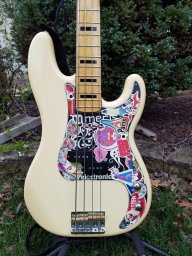
Two quick question:
1. For someone who plays at a church and likes motown/R&B, what Dingwall would be well suited for that?
2. Does anyone have a picture of a Shell Pink bass??
1. Yes, it’s such a versatile instrument. I use mine for everything, and I really mean that. A few weeks ago I played a Top 40 gig, cut a metal track and did an RnB track in one weekend on one bass.
2.
I'd love to see that broken down, because nothing I see in the fee listings would indicate that. Did you include shipping or was that separate/paid in addition? Both Reverb and E-Bay will charge you the 7.7% total on the shipping costs, even if they are separated. I've listed and sold on Reverb lately and never had fees that high.
I think what you're missing are the cross border fees, 1% for cross border and then another 2.5% if the buyer pays in a different currency. So I suspect we're at 11.2% fees and then a real awful exchange rate on the currency conversion bringing out to a net 14.7% hit.
It's all in the small print here - Billing Policy | Reverb.com
Honestly I'd love to see it broken down as well now that I've been looking into it, it should be a standard receipt they provide for every transaction. The takeaway is there are many hidden fees, especially if you ship internationally.
Also I should say, I'm not super annoyed about it or anything. I knew what I was getting into and the bass was priced with the fees in mind so I got close to what I wanted. It's just not a simple 5% as the headline advertises.
Makes sense. My opinion is that with the knobs on central… passive and active with the dg were identical. I should listen again. It would make sense that there might be some difference as it is an additional circuit.Short answer: yes, the DG Tone Capsule is true bypass.
Longer answer: even with all of the EQ pots at the center detent, the Tone Capsule has a definite tone. I felt like what it did was scooped the mids - I had to boost low mids and cut high mids a bit to get my active and passive tones sounding more or less the same.
I swapped mine out for a Nordstrand 3-band, and while I'm not crazy about the taper on the pots ( I think they're log and I'd prefer linear) the active and passive tones are almost identical - the only difference I'm hearing is a touch more high-end due to the buffering that active mode provides.
1. Yes, it’s such a versatile instrument. I use mine for everything, and I really mean that. A few weeks ago I played a Top 40 gig, cut a metal track and did an RnB track in one weekend on one bass.
2.
View attachment 4577940
Thank you for your insight, and that thing is a real beauty!!
I think what you're missing are the cross border fees, 1% for cross border and then another 2.5% if the buyer pays in a different currency. So I suspect we're at 11.2% fees and then a real awful exchange rate on the currency conversion bringing out to a net 14.7% hit.
It's all in the small print here - Billing Policy | Reverb.com
Honestly I'd love to see it broken down as well now that I've been looking into it, it should be a standard receipt they provide for every transaction. The takeaway is there are many hidden fees, especially if you ship internationally.
Also I should say, I'm not super annoyed about it or anything. I knew what I was getting into and the bass was priced with the fees in mind so I got close to what I wanted. It's just not a simple 5% as the headline advertises.
it can add up for sure. Reverb fee, currency conversion rates, banks charging you a few % extra on currency conversion, shipping processing fees, tax at the border, duty at the border.
i did a big resto/hotrod job on a classic sports car around 2015. Most of my parts came from the usa (i am in canada). I saved a lot with a credit card that charged no extra currency conversion fees. I also opened an american bank account. I had friends in the us, so i would buy, and most shipping was free to the usa… so i would have everything sent to him. So i paid no state tax. Then i had him ship them to me via quality courier with an astronomically low declared value to bypass customs delays, customs fees, duty, and canadian sales tax. It something were lost or damaged in shipping i would be in trouble… but pre covid everything ran smooth. Some vendors shipped direct to me at a lower declared value also. It all added up to an easy 20%+ saved on the dollar… and many thousands of dollars saved. I pay enough tax… and all savings were used for more parts. :-D
i will likely be doing similar when my canadian dingwall is ready in april, as it is from a usa vendor. I can save an easy 1000$. I will probably buy a pjb cab with that.


