• TalkBass has been independent since 1998. Add your voice.
    Create a free account to reply to discussions, view embedded media, and browse with fewer display ads.
    Join freeLog in
    Want zero display ads or expanded classifieds tools? Compare plans.

Dingwall Owners Club

Anybody care to talk specifics about the P-tone pickup?

I am still on the fence about whether I could use a slightly more mid-forward voicing for my ABZ. I tried the new nickel rounds and really liked their effect on the mids. Sadly, I went back to the SS strings because the nickels excited a bit of a dead spot on the G string.

Over the weekend, I hooked a series-parallel coil switch into the neck pickup wiring. I thought it pushed the tone in the right direction, but I found it overpowering in the low end.

The trouble is that I'm not looking for a drastic change, just a little fine-tuning. I only dial the tone control back about an 1/8th to a 1/4 turn even with the SS strings, unlike some folks on here.

Thus my interest in the P-tone. If it goes for a more detailed midrange presence (like a 60's P-bass with rounds), it might be just the ticket. On the other hand, if it's all about a big, pillowy low end, then it would be too much for me.

Comments?

I've got the p-tone pickup on the ABZ5. Definitely adds a mid-range subtleness that exemplifies the p-bass tone. Dialing the tone down using just the p-tone neck pick-up position yields the thick, pillowy low end sound. However, spin the selector to series (or parallel) and you've got a different sound -- think p-bass on steroids. That may be the 60's p-bass round-wound sound you're looking for. As you've discovered, you can get a wide spectrum of sounds from this passive bass. The tone control is your friend!
 
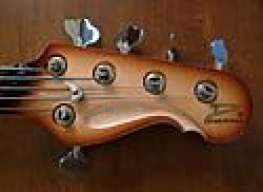
Just got back in town from 5 days away with my family, and found a set of the new Dingwall Nickel strings waiting for me! I have rehearsal in a couple hours and a 'sold out' theater gig tomorrow night supporting international touring reggae act John Brown's Body, so I quickly put them on and I'm ready to give them a spin.

Right off the bat, I enjoyed the fact that they fit at the nut perfectly without any worries. And that they appear to be 'stepped slightly at the bridge and took no adjustment there at all to have the same action. In fact, I didn't need to adjust the truss rod at all for what appears to be the same action I always have.

10317153636_9c6132895c_c.jpg


I'll let everyone know how they work for me after tonight and tomorrow. We' have an active few months ahead, including a venue that we've been trying to break into that has booked us for 3 Saturdays in November & early December.
 
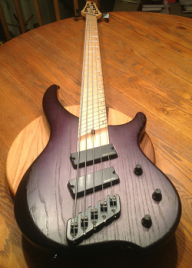
I love that bass!

Me too ! Arguably the prettiest stain work that I have ever seen.


Thanks guys, I love it too! :D

So last night I spent about 3 hours playing in a band setting at pretty close to full gigging volume with the new nickel wrapped strings. Right off the bat, I can say that there ARE some decided differences from the SS strings, some in the places you’d expect some in other ways. I think I really like these. I’ll have a better idea tomorrow after we try them on stage tonight.

First off, the wraps go all the way up on these rather than the exposed cores of the SS ones. They ‘settle in’ quicker than the SS strings, where I “stretch” and tune each string for a few minutes. These ones only took one or two stretches before they remained in tune and were ‘solid’.

I didn’t actually check the gauges before playing and right off, they have *slightly* more tension than the SS strings. Not in a bad way. I still maintained my ‘sweet spot’ zone for my right hand, which resides either right over the neck pick up to up at the neck joint. The extra tension was noticeable but again, pleasant to me and didn’t make me want to change my hand position. When I got home, I do see that the gauges are very slightly heavier than the SS set.

Tone wise…I really like these strings. It may take a bit to get used to the different character on the top end, with a subdued upper-mid and a restrained brightness way up high (still can get string noise and cut if you want). I adjusted how far back I roll off my treble control slightly. It may take a bit to get used to the tamed upper end, but I do roll mine off quite a bit, so it won’t be too much of a transition I think.

What you get in tradeoff is pretty awesome. These strings sound HUGE, with a ton of really ‘sweet’ rich harmonic content/complexity in the lows and low mids. They’re really beautiful and musical down there. They also have a bit more punch in that area, making churn and burn 8th notes or faster passages fun to hit. To me I feel like they sound more ‘in tune’ (the overtones). The little added tensioning also had me even happier on the B string and down in the first/open position. That range is even more coherent that the already good sounding lows that you’re used to. I also noticed that these strings ‘compress’ more than the other ones. They physically stay in control a bit more when you dig in, and I could dig in without getting fret rattle or bottoming out, while keeping the volume more even when digging in.
 
Interesting. From the early reports, all seem to be in agreement that there is added tension. That would appeal to me if it doesn't alter set up or force truss adjustment. I would like to be able to jump back and forth without doing a new set up each time.

I wonder if in fact the higher tension will be noticeable on the Super series?
 
Interesting. From the early reports, all seem to be in agreement that there is added tension. That would appeal to me if it doesn't alter set up or force truss adjustment. I would like to be able to jump back and forth without doing a new set up each time.

I wonder if in fact the higher tension will be noticeable on the Super series?

They were a drop fit for me. I didn't adjust the truss rod and there is no noticeable change in action. If you look at the change in gauges, they're very slight, a few hundreths here or there. It was noticeable to me, but I'm particularly picky about the tension and string feel and I still like the way they feel.
 
Dingwall strings 2, diagnostic skills 0...

First, I thought I had bad A string on my brand-new ABZ, but it turned out that my tuner software had gone berzeek. Then I observed a slight dead spot with the new Nickel rounds. Yesterday, I was back at the same venue with the stock SS strings. Sure enough, there was the dead spot again! Looks like it was a resonant interplay between the awful room, and the crappy slapped-together 10"wedge that I've been using for that gig.

Thus, a corrected review of the new long-scale nickel rounds:

The adjusted gauges are a big hit with me. I would be pleased if Sheldon made the same adjustments with the new SS sets as well. The larger diameter of the B string felt a little disconcerting at first, but I quickly acclimatized. In every way, the slight extra stiffness improves the feel of the instrument. I can also dig in a little harder before fret rattle.

I thought the "barbed wire" windings on the old strings were a cool idea, and assumed that they improved tuning stability. After going back and forth with the nickels, I think that it may be the other way round. The old SS strings are actually a little touchy to tune, and seem to take longer to settle in after a swap.

The windings on the new strings feel amazingly similar to the old ones, which serves as a reminder that the old strings had a smoother and less abrasive feel than most stainless rounds.

I used to adjust the intonation on my old bass every time I dropped in a new set of D'Addario XLS's, yet here I am switching gauges and compounds with Dingwall strings, and not really needing to touch anything! I don't know how Sheldon and the guys do it, but they obviously wave a pretty big stick in negotiations with their string suppliers.

What Sheldon describes as a throbbing quality, I hear as just the right amount of extra heft and midrange complexity. There's still plenty of zing up top. We're talking pretty subtle differences, but it's exactly what I felt was missing with the original SS set.

The ABZ already has an impressive ability to straddle the fence between bright, modern tones and darker, old-school thump. Still, I was finding it a touch too "modern" and aggressive for a couple of my regular gigs. With the nickels, it's really hitting the sweet spot for me. It'll take a few more gigs to be sure, but the P-tone pickup might have dropped off my Christmas list.

Unless you have a skin allergy to nickel, these strings are a cool, inexpensive upgrade. I would recommend that any Dingwall owner give them a try.
 
Dingwall strings 2, diagnostic skills 0...

First, I thought I had bad A string on my brand-new ABZ, but it turned out that my tuner software had gone berzeek. Then I observed a slight dead spot with the new Nickel rounds. Yesterday, I was back at the same venue with the stock SS strings. Sure enough, there was the dead spot again! Looks like it was a resonant interplay between the awful room, and the crappy slapped-together 10"wedge that I've been using for that gig.

Thus, a corrected review of the new long-scale nickel rounds:

The adjusted gauges are a big hit with me. I would be pleased if Sheldon made the same adjustments with the new SS sets as well. The larger diameter of the B string felt a little disconcerting at first, but I quickly acclimatized. In every way, the slight extra stiffness improves the feel of the instrument. I can also dig in a little harder before fret rattle.

I thought the "barbed wire" windings on the old strings were a cool idea, and assumed that they improved tuning stability. After going back and forth with the nickels, I think that it may be the other way round. The old SS strings are actually a little touchy to tune, and seem to take longer to settle in after a swap.

The windings on the new strings feel amazingly similar to the old ones, which serves as a reminder that the old strings had a smoother and less sticky feel than most stainless rounds.

I used to adjust the intonation on my old bass every time I dropped in a new set of D'Addario XLS's, yet here I am switching gauges and compounds with Dingwall strings, and not really needing to touch anything! I don't know how Sheldon and the guys do it, but they obviously wave a pretty big stick in negotiations with their string suppliers.

What Sheldon describes as a throbbing quality, I hear as just the right amount of extra heft and midrange complexity. There's still plenty of zing up top. We're talking pretty subtle differences, but it's exactly what I felt was missing with the original SS set.

The ABZ already has an impressive ability to straddle the fence between bright, modern tones and darker, old-school thump. Still, I was finding it a touch too "modern" and aggressive for a couple of my regular gigs. With the nickels, it's really hitting the sweet spot for me. It'll take a few more gigs to be sure, but the P-tone pickup might have dropped off my Christmas list.

Unless you have a skin allergy to nickel, these strings are a cool, inexpensive upgrade. I would recommend that any Dingwall owner give them a try.


Thanks for the good review and all the pointers, I'm waiting delivery of the new Dingwall nickels and I can't wait to try them on my ABZ and ABII, I have tried those Payson ones before with disappointing results in both the overly dark sound and the excessive tension of them though I understand he is now offering a lighter gauge but if the actual nickel formula Payson uses is the same as the thicker one I shan't bother being disappointed again ( remember I'm entitled to my opinions Payson ) and I trust Dingwall strings over any other manufacturers a thousand to one, good of you to take the time to review these strings
 

Latest posts