• TalkBass has been independent since 1998. Add your voice.
    Create a free account to reply to discussions, view embedded media, and browse with fewer display ads.
    Join freeLog in
    Want zero display ads or expanded classifieds tools? Compare plans.

Dingwall Owners Club

I saw the official Dingwall video on Kyle's bass and that switching system sounds awesome!

It gave me option anxiety! But it is an exceptionally good sounding bass. Definitely seems to be the flagship of the entire Combustion line. If I didn’t have a Z on deck, I would have bought the KK3 today. And put the simpler Sklar electronics in it. I could sell the electronics/switching from a KK3 here on TB in less than 5 minutes. :D
 
  • Like
Reactions: seedokebass
I finally got around to doing some mods to a few basses. Very pleased. Yanked the DGTC out of my fretless and swapped it with the glockenklang from my ABZ. Both basses gained from this trade for my Usage.
The glockenklang magic sure works for fretless.
7E9FA7AB-1B5A-49E3-91CE-2CDE491D4810.jpeg
 
I finally got around to doing some mods to a few basses. Very pleased. Yanked the DGTC out of my fretless and swapped it with the glockenklang from my ABZ. Both basses gained from this trade for my Usage.
The glockenklang magic sure works for fretless.
View attachment 4935631

That bass is INCREDIBLE.
 
  • Like
Reactions: AB Nate
I need help from my Dingwall brothers and sisters. I’m trying to decide if putting Babicz rails on my Combustion 3-6 upgrade is worth it. Anyone done this? Results?
I put them on 2 of my Combustions. A 4 and a 5 String. I was very happy with the results. I think they add a slight bit more weight, but I like the adjustability the solo rails offer. Im not really good at explaining or writting reviews but to me it was well worth the upgrade. I have an NG3 and a Droc that will probably be getting them in the near future as well.
Matt
 
  • Like
Reactions: Derek Williams
I need help from my Dingwall brothers and sisters. I’m trying to decide if putting Babicz rails on my Combustion 3-6 upgrade is worth it. Anyone done this? Results?
I noticed @Jamie_Funk has them on his combustion here


Picked up a second-hand MINT NG-3 (plastic still on pickups and guard, looks like it is brand-new out of box for the first time, only used gently in the studio) this Sunday - plays like a dream and a great companion to my 2016 Combustion :)

View attachment 4934274
 
I have a non-Dingwall question... I couldn't figure out where best to post this.

I am new to the world of metal bands, and bass seems to occupy a slightly different role in modern metal. I'm newly in a progressive metal-ish band, and I'm getting a tone I love from my NG3 with bridge and middle pickups in series, DG Infinity mostly just for eq, MBD for a bit of hair, PC-2A compressor. The tone is very bright, with a boost around 300Hz so it doesn't get thin. I have my first gig in a couple of weeks, and while I'm confident about eq'ing non-metal tones, I'm struggling with the proper ratio of lows to highs.

I generally err on the side of a brighter sound because through the club's PA it will probably have a huge boost in the lows. I want every note to be defined and punchy, while having enough lows to be supportive and fat sounding. My instinct is to let the FOH take care of the brightness/heaviness of the sound, but maybe that's not the best way.

So how do I make this balance work? The band leader likes the brightness of my tone, but I want the music to GROOVE, and I don't want to let my preconceptions from other genres steer me wrong.
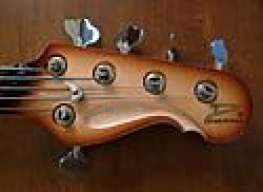
 
I have a non-Dingwall question... I couldn't figure out where best to post this.

I am new to the world of metal bands, and bass seems to occupy a slightly different role in modern metal. I'm newly in a progressive metal-ish band, and I'm getting a tone I love from my NG3 with bridge and middle pickups in series, DG Infinity mostly just for eq, MBD for a bit of hair, PC-2A compressor. The tone is very bright, with a boost around 300Hz so it doesn't get thin. I have my first gig in a couple of weeks, and while I'm confident about eq'ing non-metal tones, I'm struggling with the proper ratio of lows to highs.

I generally err on the side of a brighter sound because through the club's PA it will probably have a huge boost in the lows. I want every note to be defined and punchy, while having enough lows to be supportive and fat sounding. My instinct is to let the FOH take care of the brightness/heaviness of the sound, but maybe that's not the best way.

So how do I make this balance work? The band leader likes the brightness of my tone, but I want the music to GROOVE, and I don't want to let my preconceptions from other genres steer me wrong.

Sounds like you are on the right track, brightness is key for cutting through, and the mids, from 500 Hz to 1.5 kHz are great for adding punch. I usually cut around 250 - 300 Hz as this part of the spectrum can get muddy quickly, especially with downtuned guitars crowding the mix. I usually boost at around 80 to 100 Hz to thicken the sound up, and run a high pass filter at around 50-65 Hz to keep everything tight.
 
Players o
So how do I make this balance work? The band leader likes the brightness of my tone, but I want the music to GROOVE, and I don't want to let my preconceptions from other genres steer me wrong.
I’m strongly of the opinion that players overthink and overconcern themselves with what you’re asking. You’ll get suggestions about every type and kind of gear, but at least take what I say into consideration, as you may find it may help. Lots of this is concept, proper use of the gear you have, and a good grasp of how the audio spectrum works.

First , groove is a a collective agreement about where a certain type of repeated rhythm is felt by a group of participants. It’s a bunch of players doing their own thing, but together in a way that complements the whole. Tone has nothing to do with that.

Second, don’t expect your live playing sounds and mixes to sound like your favorite album up on stage. Even if you have the best inear system in the world. This won’t happen. The surgically precise control of the audio proceedings in a recording studio can’t be duplicated on live stages very well.

Third, you have to consider the volumes you’re dealing with and the other instruments in the band. The loudest thing up there will be the kick drums, and the guitars will compete with you for the low end. You’ll have to use the idea of frequency slotting to find a place that isn’t as much of a traffic jam of sonic information and find a way to have some presence and get heard. Normally, the brighter sonics of new strings, pick playing, and midrange and hi-mid boosts from 3k and above help with that. Exact frequencies depend on your taste in what works best in the situation you’re in.

For every 20 modern metal bands I see, I can only hear one bassist out of all of them. Overuse and improper use of distortion, effects, and slack technique are normal and just make everything a total mess of just “boom” with no note info and fret noise. Usually the player that can be heard has figured out that part of the natural sound of the bass must be preserved to project well. If your sound is all clipping and square waves, it’ll get lost in the mix. Not on recordings, but it will on a live stage. Effect devices and overdrive/distortion units with blend controls help with this a lot.

If you’ve got a good sounding bass with an active preamp with the boosts turned up in a sensible manner, it will be a monster through a PA if you don’t go nuts with the effects. Just trust it do so. Playing at home on your couch and up on deck onstage at 110 db are two different things. An active bass with a boost of 5-6db at 40hz or around there will blast low end. Just let that take care of itself.

It’s also okay to let the sound crew handle things and let them do their thing. It’s common practice to make fun of how lazy and incompetent they are but there’s a lot of guys and gals out there that are really skilled at their craft. They take their work as seriously as you take your bass playing. If you give them a good raw pre-processing sound that they can rely on, they will do their part to make it work in the band as best they can in most cases.
 
I have a non-Dingwall question... I couldn't figure out where best to post this.

I am new to the world of metal bands, and bass seems to occupy a slightly different role in modern metal. I'm newly in a progressive metal-ish band, and I'm getting a tone I love from my NG3 with bridge and middle pickups in series, DG Infinity mostly just for eq, MBD for a bit of hair, PC-2A compressor. The tone is very bright, with a boost around 300Hz so it doesn't get thin. I have my first gig in a couple of weeks, and while I'm confident about eq'ing non-metal tones, I'm struggling with the proper ratio of lows to highs.

I generally err on the side of a brighter sound because through the club's PA it will probably have a huge boost in the lows. I want every note to be defined and punchy, while having enough lows to be supportive and fat sounding. My instinct is to let the FOH take care of the brightness/heaviness of the sound, but maybe that's not the best way.

So how do I make this balance work? The band leader likes the brightness of my tone, but I want the music to GROOVE, and I don't want to let my preconceptions from other genres steer me wrong.
I had a really good experience sending a DI from my then D800 to the PA. I was using a DP-3X pedal and the sound engineer made my tone clank with a ton of depth that fit so awesome in the mix. If you have one I'd try it out to see if it fits!

To me the soundguy will make or break a bands sound, no matter what gear they have.

One of my buddies bands has their friend do sound and the dude always mixes a lack of lows in the mix. The bass is usually non existent except for some top end notes that get through the mix.
 
  • Like
Reactions: smeet and J R Knots
I had a really good experience sending a DI from my then D800 to the PA. I was using a DP-3X pedal and the sound engineer made my tone clank with a ton of depth that fit so awesome in the mix. If you have one I'd try it out to see if it fits!

To me the soundguy will make or break a bands sound, no matter what gear they have.

One of my buddies bands has their friend do sound and the dude always mixes a lack of lows in the mix. The bass is usually non existent except for some top end notes that get through the mix.
A long time ago, I went to a Rob Zombie concert in Vegas, and The Damned opened for him. They sounded awful, and it was super, super apparent that whoever was the sound guy on that set was at fault.
 
A long time ago, I went to a Rob Zombie concert in Vegas, and The Damned opened for him. They sounded awful, and it was super, super apparent that whoever was the sound guy on that set was at fault.

I remember almost every large show I went to way back, the support band would sound quieter and worse than the 'headliner'. I'm convinced the sound people must have been under instruction to either not use the full range of PA or deliberately make them sound worse.
I gave up on big shows a long time ago, much prefer a small local venues these days.
 
I remember almost every large show I went to way back, the support band would sound quieter and worse than the 'headliner'. I'm convinced the sound people must have been under instruction to either not use the full range of PA or deliberately make them sound worse.
I gave up on big shows a long time ago, much prefer a small local venues these days.
The headliner has always been louder at big shows, and I think it is deliberate and I’ve always hated that. It worked in the old days, because overall the volumes were lower, so the headliner sounded better than the opening acts. A contrasting modern example was the Jinjer show I saw recently. The opening acts had absolutely stellar sound. I could hear every instrument and actually understand the lyrics, which is pretty rare in a metal band. The mix was also great for the headliner, but it was so over-the-top loud that it hurt even with my 33dB cut foam plugs. I left early, but my tinnitus is permanently louder from that single show. :(

If I ever go to a big show again, I will probably have to bring construction headphones to go over the plugs. Ridiculous. Why???
 
Live sound is such a crap shoot. You can slog through a set, barely able to hear anything clearly and have folks out front tell you it sounded great .

Or, stage sound was crystal clear, everyone is on point, and after the set, “Man, sounded really muddy, I couldn’t hear you at all. Looked like you guys were having fun…”

Yet we still spend thousands chasing sound. And buying tickets. And the volume thing is stupid. Even with earplugs. Without plugs it’s just a wash of noise.
 
  • Like
Reactions: SemiDriven
Correct me if I’m wrong but depending on the show the bands often have their own sound guy and board. Obviously the higher $$$ dollar bands in there would have a higher end set up including personnel and components.

every time I have seen Archspire they sound insane. They also travel with their own mixer and sound guy. Sometimes bands with share obviously but budget is always a factor from band to band within a show.
 
The guitarist for Intervals got mad when I posted on social media how god awful the sound was for their set when they opened for Chon and BTBAM a couple years ago. It was seriously the worst mix I’ve ever heard. All sub-kick and snare with some of the guitars weedly-weedlies coming through on top. Couldn’t hear the thunderous shredding of Jacob Umansky ant all.

Aaron (guitarist, Intervals) basically called me an idiot, that it was my fault for standing where I stood (he incorrectly said, based on my pic, that I was in the pit which I was not). He did defend the bands sound guy, which is nice and all, but it seriously sounded like he forgot to take several mics/signals off mute for the set. Chon and BTBAM sounded phenomenal, though.

Everything was way too loud, however.