• TalkBass has been independent since 1998. Add your voice.
    Create a free account to reply to discussions, view embedded media, and browse with fewer display ads.
    Join freeLog in
    Want zero display ads or expanded classifieds tools? Compare plans.

Dingwall Owners Club

Glockenklang used to sell the same, or a similar preamp to the one put in Dingwalls. Shouldn't be too hard to source.

I can't perceive any tonal or level difference between active and passive modes.

"Due to the high performance electronic, in flat position of the eq you can hear no difference between active and passive mode!"
--->Glock Uno 3 Band Preamp
 
Last edited:
  • Like
Reactions: spiritbass
I've been playing my bass in passive mode lately, and really enjoying the sound.

The preamp in the bass is no slouch - a Nordstrand 3B; I like that the Nordy's EQ is flat at center detent, and there's no gain boost unless you dial one in.

It's been my favorite pre in this bass so far; the bass came with a Bartolini NTMB-F, then I installed a Bart TBIBT, then a Darkglass Tone Capsule, and now the Nordy.

I think I keep trying stuff out because the buffering and impedance change from every preamp I've tried so far alters the tonal profile in a way that I'm not liking. And when I think about it, the dual-buffered signal chain of the TBIBT was the one that moved the bass farthest from my preference.

Are there any preamps that truly sound the same flat as the bass sounds passive?

Right now I'm leaning toward removing the active electronics from the bass and replacing with a passive, bypassable varitone circuit.

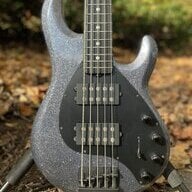
The Glockenklang in my ABZ is about as transparent as they come, which is why I like it. It literally *just* boosts/cuts the frequencies you change, it has no baked-in sound of its own. It's difficult to tell any difference between passive and active mode.
 
Last edited:
I recently installed a Glockenklang in my NG, it’s more transparent than the original Tone Capsule but it still seems brighter than passive. I can definitely tell a difference when switching, but I am running through a DI. I suspect with a cabsim or proper cab it might be less noticeable.

I've had the same experience.

Is it maybe because if you have the treble at midday in active, when you switch to passive the tone will be at 50% (the treble knob is the passive tone knob)? I find I need to boost it to full to have the same sound as flat active.
 
Is it maybe because if you have the treble at midday in active, when you switch to passive the tone will be at 50% (the treble knob is the passive tone knob)? I find I need to boost it to full to have the same sound as flat active.
I'll try that, maybe that is the issue. I was under the impression that the 50% detent was 100% tone when I read this: "Due to the high performance electronic, in flat position of the eq you can hear no difference between active and passive mode!"
 
Is it maybe because if you have the treble at midday in active, when you switch to passive the tone will be at 50% (the treble knob is the passive tone knob)? I find I need to boost it to full to have the same sound as flat active.
Mine doesn’t work like this. The passive tone control is only effective in positions counterclockwise from the center detent in both active and passive mode. In other words, with the pot at the center detent it’s the same as having a tone knob on full with a traditional passive bass.
 
  • Like
Reactions: Derek Williams
Mine doesn’t work like this. The passive tone control is only effective in positions counterclockwise from the center detent in both active and passive mode. In other words, with the pot at the center detent it’s the same as having a tone knob on full with a traditional passive bass.
The ABZ I used to own had a 2-band Glockenlang and the tone control worked like:
  • In active, it was active treble boost from center detent (call it 5) to all the way up (10). It functions as a traditional tone control from 5 all the way down to 0.
  • In passive, the treble control worked like a traditional tone control across the whole range of rotation. I actually really liked having the center detent, because that position was usually just right. Maybe what I heard in passive mode from 5-10 was just placebo effect?
 
  • Like
Reactions: Nuage420
The ABZ I used to own had a 2-band Glockenlang and the tone control worked like:
  • In active, it was active treble boost from center detent (call it 5) to all the way up (10). It functions as a traditional tone control from 5 all the way down to 0.
  • In passive, the treble control worked like a traditional tone control across the whole range of rotation. I actually really liked having the center detent, because that position was usually just right. Maybe what I heard in passive mode from 5-10 was just placebo effect?
This is not how the one in my Super J works. I’ll be at my studio later today to confirm.
 
  • Like
Reactions: J Posega