
NICE! That is a KILLA' setup. Well played, sir.
You are officially one of the mostest, coolest guys I know, on the internet, in some other state, that I've never been to...

TalkBass has been independent since 1998. Add your voice.
Create a free account to reply to discussions, view embedded media, and browse with fewer display ads.
Join free Log in
Want zero display ads or expanded classifieds tools? Compare plans.

Awesome!
 I bet it sounds as huge as it looks.
By all means try playing standing up with a strap! (Hopefully you have one available?)I haven't even put a strap on it yet. I'm playing seated so I can slide the bass around to find the most comfortable position.
I have tried sliding the bass to the right to give better access to the frets near the nut. The problem seems to be more the extreme angle of the frets at the nut end, not the distance to the frets.
Then again, one objective of the 5-string for me was to not have to play near the nut, apart from playing low B to D#. There are some songs I play that use open strings on the 4-string that would be difficult (but not impossible) to play a string down at the 5th fret of a 5er.
I probably just need more practice... and learning the 3rd (5th?) position notes!

I like it!
I never bring a “security” bass when I’m trying something new, otherwise I may give-up to easily. If I make it through one two whole gigs and I’m still not happy then I know I’ve given it a fair trial.
You guys are a bit more "forgiving" than I, LOL! I bring two of, almost, everything, and if something is bringing me down, especially during a gig, it gets benched ASAP. I've swapped basses, mid-set. I've swapped amps, mid-set. I've completely bypassed pedals that I used the night before because they sounded terrible the next night. The only thing I don't bring spares of is cabs, and I've paid for that on several occasions...
My philosophy is "I'm getting paid decent money to be at my best, and this piece of gear is preventing me from doing that, so I need to fix this if I can..." That's why I'm trying to get back into Dingwall basses...
Make sure you're not trying to use the "traditional" hand on the fretboard. Relax it because the frets are angled that way. Jump in an play normal. I agree with everyone else that it shouldn't hurt. I also have a Super J that I have TI flats on and I love them. The sound (and the playability) is very smooth. Payson has a set of flats for the long scale. I've picked a set up but haven't had time to try them yet.
I too wear my bass at a height where my left wrist is straight, while the right wrist is angled. This feels most comfortable for me since I usually work more with the left hand than with the right hand.That wrist is also straight (my right wrist does have a bend, but doesn't seem to bother me).


I have almost the opposite condition. My left wrist is more comfortable at an angle, while my right wrist is more comfortable almost straight. I've broken the left wrist multiple times over the years (childhood, early adulthood, a few years back) so I don't know if that has anything to do with it.
If you watch someone training in dressage, one of their goals is to keep their heels down, toes pointed up in the stirrups. It looks extremely uncomfortable!
When I pointed this out to a friend who was really good at it, they shrugged and said that's the way they trained their ankles, it wasn't a bit uncomforable.
View attachment 2933928 View attachment 2933929
Yep, generally speaking you are not, that is true. But I find that abandoning that rule for playing the four lowest notes on a 37" B string really helps the ergonomics quite a bit, so the saying "rules were meant to be broken" comes to mind.I was taught I'm not supposed to wrap my thumb around the neck...
 YMMV
YMMV
Yep, generally speaking you are not, that is true. But I find that abandoning that rule for playing the four lowest notes on a 37" B string really helps the ergonomics quite a bit, so the saying "rules were meant to be broken" comes to mind.

Good points. I have broken both wrists and yet prefer long scale basses. One key to avoid injury is to always keep the wrist "gate" open. If we are in a cramped position - whatever that position is to any particular person - then we should find a solution so that the muscles are never in a tetanic contraction.Yeah, everyone has different bodies. Although if you're suffering joint pain in one wrist or the other, it's time to explore your ergonomics. Because I play with my right hand up off the first pickup or near the base of the neck, my right hand angle is generally not bad since my arm is angled across the 'face' of the bass' playing surface.
My thought is that with the longer neck those angles can get more extreme if you're already in the ballpark of over-flexed-strained joints. And obviously those of us who have played for decades have manipulated some of our joints in funny ways over time. Or in my case, I've also slowly screwed with my bone structure so that I have one shoulder that's noticeably higher than the other.
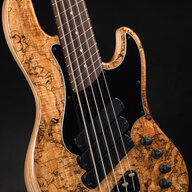 I see a lot of guys with death-grip fretting going on, and you certainly don't need it, especially with a Dingwall. You can play faster and more efficiently if you're not heavily anchoring your hand in a position or digging in that hard with your left hand. My early morning bass routine is to work regularly and consistently on reducing all fretting to the smallest softest movements I can manage. Less stress and strain means faster playing, longer playing and more accurate playing. The more you tense up your fingers and joints, the more likely you're carrying that stress out in other parts of your body.
Here are a couple good videos showing straight left wrist, thumb primarily behind the neck. Every once in a while, his thumb pokes out from behind the neck briefly, like Punxatawney Phil. In my case, in looking at my video, I realized I was probably just using the thumb to mute the low string. He might be doing the same.I'd agree that I find myself doing this in first position from time to time without any negatives.
Here are a couple good videos showing straight left wrist, thumb primarily behind the neck. Every once in a while, his thumb pokes out from behind the neck briefly, like Punxatawney Phil. In my case, in looking at my video, I realized I was probably just using the thumb to mute the low string. He might be doing the same.
There are all kinds of ways to mute strings: right palm, right thumb, right fingers, left fingers, left thumb. After 40+ years of playing, I realize that I use them all, without ever thinking about which method I'm using, just that it's probably the most efficient or practical method based on what else I'm doing at that moment.


On another note, I have decided tentatively to do without a stage amp and DI through the PA. Any advice on good-sounding preamp/DIs greatly appreciated! Nothing too effects-laden, just a clean, warm-sounding tone.


