
Enjoy the benefits of a premium membership!
Upgrade Account
-
TalkBass has been independent since 1998. Add your voice.
Create a free account to reply to discussions, view embedded media, and browse with fewer display ads.
Join free Log in
Want zero display ads or expanded classifieds tools? Compare plans.
You are using an out of date browser. It may not display this or other websites correctly.
You should upgrade or use an alternative browser.
You should upgrade or use an alternative browser.
Do I simply prefer passive?
- Thread starter -Asdfgh-
- Start date
More options
Who Replied?
The way I look at it is: how many preamps do you need?
If you (a) like the baked-in sound of your bass/pickups to begin with and (b) have EQ on your amp to tweak the tone a bit, then that’s probably enough tone-shaping.
I have a couple of old Award Session MB-10s, and although they are meant for guitar then provided I leave the speaker emulation off, it gives a passive bass a sound is characterise as being akin to active. I have a couple of acoustic guitar preamps that do something similar, although with more bands of EQ, although none particularly matched to bass. But I also have preamps in my amps. However, I'm struggling a bit with a new, active bass to find 'my' sound.
I've never seen an Award- Session MB-12.
I have an active bass, but also a number of passive ones and various external preamps. I find I can easily dial in a tone I like with the passive instruments, but find it more of a faff with the active. My first bass was active, so it's not like I'm that much of an old fogey, although IIRC that just had a simple passive tone. I've also owned a couple of Westone Thunders (IA and III) and a Fender Cowpoke that I was fine with. Have I just BECOME and old fogey (don't answer that..).
I don't have a preference: if a bass feels and sounds good I don't care if the tone is produced by a team of ladybirds pedalling inside a machine that fits in the control cavity. Or aliens. What I do like A LOT is a passive tone control.
Active EQ found on onboard preamps tends to not be exactly what I want. I don't need much in terms of bass EQ, I can set it once and forget, so I can do that outside the bass, ok. Mids it's something I do like to have control on my bass, a nice semiparametric module does teh job, like those on John East preamps and some others. But the treble control doesn't do what I want a treble control to do, and many times it's set way too high to do anything other than taming finger-string noise. A passive tone control however is just what I like.
An active bass with a passive tone control (on top of whatever else) would be my preference everytime.
I think some people who prefer passive basses what they really like is the passive tone control.
There's a cycle:
1. You get a P-bass and learn how to play it
2. You convince yourself that you need a jazz bass
3. You like that zing and quack when you play in your bedroom
4. You realize that it sucks in the mix
5. You get an active bass so you can PUMP IT UP. Yeah, that's the answer!
6. You spend a year trying to get it to sound OK in the mix
7. You kinda give up and end up running it in passive mode
8. You go back to your P-bass.
1. You get a P-bass and learn how to play it
2. You convince yourself that you need a jazz bass
3. You like that zing and quack when you play in your bedroom
4. You realize that it sucks in the mix
5. You get an active bass so you can PUMP IT UP. Yeah, that's the answer!
6. You spend a year trying to get it to sound OK in the mix
7. You kinda give up and end up running it in passive mode
8. You go back to your P-bass.


1. You get a P-bass style bass and learn how to play it, though not a crappy 70/80s Fender.There's a cycle:
2. You convince yourself that you need a Steinberger, buy it and play it for 30y in a number of bands.
3: Move to 5 and 6 strings, mainly active the whole way through. Still have the Steinie.
4: Try P basses along the way, realise, meh, overrated. Go back to playing what I like.
There's a cycle:
1. You get a P-bass and learn how to play it
2. You convince yourself that you need a jazz bass
3. You like that zing and quack when you play in your bedroom
4. You realize that it sucks in the mix
5. You get an active bass so you can PUMP IT UP. Yeah, that's the answer!
6. You spend a year trying to get it to sound OK in the mix
7. You kinda give up and end up running it in passive mode
8. You go back to your P-bass.
Thst may well be the route some people take - however my own take on this is I reached 5. in about 1980 - I didn’t move to step 6 as I found the flexibility of the onboard preamp gave me everything I wanted in bass tone - for the last 15 yrs I’ve occasionally dabbled with the idea of buying particularly a P bass trying a whole range of them in various settings, from an original 60 to new ones - often after hearing one get a really good sound in a live performance (most recent was last night - Paul McCartney and band headlining at Glastonbury - the guy who plays bass when Paul Mc doesn’t used a 63-5 fiesta red P and sounded great - btw the performance was an absolute spectacle and memorable event - just after his 80th birthday - well worth watching if you can - however I have never been moved enough to actually buy one preferring my Stingrays of varying types.
To quote Randy Jackson (bass player and producer extraordinaire) in this months Bass Player Magazine - ‘Im that guy who doesn’t like passive. I love active - I’m the newfangled guy who wants to be able to dial in what I want to dial in, and dial in how much of it I want. I want to be able to saturate and overdrive and do what I want to do.’ I’ve heard Marcus Miller say much the same - these are two mega bass players and top producers.
I prefer active - though I do have a passive long scale Tim Commerford Stingray which is very good indeed.

The whole 'P is everything' meme is getting old and stale.
Havent seen the meme, but the concept is, at least in my experience, timelessly valid.
But it is far from universal as many seem to believe it is.Havent seen the meme, but the concept is, at least in my experience, timelessly valid.
But it is far from universal as many seem to believe it is.
certainly not “universal” in the sense of done by or applicable to all people, but is a very widely agreed upon concept. Nevertheless, I meant it simply as my experience.
Isn’t this, more or less, a carefully designed version of what a treble bleed circuit is doing?you load the pickups capacitively - that loading is across the pickup, before the volume control, so the volume control is not between the pickups and the capacitive loading - it doesn’t mess with the tone when you turn it down.
There's a cycle:
1. You get a P-bass and learn how to play it
2. You convince yourself that you need a jazz bass
3. You like that zing and quack when you play in your bedroom
4. You realize that it sucks in the mix
5. You get an active bass so you can PUMP IT UP. Yeah, that's the answer!
6. You spend a year trying to get it to sound OK in the mix
7. You kinda give up and end up running it in passive mode
8. You go back to your P-bass.
Well, I got that one wrong as I started with an active Jazz.
I don't have a preference: if a bass feels and sounds good I don't care if the tone is produced by a team of ladybirds pedalling inside a machine that fits in the control cavity. Or aliens. What I do like A LOT is a passive tone control.
Active EQ found on onboard preamps tends to not be exactly what I want. I don't need much in terms of bass EQ, I can set it once and forget, so I can do that outside the bass, ok. Mids it's something I do like to have control on my bass, a nice semiparametric module does teh job, like those on John East preamps and some others. But the treble control doesn't do what I want a treble control to do, and many times it's set way too high to do anything other than taming finger-string noise. A passive tone control however is just what I like.
An active bass with a passive tone control (on top of whatever else) would be my preference everytime.
I think some people who prefer passive basses what they really like is the passive tone control.
Maybe I need active pres for the passive instruments, a passive tone for the active? The Thunder IA I wish I'd kept had a single active tone knob (boost lows, cut highs one way, reverse the other, IIRC) and a passive tone. And active on/off and a series/parallel for what was in fact a P pickup under a big soapbar style cover.
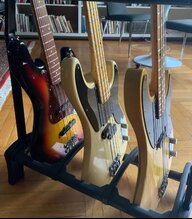
Jazz Basses suck in a mix? Hmm …
Helps if you add some overdrive.

I prefer passive as well. They're much simpler, don't consume batteries, and (to my ear) are just naturally closer to the sound I want. If I need to change the EQ to suit a room, I'll do that with a parametric pedal, but the purpose isn't to shape the bass's tone, but rather to shape the room's response.
Whereas a preamp on an active bass is kind of taking away the pickup's job as a filter and doing double-duty. And while that's a perfectly valid way to do things, I prefer to decouple timbre from room acoustics; I want to be able to influence one without also changing the other.
Whereas a preamp on an active bass is kind of taking away the pickup's job as a filter and doing double-duty. And while that's a perfectly valid way to do things, I prefer to decouple timbre from room acoustics; I want to be able to influence one without also changing the other.
Last edited:

Isn’t this, more or less, a carefully designed version of what a treble bleed circuit is doing?
No - it’s quite different. It actually works quite a bit better at what a treble bleed circuit is trying to do - more consistent response as you vary the volume control.
A treble bleed circuit does nothing to extend response at max volume, which this does - in whatever amount you want it to.
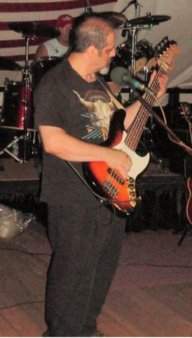
...God I sound lazy with my lazy sound lol! Been playing for 32 years, so I guess simple works for me haha!!
The older I got, the fewer knobs I want (or need) to deal with; it's just not that difficult to get a great, workable tone in a mix.
"Versatility" is totally overrated imho.


You have a pbass and play it for years. Then you realize that unless you really love that tone you're not going to be happy. Then you sell it and get something with humbuckers and never look back. I have fun playing my Warwick and go back here and chuckle at the pbass fans always saying how great they are. Lol1. You get a P-bass style bass and learn how to play it, though not a crappy 70/80s Fender.
2. You convince yourself that you need a Steinberger, buy it and play it for 30y in a number of bands.
3: Move to 5 and 6 strings, mainly active the whole way through. Still have the Steinie.
4: Try P basses along the way, realise, meh, overrated. Go back to playing what I like.
Overdrive, mid boost. Hmm. Sounds like a Sadowsky.Helps if you add some overdrive.

If you're using passive basses with "external preamps" the lines are blurred. If those preamp were installed directly in your bass there would he zero difference... and your bass would then be active. The only thing keeping your basses passive is a cable between the bass and preamp
It seems to me you don't really like stacked preamps. Your active basses running into your preamp pedals or rackmounts or whatever wind up stacking preamps.
Latest posts
-

-
-
Vintage German parlour looks classical but needs steel strings?
- Latest: bass player 53
-

-