
Sorry, won't allow me to change it.Poll needs to be multiple choice.

Enjoy the benefits of a premium membership!
Upgrade Account
-
TalkBass has been independent since 1998. Add your voice.
Create a free account to reply to discussions, view embedded media, and browse with fewer display ads.
Join free Log in
Want zero display ads or expanded classifieds tools? Compare plans.
You are using an out of date browser. It may not display this or other websites correctly.
You should upgrade or use an alternative browser.
You should upgrade or use an alternative browser.
Do you prefer simple or complex controls on your bass(es)?
- Thread starter scuzzy
- Start date
More options
Who Replied?

I prefer 5 knob active basses.
Master vol, PU blend, bass, mid, treble.
Is that complex active or simple ?
Master vol, PU blend, bass, mid, treble.
Is that complex active or simple ?

Neither do I except sometimes practicing at home volume. Otherwise, it's full throttle for both.I don't use the T one.
V, T, done.
I don't use the T one.
Neither do I except sometimes practicing at home volume. Otherwise, it's full throttle for both.
You're hopeless...


1- volume / 1- tone is all one needs... unless you need more... I decided to take a walk on the wild side & (assemble) a Jazz bass- 2 of each (shudder...)
kinda reminds me of this vid- (humorous but true) (do we need it or don’t we need it?)
kinda reminds me of this vid- (humorous but true)
(do we need it or don’t we need it?)
Last edited:
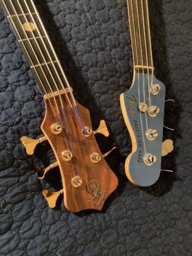
Complex passive. That’s an idea I am juggling in my head:
- two humbuckers
- pickup switch
- switch for single coils
- volume control (I use it a lot)
- low-pass filter with three knobs (freq, slope, and res)
- a switch for mid scoop (like, -6dB at 475Hz)
It’ 4 knobs and 3 switches. Probably will sound like crap, of course. Fact is that I like both humbuckers and single coils; I never touch the lows eq knob; I use the active mids and highs knobs only for cut; I use the blend knob as a three way switch; and I am fascinated by LPFs. So I concocted in my mind the set-up ticking all the boxes.
- two humbuckers
- pickup switch
- switch for single coils
- volume control (I use it a lot)
- low-pass filter with three knobs (freq, slope, and res)
- a switch for mid scoop (like, -6dB at 475Hz)
It’ 4 knobs and 3 switches. Probably will sound like crap, of course. Fact is that I like both humbuckers and single coils; I never touch the lows eq knob; I use the active mids and highs knobs only for cut; I use the blend knob as a three way switch; and I am fascinated by LPFs. So I concocted in my mind the set-up ticking all the boxes.



Simple answer. I prefer it to sound good and it looks like they all can. I do have to say that he active basses mean less twiddling on the amp or needing to change basses. Great for cover band
For recording engineers like the simple basses but the actives actually behave well as well if you set everything flat
Passive simple is 72 P bass and Jazz Bass, Fender PJ CIJs - Fenders
I do not have a complex passive. All have simple cut only tone controls
My active simple is a Bartolini Q pre-amp (not a tone control per se) and volume.
StingRay 5 with Piezo and 3 band EQ is complex active - so is TRB 6P. both are 3 band EQ
Even more complex is Tune BEB6 with Mike East PreAmp -- which has Vol Blend and 4 band EQ (boost and cut) 18V. There are even internal trim pots to adjust the tone further. The pickups are quadcoil soap bars and has a switching system which are single coil, series and parallel mode and then there is a mode where the soapbars are electrically like a virtual P and can be done because they are quadcoil. It also has a passive mode and the tone controls become cut only.
The upright bass is the most complex
2 element StatB pickup system. and an ATM-350 or Remic condenser mic, into a preamp with individual 5 band EQ (low, low mid, hi mid, treble, presence), Notch Filter, HPF, phantom power for both mic and pickup (which is like a piezo and mic needing 12v).
I now someone with even a more complex setup with an additional Krivo magnetic and because he slaps also has piezo on the fingerboard. So he has to mix 4 sources. He uses 2 preamps like mine into a 2 channel Acoustic Image Focus (1000W)
Coming soon is a Wes Lambe / Clay Conner Universal 7. Bass strings and guitar strings - I hope I can learn how to play it. It has stereo pickups. It looks complex but fortunately it has simple EQ
For recording engineers like the simple basses but the actives actually behave well as well if you set everything flat
Passive simple is 72 P bass and Jazz Bass, Fender PJ CIJs - Fenders
I do not have a complex passive. All have simple cut only tone controls
My active simple is a Bartolini Q pre-amp (not a tone control per se) and volume.
StingRay 5 with Piezo and 3 band EQ is complex active - so is TRB 6P. both are 3 band EQ
Even more complex is Tune BEB6 with Mike East PreAmp -- which has Vol Blend and 4 band EQ (boost and cut) 18V. There are even internal trim pots to adjust the tone further. The pickups are quadcoil soap bars and has a switching system which are single coil, series and parallel mode and then there is a mode where the soapbars are electrically like a virtual P and can be done because they are quadcoil. It also has a passive mode and the tone controls become cut only.
The upright bass is the most complex
2 element StatB pickup system. and an ATM-350 or Remic condenser mic, into a preamp with individual 5 band EQ (low, low mid, hi mid, treble, presence), Notch Filter, HPF, phantom power for both mic and pickup (which is like a piezo and mic needing 12v).
I now someone with even a more complex setup with an additional Krivo magnetic and because he slaps also has piezo on the fingerboard. So he has to mix 4 sources. He uses 2 preamps like mine into a 2 channel Acoustic Image Focus (1000W)
Coming soon is a Wes Lambe / Clay Conner Universal 7. Bass strings and guitar strings - I hope I can learn how to play it. It has stereo pickups. It looks complex but fortunately it has simple EQ
Last edited:

I love it all, as long as it's well designed for the instrument. Simple passive P bass to complex active Game Changer circuits, parametric eq's, pickup switching, series/parallel, etc.. Sometimes I want meat and taters, sometimes I want foie gras.

I don't really mind too much about the control setup - whatever it is, I'll figure it out. My only real preference is - I much prefer a single master volume and tone with a pickup selector to a VVT configuration. I have a jazz that's VVT and it's fine - it's the nature of a jazz. But for PJ config or dual soapbars? give me a selector please.

My thing is I like having the options to dial a bass into one ideal sound for that specific bass but I don’t like having a ton of knobs and stuff on the outside of the bass for cosmetic reasons and also because I hate it when I have a bass dialed in and then accidentally bump something out of position and I also don’t like it when the volume knob is too close to another knob. I’d rather be able to roll the volume knob will my palm instead of having to turn it with the tips of my fingers. So if i could have it how I wanted I would want all the eq controls along with blend/ pickup selector stuff inside the control cavity where they could be adjusted with a mini trim pot like the ones in this pedal. That way I could dial in what sounds best to me but not have to worry about it anymore.disclaimer: This thread is a great excuse to post a pic of my favorite basses.
I believe that the majority of the folks on this forum will likely say simple, ala Precision bass with a volume and tone, or simply a volume, or perhaps straight to the jack. I have one p-type bass, and I do love to play it on occasion due to it's simplicity and versatility within that simplicity. But although I own and enjoy playing several passive basses, I still default to basses that are primarily active, with the ability to go passive.
I think that I now have my primary 4 basses. They are all 4 active with passive options. I would group them into "boutique" -style 4 and 5 string, and more "traditional" (non-coffee table) -style 4 and 5 string.
View attachment 3801052
Between these 4 basses, there are....
All can go from active to passive. 3 out of the 4 have a passive tone control, which has proven to be a very useful thing. One of them, the passive tone control works in active or passive mode.
- 10 pickups
- 23 knobs
- 14 switches
- 8 batteries
- 38 pickup combinations
It has taken quite a bit of exploration and tweaking to learn each up to this point, and how I can utilize their potential. I certainly have more learning to do. I primarily play at church and at home. Playing at church is comparable to playing in a cover band (but with less booze) so you never know what bass or amp might show up on a recording. Versatility has been good for my mental state, as I like to sound as close to the recording as possible, although I'm sure most people don't know or care.
So what do most of you prefer?
Simple Active - no switches, simple 2 band EQ or similar
Simple Passive - no switches, tone control
Complex Active - Lot's of knobs and switches
Complex Passive - Lot's of knobs and switches
On the outside of the bass just give me volume knob in a good position and a active passive switch just incase the batteries are dying
Last edited:

Anthony Jackson has a deal for you!
LoL! But no deal for me alas. See the pretty little butterfly inlay on the headstock? That puts it completely out of my ambit price-wise.
I like switches/gadgets. That being said... my main player.
Two on/off/on switches. Wired stereo.
Each pickup half volume/off/full volume.
Like that 370/301 stack.
Still have my 301. Wish I still had the Acoustic head that once went with it.
LoL! But no deal for me alas. See the pretty little butterfly inlay on the headstock? That puts it completely out of my ambit price-wise.
Actually, Scott Devine in his YouTube channel did a giveaway with this very bass...
I didn't win it... think it finally went to a Brazilian bass player.
Actually, Scott Devine in his YouTube channel did a giveaway with this very bass...
I didn't win it... think it finally went to a Brazilian bass player.
Seems like it found a more appropriate home in the hands of a Brazilian bassist if so. I could see that bass being a natural for latin jazz.

Last edited:
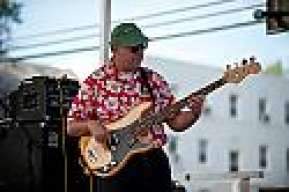
disclaimer: This thread is a great excuse to post a pic of my favorite basses.
I believe that the majority of the folks on this forum will likely say simple, ala Precision bass with a volume and tone, or simply a volume, or perhaps straight to the jack. I have one p-type bass, and I do love to play it on occasion due to it's simplicity and versatility within that simplicity. But although I own and enjoy playing several passive basses, I still default to basses that are primarily active, with the ability to go passive.
I think that I now have my primary 4 basses. They are all 4 active with passive options. I would group them into "boutique" -style 4 and 5 string, and more "traditional" (non-coffee table) -style 4 and 5 string.
View attachment 3801052
Between these 4 basses, there are....
All can go from active to passive. 3 out of the 4 have a passive tone control, which has proven to be a very useful thing. One of them, the passive tone control works in active or passive mode.
- 10 pickups
- 23 knobs
- 14 switches
- 8 batteries
- 38 pickup combinations
It has taken quite a bit of exploration and tweaking to learn each up to this point, and how I can utilize their potential. I certainly have more learning to do. I primarily play at church and at home. Playing at church is comparable to playing in a cover band (but with less booze) so you never know what bass or amp might show up on a recording. Versatility has been good for my mental state, as I like to sound as close to the recording as possible, although I'm sure most people don't know or care.
So what do most of you prefer?
Simple Active - no switches, simple 2 band EQ or similar
Simple Passive - no switches, tone control
Complex Active - Lot's of knobs and switches
Complex Passive - Lot's of knobs and switches
Simple plug & play for me ... a passive, old school P-Bass with the volume & tone controls "wide open" is the way I roll for the most part. Back when I was young, dumb and full of you-know-what and was playing music full time and attempting to live out my Grateful Dead fantasy ... I had an Alembic Series I "Point" model bass. The power supply split the pickups into a stereo signal that enabled me to run each pickup into a channel of my Alembic F-2B stereo preamp. The output of that went into a Furman Parametric EQ and then into an Ashly 2-way crossover in front of a Crown DC300A poweramp and into a Sunn Concert Bass bottom with a pair of JBL K-140 15s and a pair of JBL 10s (don't remember the model). Anyway, it was a a great rig * with a whole lotta tweaking ability at my fingertips. However, once I finally arrived at my favorite settings, I pretty much played it that way for the most part and varied the sound mostly with where I plucked the notes and playing technique in general.
* However, I'd been playing a '58 P-Bass through a '73 "blue line" SVT and the above Sunn Concert Bass bottom loaded with JBL K140s for years before amassing the components for my Grateful Dead fantasy setup and quite honestly, it was just as good.

It depends on what simple means at that moment. For me, once I figure out how it all works, it's simple. I like the simplicity of a P bass, because I get different things out of it in different ways. I already know that the controls are only going to do so much for me. But I can pluck it up by the neck, over the pickup, down by the bridge, etc. When I combine that with the effects of the volume and tone I wind up with a lot more variety. So, the complexity then is shifted from the controls to how well I know the instrument in general.
On my Warwick Streamer LX, the controls are more complex than a P bass, and it's full of all these adjustable parts. It takes a long time to dial it in the way I want it if I'm giving it a full setup from scratch, and more of the tonal control feels to me to be focused on the electronics. I tend to pluck more where it's most comfortable stringwise, roughly in the same place over the pickups, and use the pots to dial in the sound I want or need for a particular song. At first, they were different than what I was used to, but when I got them figured out, I didn't even have to look down, anymore. So, it's not really complicated.
So, I might look at a bass with a million knobs and switches and think it looks like you need a pilot's license to operate it, but to somebody who spends a lot of time in a studio, it might seem extremely simple.
When it seems like too much to me is when the controls begin to seem redundant or like they don't produce a useful effect, or if they make the instrument start to feel wrong for the setting. Generally what I do, or did, was to play my Warwick in the studio and take my American Special P bass (with nickel rounds) to a gig. I've played the Warwick live, but goofing with knobs on the fly live, once all the sound is dialed in isn't something I like doing.
On my Warwick Streamer LX, the controls are more complex than a P bass, and it's full of all these adjustable parts. It takes a long time to dial it in the way I want it if I'm giving it a full setup from scratch, and more of the tonal control feels to me to be focused on the electronics. I tend to pluck more where it's most comfortable stringwise, roughly in the same place over the pickups, and use the pots to dial in the sound I want or need for a particular song. At first, they were different than what I was used to, but when I got them figured out, I didn't even have to look down, anymore. So, it's not really complicated.
So, I might look at a bass with a million knobs and switches and think it looks like you need a pilot's license to operate it, but to somebody who spends a lot of time in a studio, it might seem extremely simple.
When it seems like too much to me is when the controls begin to seem redundant or like they don't produce a useful effect, or if they make the instrument start to feel wrong for the setting. Generally what I do, or did, was to play my Warwick in the studio and take my American Special P bass (with nickel rounds) to a gig. I've played the Warwick live, but goofing with knobs on the fly live, once all the sound is dialed in isn't something I like doing.

disclaimer: This thread is a great excuse to post a pic of my favorite basses.
I believe that the majority of the folks on this forum will likely say simple, ala Precision bass with a volume and tone, or simply a volume, or perhaps straight to the jack. I have one p-type bass, and I do love to play it on occasion due to it's simplicity and versatility within that simplicity. But although I own and enjoy playing several passive basses, I still default to basses that are primarily active, with the ability to go passive.
I think that I now have my primary 4 basses. They are all 4 active with passive options. I would group them into "boutique" -style 4 and 5 string, and more "traditional" (non-coffee table) -style 4 and 5 string.
View attachment 3801052
Between these 4 basses, there are....
All can go from active to passive. 3 out of the 4 have a passive tone control, which has proven to be a very useful thing. One of them, the passive tone control works in active or passive mode.
- 10 pickups
- 23 knobs
- 14 switches
- 8 batteries
- 38 pickup combinations
It has taken quite a bit of exploration and tweaking to learn each up to this point, and how I can utilize their potential. I certainly have more learning to do. I primarily play at church and at home. Playing at church is comparable to playing in a cover band (but with less booze) so you never know what bass or amp might show up on a recording. Versatility has been good for my mental state, as I like to sound as close to the recording as possible, although I'm sure most people don't know or care.
So what do most of you prefer?
Simple Active - no switches, simple 2 band EQ or similar
Simple Passive - no switches, tone control
Complex Active - Lot's of knobs and switches
Complex Passive - Lot's of knobs and switches
In general, I much prefer simple. I’m ambivalent about the active or passive issue. As for an board EQ, if you have an amp without a baked in sound with adequate EQ controls, an onboard EQ is rather redundant. I have an onboard EQ on my active bass, but don’t use it, much preferring a flat signal allowing the amp to shape the sound.
As I’ve posted before, after 50 plus years, I still have not explored all of the possibilities of 4 strings, two volume knobs and a tone control, let alone a bunch of additional knobs.

Latest posts
-

-
 Curious what the percentage of bass players use rounds vs flats is.
- Latest: el murdoque
-

-

