
Enjoy the benefits of a premium membership!
Upgrade Account
-
TalkBass has been independent since 1998. Add your voice.
Create a free account to reply to discussions, view embedded media, and browse with fewer display ads.
Join free Log in
Want zero display ads or expanded classifieds tools? Compare plans.
You are using an out of date browser. It may not display this or other websites correctly.
You should upgrade or use an alternative browser.
You should upgrade or use an alternative browser.
Does size matter?
- Thread starter Marko 1
- Start date
More options
Who Replied?

I don’t always gig with an amp (OK, I never gig with an amp), but if I did….
I do have 3 class D heads, but the pursuit of really small and featherweight doesn’t make sense. I have a 112 cab that’s great - big enough for decent extended low end, very well braced, 43 pounds, with 2 handles - I only have to carry half that weight at a time. Give me 3 more of those, I’ll bring as many or as few as I need to a gig.
As to heads, given that I’m moving cabs at 40ish pounds, once a head is less than 15 pounds or so, it’s light enough - use that extra weight budget to make the thing bulletproof, and I’m good.
I do have 3 class D heads, but the pursuit of really small and featherweight doesn’t make sense. I have a 112 cab that’s great - big enough for decent extended low end, very well braced, 43 pounds, with 2 handles - I only have to carry half that weight at a time. Give me 3 more of those, I’ll bring as many or as few as I need to a gig.
As to heads, given that I’m moving cabs at 40ish pounds, once a head is less than 15 pounds or so, it’s light enough - use that extra weight budget to make the thing bulletproof, and I’m good.
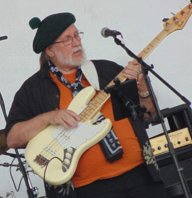
My small set up is:Scenario: No IEMs/silent stage/etc- actual rig needed to cover the stage, PA support only sufficient to supplement the house. Cost/stage/venue/genre are also not a factors.
Note: I can't cover every possible particular, I'm hoping to avoid tedious semantic arguments- please try to get the gist of the poll question; thanks.
Poll choices:
A) If I could have a rig the size of a single 2-inch Post-it note with tiny little controls (use your imagination) that I could literally stick to the wall, the drummer's forehead, or wherever I like, that would be my preference. I'd take pleasure in how small and light my rig was, even shamelessly brag about it on TalkBass.
B) I have an actual size minimum for reasons of aesthetics, showmanship, feel, romanticism, toxic masculinity, small peener, not sure why...
… and that minimum size would be (please share).
Thanks.
• Eden TN226 Class D amp. It puts out 225-watts rms into 4Ω, has a very flexible EQ system and a great auto-compressor too. Bought it used for $275 with shoulder bag specifically to play a small brew pub where we hosted Friday Night Open Mic events over 40-times a year.
• Eden EX-112 cab that will handle 300-watts rms; is very compact because it uses a whizzer cone for high-mids and highs instead of a separate tweeter horn, and it weighs 31-lbs. (uses Neodymium speaker). Paid $269 for it new. Great sounding little 112 that is about $600 less than the Eden D-series, without a lot of difference in the sound.

Most of the venues I play are medium to large venues and I use m DNS-210 cab with my DNA-800 amp. I can play all my indoor venues with that set-up because it is plenty LOUD:• Eden EX-112 cab that will handle 300-watts rms; is very compact because it uses a whizzer cone for high-mids and highs instead of a separate tweeter horn, and it weighs 31-lbs. (uses Neodymium speaker). Paid $269 for it new. Great sounding little 112 that is about $600 less than the Eden D-series, without a lot of difference in the sound.
• DNA-800 is a 4.7-lb class D amp putting out 800-watts rms into either 4Ω or 2Ω. Has a simplified, but very musical EQ system with Bass at 35Hz, low-mid at 500Hz, high-mid at 2KHz, and treble for everything about 2KHz. Also has a nice shape control that is much more gradual and far more usable than the Enhance control David put one his Eden amps. It also has a great built-in compressor that has adjustable threshold and ratio controls. Get a great sound out of it and it is really light!
Street price is $799 I got a special price on it in 2021 because I'm a member of the DNA Endorsing Artist Group. Wasn't as good as a dealer gets but was a nice discount. Plus, the warehouse was out of stock and David had enough parts to make one for me and a couple of other Endorsing Artist, so he built one for me and signed it.

I run that into my DNS-210 cab and that's all I need for any indoor venue now. Street price is $799 I got a special price on it in 2021 because I'm a member of the DNA Endorsing Artist Group. Wasn't as good as a dealer gets but was a nice discount. Plus, the warehouse was out of stock and David had enough parts to make one for me and a couple of other Endorsing Artist, so he built one for me and signed it.
• The DNS-210 will handle 700-watts rms, weighs 51-lbs, and is ungodly LOUD. At 51-lbs, it's not the lightest 210 out there but it is lighter than David's Eden XLT and XST cabs. Better yet though is that I no longer need to use my 410 cab on any indoor venues. So a 51-lb cab that replaces a 79 to 100-lb 410 cab for medium and large venues is a good weight savings. Sound is super clear and clean and if you play bass chords you can easily distinguish each of the three notes. It has a really low (34Hz) and tight bottom end.
Did I mention it gets LOUD. I have to be careful at large venues to stay out of its 60° cone of dispersion because it can get painfully loud at those if I get within 3 or 4-feet of it. I bought my DNS-210 at an Endorsing Artist price in 2019 when I was accepted in the group. Street price is right around $849.
Picture below is of my DNS-210 with my 800-watt Eden amp that I used to run it bridged at 800-watts into it. Big reason I went of the DNA-800 as my main amp is because my big Eden amp weighs about 36-lbs in its rack. I can get the same sound out of both of them and 4.7-lbs. is really light and easy to move.
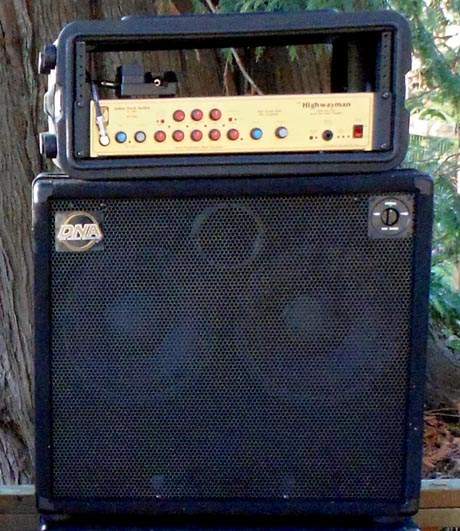
Did I mention it gets LOUD. I have to be careful at large venues to stay out of its 60° cone of dispersion because it can get painfully loud at those if I get within 3 or 4-feet of it. I bought my DNS-210 at an Endorsing Artist price in 2019 when I was accepted in the group. Street price is right around $849.
Picture below is of my DNS-210 with my 800-watt Eden amp that I used to run it bridged at 800-watts into it. Big reason I went of the DNA-800 as my main amp is because my big Eden amp weighs about 36-lbs in its rack. I can get the same sound out of both of them and 4.7-lbs. is really light and easy to move.
And finally, for outdoors and Music Festivals, I'll run either my DNA-800 or my Eden WT-500/800 into my DNS-410 cab.
I bought that cab in 2015 expecting it to be the last cab I'd need to buy and then found out small venues would freak out if I rolled it in. Nonetheless, this is an amazing sounding cab. Everything I said about the sound of my DNS-210 is true about this cab. It doesn't go quite as low as the DNS-210 though the 410 goes down to a fundamental of 37Hz and the 210 will go down to 34Hz. They both are clear, clean, articulate and LOUD with a very low and tight bottom end. It will handle 1400-watts rms though I get told to turn down at Music Festivals long before I even get close to putting 800-watts through it. Good news about that is that I will never need to lug around an 810 cab. In 2015, I paid $1,000 for it and now they seem to run around $1,149 to $1,249.
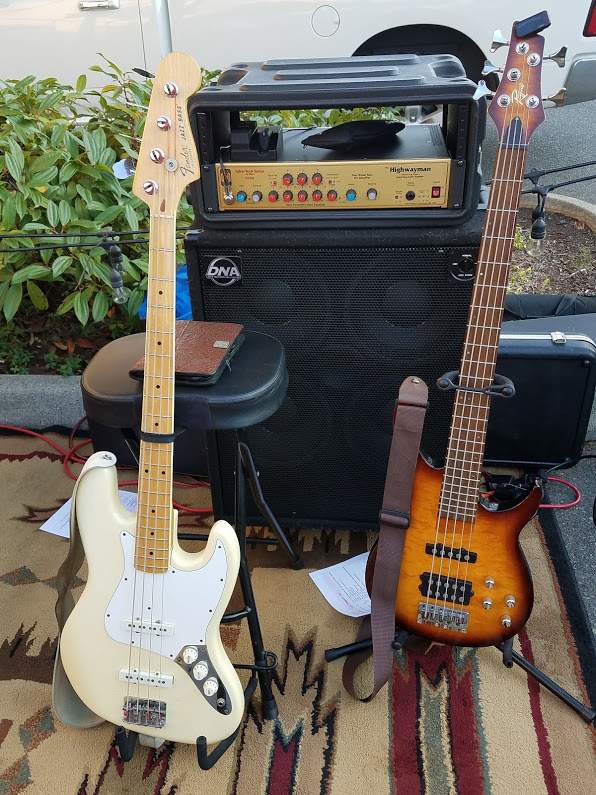
And if I really want to get carried away, I can run the stack below using my DNA-800 amp.
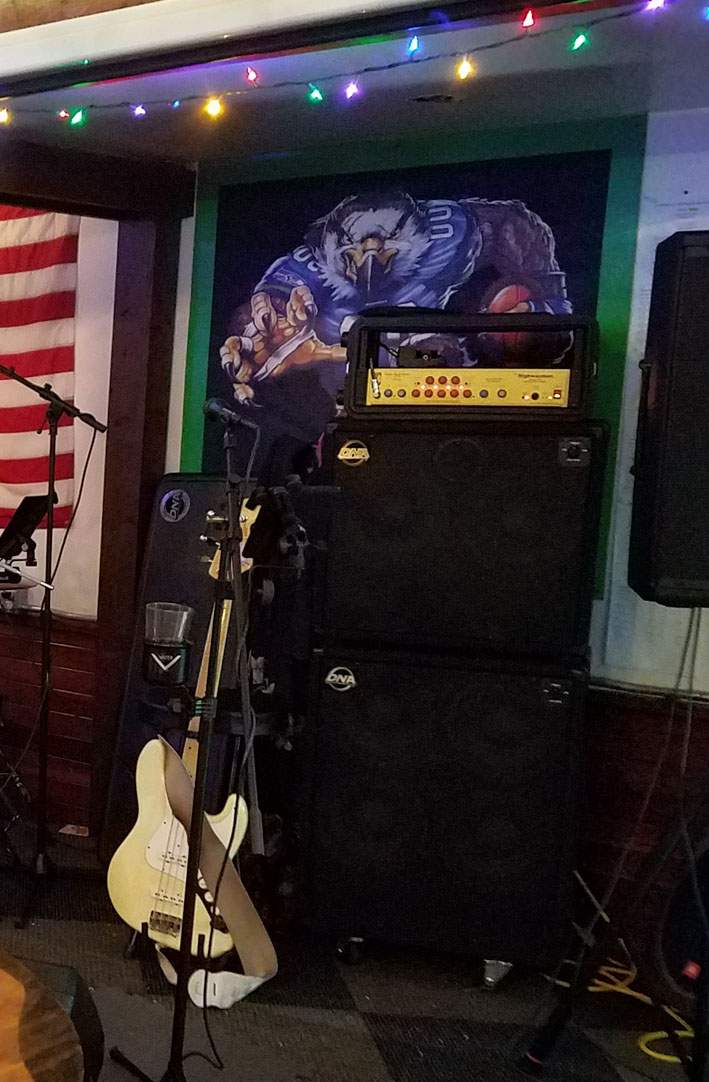
• I just had the DNS-210 plugged in at this venue. Was first gig with it and wasn't sure it would handle an "almost large" venue. Knew the 410 would handle it and I could unplug the 210 and plug the 410 in within a couple of seconds. My 410 ended up being an amp stand that night as the 210 was more than enough.


Passinwind
I know nothing.
- Dec 3, 2003
- 23,042
- 45,891
- Disclosures
- Designer/Toaster Tech @ Passinwind Electronics
Wrong thread, head to Band Management.I want the shifty kitty

Do the stairs in your house run up and down the walls at various angles?
Wrong thread, head to Band Management.

- Feb 12, 2006
- 60,951
- 5
- 220,594
- Disclosures
- Development Engineer-Mesa Boogie, Development Engineer-Genzler (pedals), Product Support-Genz Benz
Yes, perception based on different listening positions, and also different amp voicings can greatly alter the impression of tone and impact.Big x-factor is proximity to head and body and DI.
My little TC208 and Eden TX226 at shoulder height is a whole vibe.
@agedhorse is a heavyduty resident expert.
- Feb 12, 2006
- 60,951
- 5
- 220,594
- Disclosures
- Development Engineer-Mesa Boogie, Development Engineer-Genzler (pedals), Product Support-Genz Benz
Size is just size, because there are 15's that have the perceived tone of what 10's are commonly assumed to be, and there are 10's that that have the perceived tone of what 15's are commonly assumed to be.I really like the sound of a 15" speaker for bass but there are acceptable alternatives.

Wrong thread, head to Band Management.
LOL!!! Man it's a good thing I didn't have anything in my mouth...
Passinwind
I know nothing.
- Dec 3, 2003
- 23,042
- 45,891
- Disclosures
- Designer/Toaster Tech @ Passinwind Electronics
Do the stairs in your house run up and down the walls at various angles?
Do I give a toss about my amp looking big or small? I’ve never cared about that.
Read page 1…this is weird…
Skipped to page 7…OT pile on.
YES!
Skipped to page 7…OT pile on.
YES!
I blame Charles
Read page 1…this is weird…
Skipped to page 7…OT pile on.
YES!
No biggy. Next time go with “DO YOU LIKE THE LOOK OF BIG AMPS OR SMALL AMPS”I ASSumed that folks would read the opening post, and maybe even a bit of the thread before responding.
I'll try to not make that mistake again.
If you ignorant people had read the OP, which none of you apparently did, you’d realize this thread is actually about the most important and crucial aspect of playing the bass, the… [/headexplodes]

Scenario: No IEMs/silent stage/etc- actual rig needed to cover the stage, PA support only sufficient to supplement the house. Cost/stage/venue/genre are also not a factors.
Note: I can't cover every possible particular, I'm hoping to avoid tedious semantic arguments- please try to get the gist of the poll question; thanks.
Poll choices:
A) If I could have a rig the size of a single 2-inch Post-it note with tiny little controls (use your imagination) that I could literally stick to the wall, the drummer's forehead, or wherever I like, that would be my preference. I'd take pleasure in how small and light my rig was, even shamelessly brag about it on TalkBass.
B) I have an actual size minimum for reasons of aesthetics, showmanship, feel, romanticism, toxic masculinity, small peener, not sure why...
With these two choices with no room for qualification, I'm a B.
… and that minimum size would be (please share).
Thanks.
The only problem with small rigs is doppler distortion. That's where the driver cones are moving back and forth so fast that the pitch shifts like a horn being honked from a moving car. Larger driver cones need less excursion to produce low notes so it's not audible. I have played through a couple of Markbass cabs where the little long-excursion drivers were pumping so hard that there was audible doppler distortion (aka intermodulation distortion) to the extent that the pitch was altered. It's a lot more noticeable with a fretless bass where you're actively listening for pitch.
But do you like the look of a small amp or a big amp?The only problem with small rigs is doppler distortion. That's where the driver cones are moving back and forth so fast that the pitch shifts like a horn being honked from a moving car. Larger driver cones need less excursion to produce low notes so it's not audible. I have played through a couple of Markbass cabs where the little long-excursion drivers were pumping so hard that there was audible doppler distortion (aka intermodulation distortion) to the extent that the pitch was altered. It's a lot more noticeable with a fretless bass where you're actively listening for pitch.

I ASSumed that folks would read the opening post, and maybe even a bit of the thread before responding.
I'll try to not make that mistake again.
And instead went with a click-bait "Size Matters" .... right.


