• TalkBass has been independent since 1998. Add your voice.
    Create a free account to reply to discussions, view embedded media, and browse with fewer display ads.
    Join freeLog in
    Want zero display ads or expanded classifieds tools? Compare plans.

E#. Wait, what?

ugg, drunken posting, my bad.
E# and B# are best avoided for clarity's sake - it's better to write Bb chords than A#, Db than C#.

Not always.

Here's an excerpt from the show I'm playing this month. I would have strongly preferred to see an E# written in measure 60 rather than an F natural:

upload_2015-10-6_11-38-22.png


An E# would have made it much more clear that the interval between the "F" in measure 60 and the A# in measure 61 is a fourth; as written, it looks like some sort of third.

Similarly, here is an excerpt from a guitar part I recently received:

upload_2015-10-6_11-44-15.png


I definitely prefer seeing an E# in the second measure rather than an F natural, because the third of the C#7 chord is an E#, not an F.

 
Technically, it's a real thing. And if E# is an accidental somewhere in the mode relevant to what you're doing, it's legitimate. But still weird and very unusual and weird.

If E# is the key the song is in, it's just stupid.

Also, based on your description of the song, it should be E#, B#, F#

Is it the same note?

With equal-tempered tuning, they're the same. (Like on a guitar with frets, like in this case in particular.) However, as part of a scale E# and F are different things theoretically. If E# is the root key, it is the same as F unless you are deliberately trying to punish someone who is trying to sightread. :) Saying "Yes E# is a real key" is *this close* to saying "Yes December 32 is a real day."
 
Last edited:
Not always.

Here's an excerpt from the show I'm playing this month. I would have strongly preferred to see an E# written in measure 60 rather than an F natural:

View attachment 703623

An E# would have made it much more clear that the interval between the "F" in measure 60 and the A# in measure 61 is a fourth; as written, it looks like some sort of third.

Similarly, here is an excerpt from a guitar part I recently received:

View attachment 703625

I definitely prefer seeing an E# in the second measure rather than an F natural, because the third of the C#7 chord is an E#, not an F.
right it is, and of course if they wrote E - Db7 you'd have a messy key change. I don't use notation enough these days, mostly just writing out vocal harmony.
It was an interesting lesson one day, when the clarinet soloist theory teacher told us Bb and A# are not neccessarily the same pitch, and it depends on context, scale motion, leading tones -
BITD I used to write out bass parts, and this guy in a studio who played a pink P-bass could read 'em cold....
 
I think the explanation, "He says it's when you bend an E." is a bit goofy. Technically, it true, there is an E# as mentioned (A augmented chord, or even the C# major scale), but I would've communicated it differently.

Invalid Link Removed

So the problem becomes: Is this riff actually "F to C to F#." Or "E, bend to F then C then F#?"
And that brings up, "How do I bend an open E if I'm supposed to play at that particular octave?" Oh well.

I would love to know the actual chord progression.
Whammy bar!!
 
I haven't seen e# mentioned in years. Never in my rock band. I can tell you though I have played sheet music at some point that was written with e#. Back in high school or in a jazz band. I want to say it was to lesson the confusion in a song that went back and forth between f and f# lot so there wasn't so many accidentals. If you think about it, it would be annoying to have so many accidentals.

But the guitar player is definelty incorrect e# is not "slightly bending an e" it literally is F.
 
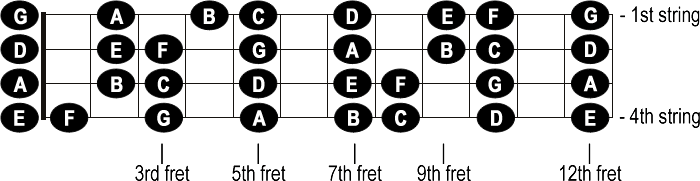
natural-notes-on-bass-neck.gif


As you can see from the diagram of the note names, there is no E#, but remember, to sharp a note, move up (in pitch) one fret, so in theory that would be the first fret on the E string, or F.

Now you're being silly. Based on that assumption, the diagram could have an A# written and you could say there's no Bb, but we know there is.

Does E# exist in Western music? Yes.
Is it used often? No.

But more importantly, does the guitarist in the original thread fully understand what they're talking about? No.

 
Now you're being silly. Based on that assumption, the diagram could have an A# written and you could say there's no Bb, but we know there is.

Does E# exist in Western music? Yes.
Is it used often? No.

But more importantly, does the guitarist in the original thread fully understand what they're talking about? No.

I am going on an admitted stretch, but that is how it was explained to me years ago. Quite possibly wrongly, but that is what I was told.

Simply put, to "bend a note" the string needs to be fretted in the first place. The first opportunity to fret on the E string is F, you can't halfway fret it without simply muting the string. I guess you could try to fret it up by the nut and get a slightly F flat E sharp kind of note, I don't think it would be spot on though.

If you were playing a 5 string, 5th fret on the B string and bend maybe?
 
E# is just an F. It's called an enharmonic. Just look at a piano and notice there are no black keys between B and C, or E and F... There are naturally occurring half steps between B-C and E-F. Therefore, E# is F, Fb is E, and B# is C, Cb is B.

It doesn't sound like your bandmates understand this either. Sure, if you bend an E enough, you get E#/F, but you could also get there by playing one fret to the right of E, which is F.

Just make sure they don't tell you to play an H, and you'll be fine ;)
 
songs do sometimes go into crazy keys because of a modulation.
"touch of grey" is in B, then the bridge goes up a whole step to C#m, C# major, F#, G#m, D#, etc.
For my brain it'd be a lot easier to follow in flat keys, but technically those are the chords more closely related to the key of B major.
even worse is bryan adams' "everything I do" in D flat.
the bridge goes down a whole step.
Cb, Fb, Cb, Gb, etc
if you pretend it's B instead of C flat, you end up in sharp keys instead of flat keys, then it would modulate back to D flat from "G sharp" -- obviously that should be A Flat, the five chord of D flat. proper theory dictates you have to use c flat and f flat chords, if you're writing it out. (can you tell I've been waiting for a chance to complain about this song?)
tl;dr -- sometimes is really makes sense to use these weird names because chords and notes all relate to each other.
 
  • Like
Reactions: Imaginary Pony
It only exist in a "relative form". As some have pointed it out you must consider the scale and the chord progression and SOMETIMES this notation makes sense.
Let's say that in a pop/rock environment few people will use it as someone, hence you, would get confused.

Exactly. Listening to Rock & Blooze musicians talk about theory is often like listening to prison cell lawyers attempt to use legal jargon.
 
Last edited:
I had this same argument with someone while I was a music major. There are uses for E# or Cb or B#, but that mostly applies when reading and writing notation. If someone is explaining a riff to you and says E# and you get confused, he should right away say its the same note as F. Then right off the bat you learn something new, but also know what to play. The use of these notes are certainly not for bending or micro-tones! Seems like your guitarist is a theory nerd, to the point that it gets in the way of his effective ability to play with others. Just tell the guy who doesn't get it its an F instead of trying to seem like a smarty pants! To top it all off he was wrong.
 
  • Like
Reactions: KevInDaBassment

Latest posts