i use to use different basses set up with different tunings. now i use the digitech drop pedal. the pedal sounds good but once you get about 4 semitones down from e standard tuning i can start to hear what sounds like a slight octaver effect. it is something you "might" notice but once your in the mix you can't hear it.

Enjoy the benefits of a premium membership!
Upgrade Account
-
TalkBass has been independent since 1998. Add your voice.
Create a free account to reply to discussions, view embedded media, and browse with fewer display ads.
Join free Log in
Want zero display ads or expanded classifieds tools? Compare plans.
You are using an out of date browser. It may not display this or other websites correctly.
You should upgrade or use an alternative browser.
You should upgrade or use an alternative browser.
Eb tuning songs
- Thread starter ics1974
- Start date
More options
Who Replied?
Another option if your bass's tuners are widely separated enough to permit this is to install Hipshot Detuner's for all 4 strings. They even make a version that allows you to drop both 1 and 2 half steps in the same tuner, so you could get EADG, EbAbDbGb, and DGCF, as well as drop-Eb and -D tunings out of the same bass. However, this retrofitting all 4 tuners is likely to be more expensive than the Drop pedal, and opens up the door to flabby strings.
Maintain standard tuning, its better to just play it in E no one will care but the guitar player.
Given that the OP is a bedroom player of the 4-string persuasion, my recommendation is to use standard tuning and play the occasional low Eb that’s in the recording one octave up. It’ll sound fine and you’ll have a bunch more time for playing instead of tuning.
I came up playing with horns and most of my playing these days is jazz standards jams so songs in F, Bb, Eb and Ab are, to me, just another song. They aren’t going to retune a bunch of horns if the singer needs it down a half step. They transpose.
Assuming the music is rock, playing open strings is definitely rare in any rock subgenre so you need to ask yourself if that single lowest note that you’re going to play maybe three times in a whole gig is worth the retuning. If it is that important, I suggest listing the down-tuned songs and grouping them together so you aren’t tuning down for this song, up for the next then down again then ... rinse ... repeat.
I came up playing with horns and most of my playing these days is jazz standards jams so songs in F, Bb, Eb and Ab are, to me, just another song. They aren’t going to retune a bunch of horns if the singer needs it down a half step. They transpose.
Assuming the music is rock, playing open strings is definitely rare in any rock subgenre so you need to ask yourself if that single lowest note that you’re going to play maybe three times in a whole gig is worth the retuning. If it is that important, I suggest listing the down-tuned songs and grouping them together so you aren’t tuning down for this song, up for the next then down again then ... rinse ... repeat.

Any excuse to buy another bass is what I go with. So you need to get another bass and set it up for Eb.

I've been using the geary key thingy method for years or a second bass that's detuned but now that electronics are solid enough I think I'd be into trying a digital solution. If I got a new drop pedal I'd have to reconsider my head and cab situation. Or maybe just add another cabinet, my head can handle lower resistance. And I've been pretty happy with my LaBella flats on that P but might jump on the TI wagon for a change. And I've got a black pick guard so that simply won't do. Is it easier to change to a tort guard or just get a new bass? And don't get me started about the nut on that new bass I'll get, jeez. I might need a transitional bass to ease the step to the new one. I also want a Ric again, just because they're cool. Or maybe I could go back to a rack. I still have a preamp and one of those cool light up power conditioners so you can lean against your rig and read a book when your band is on break. What's a good rack power amp? Should I go back to stereo split? Has anybody ever built a head into a pedal board? Hear me out, if you got a lower profile head you could velcro the pedals on top of it and if it was too high to reach the pedals you could just stand on a milk crate. But if your head is on the floor where the heck could you put your beer?
I have a bass tuned down a half step for the ones we do in Eb - GnR, van Halen, etc.
For a lot of them I want the open string and find that’s the easiest way for me.
For a lot of them I want the open string and find that’s the easiest way for me.

If it's important to the sound of the song (for example when playing certain rock/blues/metal styles) then I tune my strings to match the guitarist. This turns the bass into a "transposing" instrument and when communicating between band members, we still call the strings E, A, D, G (even though they are actually concert-pitch Eb, Ab, Db, Gb).
On the other hand, if having the lower-octave Eb is not important to the sound of the song (for example playing jazz standards in the key of Eb with saxophone and piano) then I stay in standard tuning.
There is NO CORRELATION between a musician's skill level and whether or not they choose alternate tunings. Some of the best-of-the-best musicians of all time (like Jaco Pastorius, Jimi Hendrix, Michael Manring, Joni Mitchell, SRV, J.S. Bach, etc.) have experimented with non-standard tunings. Alternate tunings, drop tunings, and capos are not a "crutch" as some would have you believe.
On the other hand, if having the lower-octave Eb is not important to the sound of the song (for example playing jazz standards in the key of Eb with saxophone and piano) then I stay in standard tuning.
There is NO CORRELATION between a musician's skill level and whether or not they choose alternate tunings. Some of the best-of-the-best musicians of all time (like Jaco Pastorius, Jimi Hendrix, Michael Manring, Joni Mitchell, SRV, J.S. Bach, etc.) have experimented with non-standard tunings. Alternate tunings, drop tunings, and capos are not a "crutch" as some would have you believe.
Last edited:

Key of Eb and other flat keys are always preferred by horn players. When I see the Eb key signature (Bb, Eb, Ab), I play in Eb on 4 strings with standard tuning. Not been a problem for 50 years. I suggest you get comfortable playing in all 12 keys or you will always be severely limited. To me down tuning the bass 1/2 step to Eb for the sake of the key is a poor solution.
If the tune/riff was played tuned down a half step- prefer to play it that way. Especially as others have mentioned, if the tune makes heavy use of the low, open E(Eb) string. No fear of odd keys- had to learn mandolin up and down the neck in all keys and in that world a capo is verboten
Learning songs in different positions is a great exercise but hitting that booming low note an octave higher does the tune far more disservice than tuning down, imho.
Learning songs in different positions is a great exercise but hitting that booming low note an octave higher does the tune far more disservice than tuning down, imho.

Smooth_bass88
vaxx!
- Oct 31, 2006
- 12,122
- 16,796
- Disclosures
- have been on nationally released albums, charting on the Billboard 200
I keep actually two basses in Eb in my collection because a couple of the artists I work with play that way. If you're playing along to your favorite songs, sometimes a five string will work be honestly try playing along to Guns N Roses' Appetite for Destruction or Early Van Halen records or certain Green Day songs. Using a five string just doesn't work.I am a bedroom bass player (4 string bass only) and just like to learn songs and jam to mp3's. My question is regarding songs in Eb tuning.
What does everyone do when a song is tuned to Eb?
-Have a guitar dedicated just for Eb tuning
-Tune your guitar to Eb for that song then tune it back to regular tuning after
-Use software to change the pitch back to regular E tuning
-something else?
OP states he doesn't play a five string.
Last edited:

what software do you use?If it's a song my band is playing in standard, I'll run it through pitch changing software. In the time it takes to downtune and then retune your bass once, you can have it in the new key forever.
Eb is right for horns, also pretty good for keys. In fact, lots of jazz is in Eb, which is where Stevie is coming fromI read a biography of SRV and the author (who knew him well) stated that he detuned to Eb because he liked the tone he got from heavy gauge strings, but they were much harder to bend. It wasn’t a vocal range issue. Axl probably did it to save his voice, but I don’t think it worked. No idea why Stevie detuned. Maybe for horn arrangements?

For a bedroom player? Just use Audacity or something to copy and raise the song a half step up and be done with it. Much simpler. And it's probably the same fingering as the original artist was using. Otherwise you'll have to change it back for the other 7/8 of the songs you'll be playing along with. And you still get that deep note; we're playing bass here, not guitar.
If you do end up wanting to join a band that plays everything down, you'll probably just tune that way too; and again, you're still back to the same fingering.
Playing live, if one comes up I just use my Hipshot Detuner to drop to DADG. In fact, on Boulevard of Broken Dreams by Green Day we play it shifted to E, and that's exactly what I do for the outro, which drops to Db.
There's even an Adroid app called Music Speed Changer that will transpose any file as many semi-tones as you want on the fly, plus enable tempo change without pitch change for learning, and not impact the original file. I'm sure there are plenty more of those out there for every platform. I use MSC all the time.
If you do end up wanting to join a band that plays everything down, you'll probably just tune that way too; and again, you're still back to the same fingering.
Playing live, if one comes up I just use my Hipshot Detuner to drop to DADG. In fact, on Boulevard of Broken Dreams by Green Day we play it shifted to E, and that's exactly what I do for the outro, which drops to Db.
There's even an Adroid app called Music Speed Changer that will transpose any file as many semi-tones as you want on the fly, plus enable tempo change without pitch change for learning, and not impact the original file. I'm sure there are plenty more of those out there for every platform. I use MSC all the time.

For the first 10 years playing we played tuned down half step, then as we got into recording we moved to standard as it was easier to integrate keyboards, samples, etc.
Now I am in the process of setting up a guitar and bass for half step, and one each for Fripp’s alternative standard tuning (CGDAEG) because I have been writing using it.
For playing along with songs, either keep standard tuning and shift the area where you are playing or just detune for that song.
Now I am in the process of setting up a guitar and bass for half step, and one each for Fripp’s alternative standard tuning (CGDAEG) because I have been writing using it.
For playing along with songs, either keep standard tuning and shift the area where you are playing or just detune for that song.

JeezyMcNuggles
Inactive
- Feb 23, 2018
- 14,723
- 20,970
- Disclosures
- I suck, but nobody really notices
Just play it in E. Every guitar player does.I am a bedroom bass player (4 string bass only) and just like to learn songs and jam to mp3's. My question is regarding songs in Eb tuning.
What does everyone do when a song is tuned to Eb?
-Have a guitar dedicated just for Eb tuning
-Tune your guitar to Eb for that song then tune it back to regular tuning after
-Use software to change the pitch back to regular E tuning
-something else?
In late 80s- early 90s a lot
of metal/ hard rock was tuned down to Eb.
I just clicked my entire keyboard down half a step because that is how it was likely recorded to match the guitars and bass.
Probably played 2 years straight with my keys tuned down a half step. Of course this was not the way with the old Korg CX3 or Sequential circuits board.
Though the Korg has a fine tune knob on the back panel, now that I think of it so the SC board probably made me transpose- but mostly used for effects so wasn't a big deal. Plus- Eb , as mentioned is a pretty friendly key.
of metal/ hard rock was tuned down to Eb.
I just clicked my entire keyboard down half a step because that is how it was likely recorded to match the guitars and bass.
Probably played 2 years straight with my keys tuned down a half step. Of course this was not the way with the old Korg CX3 or Sequential circuits board.
Though the Korg has a fine tune knob on the back panel, now that I think of it so the SC board probably made me transpose- but mostly used for effects so wasn't a big deal. Plus- Eb , as mentioned is a pretty friendly key.
There are some bands we cover that make use of bass chords with open strings and notes fretted high up the neck (in Eb tuning), so just playing on a 5 or different positions just won't work well. Also, try to play a song like Slither (Velvet Revolver) without an open string. Although it CAN be played on a 5 without open strings, it is so much more difficult.This is exactly what I came to say. Sometimes even with a 5 string, it just doesn't flow the same. Some types of music just need those open strings to make the riffs really work. You can get by without them, but it feels different.
I have one band that always plays in Eb to accommodate the singer's range, and another band that is standard tuning. I just switch basses while I'm practicing. Even with that, I group the play list I use for practice so that all the Eb songs are together. That way, I'm not switching back forth constantly (or re-tuning).
There's a great piece of software called "Audacity" that you can use to change the pitch of songs. You can create a set of "pitch corrected" songs for yourself to play along with.

OP - Hey guys, I'm a bedroom player who just jams along to MP3's...
Talkbass - You should learn to play this specific way for all those times you'll be doing huge gigs with horn sections!
Talkbass - You should learn to play this specific way for all those times you'll be doing huge gigs with horn sections!
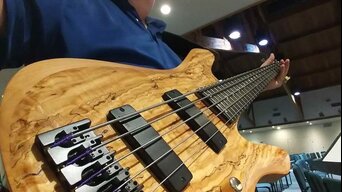
Songs in the key of Eb is where 5-string basses shine... eb2 when a eb3 just won't do it!
Latest posts
-

-
 Curious what the percentage of bass players use rounds vs flats is.
- Latest: el murdoque
-

-

