Well, Cape Cod is a pretty extreme example. Places like Sioux City or Tulsa are hardly "remote backwaters" though to hear Northeasterners talk you'd think they were on the back side of the moon.Seems I've been behind the curve on just how insane house prices are becoming on Cape Cod. Just saw a house essentially identical to mine (3 bed/2bath/1 car garage) for sale for $900K+. I can only surmise that it's targeted towards rich buyers off Cape looking for a second or third vacarion home. No young familes buying these houses. The other alarming trend is banks buying up houses and then renting them out at crazy prices. I suspect my sons may be renters for life, unless they can find a job in some remote area where housing isn't as horrific.

Enjoy the benefits of a premium membership!
Upgrade Account
-
TalkBass has been independent since 1998. Add your voice.
Create a free account to reply to discussions, view embedded media, and browse with fewer display ads.
Join free Log in
Want zero display ads or expanded classifieds tools? Compare plans.
You are using an out of date browser. It may not display this or other websites correctly.
You should upgrade or use an alternative browser.
You should upgrade or use an alternative browser.
Everyone has to be rich now??
- Thread starter Cadillac_Mike
- Start date
More options
Who Replied?

That's because of location. In Detroit you could probably that house right now for 80k.Our first house was a 900 sq ft cinder block house on a slab floor two block from the interstate in San Carlos, CA. It was 284,000 in 1998. We sold it for 420,000 in 2002, that house is over 1.5 million dollars now.
Size has NOTHING TO DO WITH IT.

Marginal rates have come down for sure but thr top 5% pay 61% of taxes. A huge chunk pay nothing. I work 2 days a week just to pay taxes.Fair to say the tax brackets have shifted significantly since the 50's. The ultra-wealthy don't pay diddly squat now.

It's interesting to put this into a historical perspective. I'm 62, and when I was growing up, I heard that "America is the richest country in the world." We were warned that if we looked beyond our shores for ideas about economics, we would face "stagnation" just like Europe. Later, these warnings included Japan. On the other hand, Russia was still behind the iron curtain, soon to be broken up, and nobody knew what the future held for China.I grew up in USA, lived in Switzerland for 9 years, then Germany for 3 years, then returned to Switzerland in 2017. My quality of life soared when I moved to Europe. Switzerland and Germany are not perfect, but compared to USA they are paradise. Everyone has access to healthcare, good grocery stores and public transportation. I do not own a car; when I need one, I rent. Europe also takes existential threats, be they environmental, social or military, more seriously. It is a tough world out there.
Today, a number of countries (Europe, Japan, possibly Korea and Australia) have stagnated their way to having noticeably better quality of life by some measures and according to some peoples opinions, and America is still "the richest country of the world," but we don't feel rich. We are no longer best in the world in life expectancy, infant mortality, maternal mortality, violent crime, incarceration, suicide, traffic fatalities, etc. We pay 2x the going rate for mediocre health care. We were warned that free health care would lead to "waiting lists" and lack of "choice." Those are now governing features of our system.
A lot of this thread is talking about individual choices and their consequences, but the countries that have pulled ahead of us have done so through collective choices, such as sharing the costs of transportation, health care, higher education, and retirement -- and building institutions that make those things more efficient. Maybe there's a lesson here.
Last edited:


There is.Maybe there's a lesson here.
There's great wealth in being a society that values and supports fellow countrymen.

With respect, as someone who started my 'professional life' in 2002/2003 after the 9/11 recession, and then got smacked squarely in the face by the 2008 crash before I ever really got my footing after graduation, there is no way one can prepare - especially when just starting out - for the amount of financial crises and upheaval that we've experienced in less than a quarter century. 2008 was one of the biggest generational shifts in housing ownership in the aftermath, with properties getting snatched off the market and into the hands of investors (public and private), reducing the available housing stock for purchase, because many of the properties were single family homes which got turned into rentals. I live in an area where that happened, so I can speak from personal experience on this one. You mentioned the sizes of homes being built. As touched on in an earlier reply, the amount of starter homes being built (1,500 SF or less?) is next to nothing now because the cost to build vs size vs selling price makes it unaffordable for builders to commit to them in many cases. Houses are being built way smaller to keep the price low (which often means they are TOO small to be practical), or they're being built bigger because they know people will pay the price for them.... because that's the only available inventory. People either choose to go into debt for a home that's too big just to own it, or they pay rent that's higher than a mortgage payment, which doesn't help their credit score at all. That's another criminal thing.... paying rent doesn't help build credit STILL to this day, unless you're one of a handful of landlords who chooses to report it.
Working people in general don't have a sense of 'entitlement', unless you consider wanting to own a house at reasonable price as being 'entitled'. It IS the conditions to a large degree, when you look at wage stagnation vs inventory vs price vs interest rates. Yes, you had high interest rates in the 80s, but you also had far lower home prices and better wages/compensation packages for jobs vs now.... and healthcare was not as expensive.
Every generation experiences challenges, but nearly all of the things you mentioned are red herrings which completely ignore the things that are completely out of peoples' control, that they can't reasonably plan for, which nearly wrecked the economy and cost many of us our jobs and livelihoods for at least a few years' time. You can be well educated with a good sense of financial responsibility and discipline and live below your means and still never be 100% prepared the way people preach about it. 2008 changed me into a skeptical bear, and made me even more reticent to go into debt of any kind, which has been very beneficial given the amount of volatility which seems to persist around us.
I mean...that chart cuts off 5 years before home prices really took off. I think that kind of undermines your point a bit. But I agree with you re: corporate ownership of housing.I started my "professional" life with a masters in structural engineering directly into the 08/09 downturn, and spent the first two years driving school buses to survive. And while I agree with a lot of the hardships we face now, I'd also point out that houses are larger and nicer (as our cars) than the standard was in the 1980's. It's not only that prices have increased, it's that the "standard" has drastically increased also.
This is all while household sizes have decreased in that timeframe by almost one person. So people are expecting much larger homes while complaining that housing is so expensive.
The median home size was around 1,500 sf in 1960.
The median home size today is around 2,300 sf.
That's a massive increase.
Interestingly, the cost per square foot hasn't changed much. People just want WAY more house than they used to. Affordability isn't the root problem. It's home sizes. I believe this changed drastically when so many households became dual income. It instantly opened up new revenue, and people immediately started buying bigger, nicer, and more stuff (including homes). The solution to "affordability" is to simply buy a smaller home. It's really not difficult to understand.
View attachment 7240441
Now, I DO agree that we should ban or severely curb corporate ownership of homes for a variety of reasons, because that is a major problem that is bad for our society and economy.
And I'll chime and say me too! My wife and I bought more house than we need (although that was because we though the extra space would provide a living area - bed, bath, sitting rooms - for her elderly relative), but we did okay - 2400 square feet for a hair under 300k. Our house is already valued at well over 400k, and that's before accounting for all the renovations and upgrades we did, including finishing a large room upstairs and adding the workshop/bandroom where the carport used to be.Take that same house that was built in 1960 and the selling price today. It will cost much more in terms of annual income. This is the point of several posts by owners of homes here. My daughter and her husband just bought an old rancher in the Chicago suburbs for 362k.
No disagreement here. See above - I wouldn't mind a smaller house that's cheaper to heat/cool and easier to clean.Across the board, I think our houses are too large in the U.S. One way to curb prices to offer smaller homes and for people to lower their standard, especially for first-time buyers.
Well I do that at my desk job and while I was in college so sure.Are you willing to get dirty, sweat, and go home every day physically exhausted?
Also I use to help with my dads shop. Stop your smugness it's not unicorns and rainbows, but white collar life isn't either.

Money is a zero-sum game. Wages double, expenses double, and we're right back where we started. I was just as broke in my twenties as people in their twenties are today. My dad was even poorer in his twenties, and my grandfather used to order just a cup of coffee at a diner for lunch so he could eat free saltine crackers with ketchup and call it a meal.
But if you spend a lot of time on social media, you'd think that millennials and/or gen z invented being poor.
But if you spend a lot of time on social media, you'd think that millennials and/or gen z invented being poor.

I’ve done both, and I don’t think you really understand what I’m asking.Well I do that at my desk job and while I was in college so sure.
Also I use to help with my dads shop. Stop your smugness it's not unicorns and rainbows, but white collar life isn't either.
I hear younger people saying there’s no opportunity now compared to what we smug boomers had, but my perspective is different. It might not be universal, but it’s mine. I think our expectations were much lower, both for pay, and for what we had to do to get that pay. Job satisfaction was not even a factor. I retired pretty comfortably, but I doubt that you would even believe what I did to get to that point.
There is opportunity though. For just one, companies are begging for people to train as line workers. They recruit heavily among people who aren’t getting much value from their degrees and are willing to work long hours in tough conditions, and willing to travel.

There is more to the article than the tagline.I'm a member of UA 467 Plumbers Union, not a teamster.
But ok
I want George Jetson’s job (and decor)The funny thing about the 50s/60s TV shows (cartoons included) is that they were either wildly idealistic and whitewashed the reality of the 'nuclear family' and the 'average family', or they lampooned it in a way that flew over peoples' heads - like Mr. Slate treating Fred like dirt, which was closer to reality in all likelihood.

I just wanted to weigh in to this discussion by pointing out that the widespread belief of workers wages not keeping up with prices, and ordinary folks losing purchasing power over the years is a false narrative.
In fact, wages have kept steady with inflation for a very long time.
While many more Americans today are certainly finding it more difficult to buy a home than their parents and grandparents, the explanation isn't erosion of wages.

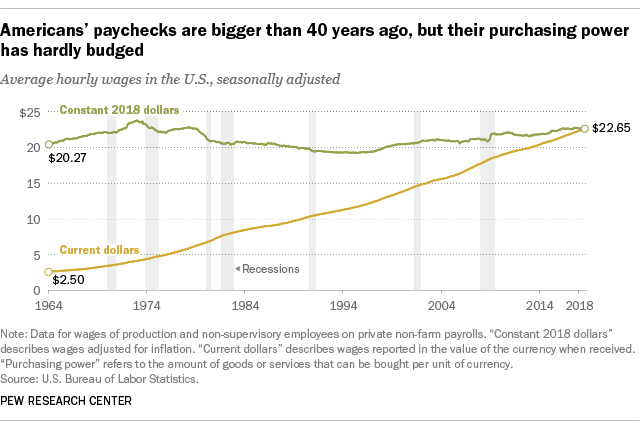
In fact, wages have kept steady with inflation for a very long time.
While many more Americans today are certainly finding it more difficult to buy a home than their parents and grandparents, the explanation isn't erosion of wages.


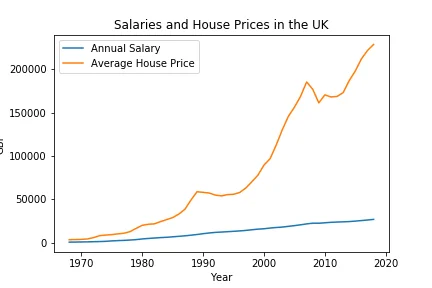
In the UK the average house price vs the average annual wage.

JazznFunk
Supporting Member
I just wanted to weigh in to this discussion by pointing out that the widespread belief of workers wages not keeping up with prices, and ordinary folks losing purchasing power over the years is a false narrative.
In fact, wages have kept steady with inflation for a very long time.
While many more Americans today are certainly finding it more difficult to buy a home than their parents and grandparents, the explanation isn't erosion of wages.
View attachment 7241047View attachment 7241048
National averages aren't indicative of local job market or even State-level wage stagnation, specifically as it relates to the minimum wage. Here in NC, our minimum wage has stayed the same at $7.25/hr for decades. That's below the certified/recognized Poverty Wage. Certain municipalities have pushed (successfully) for businesses to be Living Wage Certified, but overall the minimum wage in NC has allowed businesses to continue under-paying workers and barely meeting (if they meet at all) adjustments for inflation.
Also, your data sets (both charts) are (or are almost) a decade old. And your 2nd chart literally states in the headlines that while wage averages may have increased, *purchasing power has hardly budged*. Meaning we are not keeping pace with inflation and cost in terms of wages, especially when you look at more micro-level data in areas with high costs of living. So the narrative..... is not totally false, but it depends on how you calculate real pay vs purchasing power:
Has Pay Kept Up With Inflation?
Looking at the basic numbers and what it actually takes, on average, to pay the bills is also more helpful than un-nuanced, blanket data. This is an interesting tool which you can investigate living wage requirements and average expenses State-by-State.
Living Wage Calculator
Last edited:

National averages are what they say they are and should be interpreted as such, a national average.
-Mike
-Mike
JazznFunk
Supporting Member
Agreed. And they also demand nuanced analysis.... like considering that CEO and executive pay factors into this as well. Those high-end 'wages' (which often increase far higher and quicker exponentially than low-to-mid-level salaries do) will skew the data higher while the average worker stays more stagnant and feels the pinch more than high earners. If one wants a 'real world' view of wages vs cost vs spending power, it's probably worthwhile to parse out people making under several million dollars per year in base pay, excluding dividend and capital gains income.National averages are what they say they are and should be interpreted as such, a national average.
-Mike
Last edited:
This is true, but then again this chart was simply a national average, which is true based on the data provided to it. Sure, you can adjust any of the factors and details in the report for a more thoughtful analysis, but now you have something different from this national average.Agreed. And they also demand nuanced analysis.... like considering that CEO and executive pay factors into this as well. Those high-end 'wages' will skew the data higher while the average worker stays more stagnant and feels the pinch more than high earners. If one wants a 'real world' view of wages vs cost vs spending power, it's probably worthwhile to parse out people making under several million dollars per year in base pay, excluding dividend and capital gains income.
We can do this with any chart showing an average of anything and say 'that's not true if you do A, B, or C'.
-Mike


Guys: we got 11 pages in on this topic and kept it relatively civil. No mean feat nowadays. TB rules.


