The whirlwind continues with the third and last pedal of the box (at least in the order I pulled them out), the Octavium.
I've worked with octave pedals before. Used judiciously, they can "meaten" up a sparse instrumentation, or give the "George Benson" doubled solo effect. So there aren't many things to remember on most octave pedals except to not go crazy with low octaves. Most bass amp and PA cabs are not particularly crazy about ripping levels of 40 and lower Hz frequencies, which you get to when you attempt to play below the middle E - 80 Hz with a one-octave-under unit, which most standard octave dividers are. It can blow out anything but the most robust cabs coupled with massive power amps. Certainly a lot of the adopters of the fEarful type cabs are players using octave dividers and synth pedals that generate subharmonics, and the Eminence LFs can take that kind of woofer excursion - once again, within reason.
Also, the other problem many octave dividers have is tracking multiple notes played as a chord. Most quality units nowadays can handle fast single-note runs okay, which was not always the case.
With all that background tangential introductory blather out of the way, the Octavium has a few interesting tricks that set it apart from the norm.
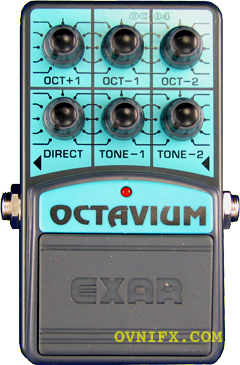
The top three controls are all volume controls for their respective +1, -1, and -2 octaves- or another way to think of it is the effect mix for each of the octaves. Yes- this unit does three octaves. Crazy! And it does them well if you are careful how you mix them. This pedal is advertised as a guitar or bass unit, so since bass is already an octave down below guitar, one could think of the -2 octave band as primarily for guitars. If you use -2 carefully on bass, it's still quite a good effect.
There is then a direct signal, which is the uneffected signal volume. Turn that off and the top row all the way down, and there is no signal. The remaining two knobs are tone controls for the -1 and -2 octaves.
The +1 octave is a fuzzed up signal, and you can't change the amount of fuzz or the tone other than by simply turning it up or down. Very unusual. It allows you to record unison riffs/lines as if you had a guitarist doubling you.
-1 octave is what most players have used and it's the most useful, as it does not limit your range on the neck as much as the -2 octave does.
If you play a large amount of the -2 octave, you are pretty much stuck way up high on the neck on a standard-strung and tuned 4 or 5 string bass. -2 is good if you add just a small amount of it to a predominately dry/direct signal, or to a signal that has mostly direct and -1 octave. If you dial up the -2 and play down below A 220 or so, it gets very growly and indistinct.
(Again these observations are probably true for most bass amps, but with more capable heads and cabinets, there is more usable range with this pedal.)
The tone controls are interesting also. The sub-octaves are clearer and more usable with the tones turned all the way down (counterclockwise). The more you turn the tones up, the growlier and more distorted the sub-octave gets- and it doesn't take much before you are into Harley-Davidson territory!
This pedal can easily double as a none-too-subtle distortion box. Just turn the direct level down, crank up -1 octave and turn up the tone - rrrrrroar!
With the sub-octaves turned up and the tones turned up, about the only way to get much distinct treble is to continue to increase the direct level and restore the treble content.
This is a potent octave dividing unit, and it probably should be labeled with a "Caution" sticker, because you can easily blow the heck out of your speakers with it.
Let's see- what else- the unit tracks two or three notes played simultaneously if there is not a lot of suboctave level going on. It doesn't take much to blow up the tracking and cause the unit to become confused on which note to select. As I expected, it does best on single-note passages, which it tracked perfectly no matter how fast I played- until I started working lower and lower notes- then the tracking started crapping out. All in all, for a non-rack unit- it did fine.
Most players will use octave effects sparingly and play higher on the neck, and this is the realm that the Octavium does best in.
Like the Moby Dick, the Octavium is one I would definitely consider. I liked it also.
I've worked with octave pedals before. Used judiciously, they can "meaten" up a sparse instrumentation, or give the "George Benson" doubled solo effect. So there aren't many things to remember on most octave pedals except to not go crazy with low octaves. Most bass amp and PA cabs are not particularly crazy about ripping levels of 40 and lower Hz frequencies, which you get to when you attempt to play below the middle E - 80 Hz with a one-octave-under unit, which most standard octave dividers are. It can blow out anything but the most robust cabs coupled with massive power amps. Certainly a lot of the adopters of the fEarful type cabs are players using octave dividers and synth pedals that generate subharmonics, and the Eminence LFs can take that kind of woofer excursion - once again, within reason.
Also, the other problem many octave dividers have is tracking multiple notes played as a chord. Most quality units nowadays can handle fast single-note runs okay, which was not always the case.
With all that background tangential introductory blather out of the way, the Octavium has a few interesting tricks that set it apart from the norm.
The top three controls are all volume controls for their respective +1, -1, and -2 octaves- or another way to think of it is the effect mix for each of the octaves. Yes- this unit does three octaves. Crazy! And it does them well if you are careful how you mix them. This pedal is advertised as a guitar or bass unit, so since bass is already an octave down below guitar, one could think of the -2 octave band as primarily for guitars. If you use -2 carefully on bass, it's still quite a good effect.
There is then a direct signal, which is the uneffected signal volume. Turn that off and the top row all the way down, and there is no signal. The remaining two knobs are tone controls for the -1 and -2 octaves.
The +1 octave is a fuzzed up signal, and you can't change the amount of fuzz or the tone other than by simply turning it up or down. Very unusual. It allows you to record unison riffs/lines as if you had a guitarist doubling you.
-1 octave is what most players have used and it's the most useful, as it does not limit your range on the neck as much as the -2 octave does.
If you play a large amount of the -2 octave, you are pretty much stuck way up high on the neck on a standard-strung and tuned 4 or 5 string bass. -2 is good if you add just a small amount of it to a predominately dry/direct signal, or to a signal that has mostly direct and -1 octave. If you dial up the -2 and play down below A 220 or so, it gets very growly and indistinct.
(Again these observations are probably true for most bass amps, but with more capable heads and cabinets, there is more usable range with this pedal.)
The tone controls are interesting also. The sub-octaves are clearer and more usable with the tones turned all the way down (counterclockwise). The more you turn the tones up, the growlier and more distorted the sub-octave gets- and it doesn't take much before you are into Harley-Davidson territory!
This pedal can easily double as a none-too-subtle distortion box. Just turn the direct level down, crank up -1 octave and turn up the tone - rrrrrroar!
With the sub-octaves turned up and the tones turned up, about the only way to get much distinct treble is to continue to increase the direct level and restore the treble content.
This is a potent octave dividing unit, and it probably should be labeled with a "Caution" sticker, because you can easily blow the heck out of your speakers with it.
Let's see- what else- the unit tracks two or three notes played simultaneously if there is not a lot of suboctave level going on. It doesn't take much to blow up the tracking and cause the unit to become confused on which note to select. As I expected, it does best on single-note passages, which it tracked perfectly no matter how fast I played- until I started working lower and lower notes- then the tracking started crapping out. All in all, for a non-rack unit- it did fine.
Most players will use octave effects sparingly and play higher on the neck, and this is the realm that the Octavium does best in.
Like the Moby Dick, the Octavium is one I would definitely consider. I liked it also.
 I apologize again for not getting rolling with this sooner. I'll get the Tourbox back on the road this Monday. I plan on "glamming" up the box a little bit- it's pretty spartan! I think the battery in the Octavium is still good, but I will check both it's battery and that of the Bass Distortion before I pack them up.



 it's that doggone postal system. thx michael...hopefully we'll get to hang soon. but i haven't been to knoxville in quite a while. i'm overdue, quite honestly.
 Yeah, sending the Tourbox using Priority Mail is a good thing. Glad to hear it made it there okay.