
Enjoy the benefits of a premium membership!
Upgrade Account
-
TalkBass has been independent since 1998. Add your voice.
Create a free account to reply to discussions, view embedded media, and browse with fewer display ads.
Join free Log in
Want zero display ads or expanded classifieds tools? Compare plans.
You are using an out of date browser. It may not display this or other websites correctly.
You should upgrade or use an alternative browser.
You should upgrade or use an alternative browser.
fdecks HPF, Part II
- Thread starter Chef
- Start date
More options
Who Replied?
I'd like to cut as much as possible to save my speakers. But wonder if the series 1 will do the job
Half a much cut as series 3, enough? Hard to say without trial and wrecked drivers.
Also of note, these things aren't magic if you overpower your speakers they will still melt. Just use your ears.
I have no idea if half of the 3 enough. I don't know anything about either. I'm simply going off what people are recommending to me. I've never used an hpf before
The design intent of the series 1&2 was to eliminate feedback with upright bass amplification.
Series 3 is what you are looking for.
Its a bit more scratch but sometimes more is more.

^this^ the 1 and 2 were designed for upright. But you can still use it with electric. The 3 has electric in mind.

- Mar 8, 2011
- 12,232
- 51,187
- Disclosures
- Authorized greenboy designs builder/Owner of BNA Audio
^this^ the 1 and 2 were designed for upright. But you can still use it with electric. The 3 has electric in mind.
I use a 3 on upright...works a treat

BurningSkies
CRAZY BALDHEAD
- Feb 20, 2005
- 27,956
- 20,348
- Disclosures
- Endorsing artist: Dingwall Guitars
The 6V peak to peak is the amount of headroom the unit has.
The HPF3 has two filters, one is a 12db per octave filter set at 35hz. The second one is a 12db per octave filter that is variable between 35-140hz, meaning that there's a knob that allows you to move where it starts to filter.
What that means is that you've always got 12db at 35hz, then you've got another filter 'knee' that you can adjust. If you set it at 35hz, you're doubling up (getting 24db at 35hz).
Otherwise, you get say 12db at 100hz (or whatever) and then another 12db cut lower down at 35.
The HPF3 has two filters, one is a 12db per octave filter set at 35hz. The second one is a 12db per octave filter that is variable between 35-140hz, meaning that there's a knob that allows you to move where it starts to filter.
What that means is that you've always got 12db at 35hz, then you've got another filter 'knee' that you can adjust. If you set it at 35hz, you're doubling up (getting 24db at 35hz).
Otherwise, you get say 12db at 100hz (or whatever) and then another 12db cut lower down at 35.

BurningSkies
CRAZY BALDHEAD
- Feb 20, 2005
- 27,956
- 20,348
- Disclosures
- Endorsing artist: Dingwall Guitars
What that really means is that you always have 24 db/oct at 35 Hz no matter where the second filter is set.
This is true...except that you gain some flexibility to have 12db of that roll off happen at 35hz or up to 140hz. Which is a nice feature depending upon the room you're in.

Without seeing a chart I'm still a but confused what exactly is happening with the moving knee.
The way it's explained it sounds like there is a fixed slope shelving filter which results in -12dB at 35hz, unspecified bandwidth, and the III adds 12dB which somehow gets a variable slope starting from 35hz/12db finishing at the specific frequency with zero cut?
The way it's explained it sounds like there is a fixed slope shelving filter which results in -12dB at 35hz, unspecified bandwidth, and the III adds 12dB which somehow gets a variable slope starting from 35hz/12db finishing at the specific frequency with zero cut?
BurningSkies
CRAZY BALDHEAD
- Feb 20, 2005
- 27,956
- 20,348
- Disclosures
- Endorsing artist: Dingwall Guitars
Without seeing a chart I'm still a but confused what exactly is happening with the moving knee.
The way it's explained it sounds like there is a fixed slope shelving filter which results in -12dB at 35hz, unspecified bandwidth, and the III adds 12dB which somehow gets a variable slope starting from 35hz/12db finishing at the specific frequency with zero cut?
Nope the fixed filter is -12db per octave. The variable is another 12db per octave high pass that is adjustable between 35 and 140.
Its not a shelving EQ, its a high pass filter.

Passinwind
I know nothing.
- Dec 3, 2003
- 23,054
- 45,941
- Disclosures
- Designer/Toaster Tech @ Passinwind Electronics
Without seeing a chart I'm still a but confused what exactly is happening with the moving knee.
The way it's explained it sounds like there is a fixed slope shelving filter which results in -12dB at 35hz, unspecified bandwidth, and the III adds 12dB which somehow gets a variable slope starting from 35hz/12db finishing at the specific frequency with zero cut?
This is a model of my new DIY variable HPF build's frequency response curves, which may or may not be similar to fdeck's in behavior:
This uses the same basic format of one fixed 2nd order section and one variable one, and the graph represents one of many possible tweaks. The circuit boards arrived a few minutes ago and I won't actually know how it sounds for a few days.
Edit: there's a graph of the older fdeck HPF's response curves here, in the owner's manual: https://docs.google.com/viewer?a=v&...FpbnxocGZ0ZWNobGxjfGd4OjQyNGJhOWE3YzdjMDY0ODg, but it uses a different format than the new ones.
BurningSkies
CRAZY BALDHEAD
- Feb 20, 2005
- 27,956
- 20,348
- Disclosures
- Endorsing artist: Dingwall Guitars
Random image of an idealized 12db per octave high pass (this one at 120hz):
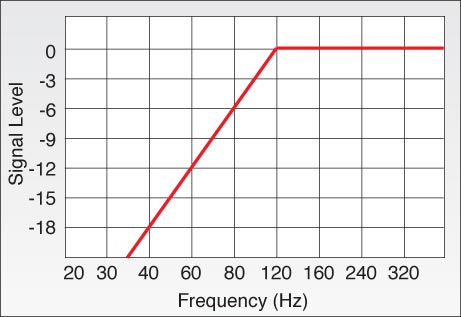
^So, the unit has two 'knees' (the point where the filter lets the signal through. One fixed at 35 hz. and a second one that you can vary. If you take that with it set at 35hz you're getting 24db per octave, then no matter where you start it, you'll be 24db or more by the time you get to where the second fixed filter acts.
^So, the unit has two 'knees' (the point where the filter lets the signal through. One fixed at 35 hz. and a second one that you can vary. If you take that with it set at 35hz you're getting 24db per octave, then no matter where you start it, you'll be 24db or more by the time you get to where the second fixed filter acts.
Passinwind
I know nothing.
- Dec 3, 2003
- 23,054
- 45,941
- Disclosures
- Designer/Toaster Tech @ Passinwind Electronics
Random image of an idealized 12db per octave high pass (this one at 120hz):
That would actually usually be characterized as a 100Hz HPF, since that is the -3dB point. There's little to no standardization for specs in the MI electronics world though...

Is the FDeck series 3 -3 dB at 35Hz (with the knob set at its lowest)? Or is that where the dropoff starts and it's -3 dB at some lower frequency?
BurningSkies
CRAZY BALDHEAD
- Feb 20, 2005
- 27,956
- 20,348
- Disclosures
- Endorsing artist: Dingwall Guitars
That would actually usually be characterized as a 100Hz HPF, since that is the -3dB point. There's little to no standardization for specs in the MI electronics world though...
More or less why I said 'idealized'... it's stolen from a prosound article explaining HPF's and is their example for 12db per octave. I've never seen a HPF that was angled like that either.They point out that the octave (120hz down to 60hz) is 12db down, so it obviously is more of an illustration on the idea rather than in real life.
While high and low pass filters are useful for removing unwanted signal above or below a set frequency, shelving filters can be used to reduce or increase signals above or below a set frequency.
http://en.wikipedia.org/wiki/Shelving_filter#Shelving_filter
http://en.wikipedia.org/wiki/Shelving_filter#Shelving_filter
alright guys, you convinced me to just go with the 3. I would be really bummed if I got the 1 and then later bought the 3 (which that is exactly the kind of thing that I do all the time)
I have a new driver on the way (to replace my blown one) and now the HPF. Hopefully I'll stop blowing them!
I have a new driver on the way (to replace my blown one) and now the HPF. Hopefully I'll stop blowing them!


