

Enjoy the benefits of a premium membership!
Upgrade Account
-
TalkBass has been independent since 1998. Add your voice.
Create a free account to reply to discussions, view embedded media, and browse with fewer display ads.
Join free Log in
Want zero display ads or expanded classifieds tools? Compare plans.
You are using an out of date browser. It may not display this or other websites correctly.
You should upgrade or use an alternative browser.
You should upgrade or use an alternative browser.
Fender American Professional Series
- Thread starter Lazarus27
- Start date
-
- Tags
- american fender professional series
More options
Who Replied?


Ha ha ha. Thanks for clarifying.Of course I am kidding.
I was about ready to start a "safe space" thread........ha ha ha

OK I have a question for those who actually own a Fender American Professional Jazz or Precision bass, on the Fender site on the specs for both style of basses it says it has a 3 ply mint guard and and it also says on one of the specs, I forgot which one it was but it says 3 ply white guard, I'm not wasting my time contacting Fenders Customer Service because they are serious idiots and they will just look at the site and tell you what to hear but I'm just trying to find out if these are actual 3 ply mint guards or actual 3 ply white guards and it is just a misprint on Fenders site.
I've looked on Sweetwaters site and it sure looks like 3 ply white.
I've looked on Sweetwaters site and it sure looks like 3 ply white.
OK I have a question for those who actually own a Fender American Professional Jazz or Precision bass, on the Fender site on the specs for both style of basses it says it has a 3 ply mint guard and and it also says on one of the specs, I forgot which one it was but it says 3 ply white guard, I'm not wasting my time contacting Fenders Customer Service because they are serious idiots and they will just look at the site and tell you what to hear but I'm just trying to find out if these are actual 3 ply mint guards or actual 3 ply white guards and it is just a misprint on Fenders site.
I've looked on Sweetwaters site and it sure looks like 3 ply white.
My Antique Olive Green Professional Precision has a 3-ply mint green pickguard.
This link on the Fender site is saying 3 ply parchment.
I had to edit this, the Sonic gray Jazz bass is showing 3 ply parchment.
I had to edit this, the Sonic gray Jazz bass is showing 3 ply parchment.
Weird....So it looks like on the Fender site that the Sonic Gray Jazz & Jazz V sport the 3 ply parchment guard and all the other Jazz basses that are the American Professional Series and the Professional Series Precision basses are 3 ply mint guards according to the spec info.
About the "Made in USA"- issue; I first became aware of this last year when Martin Guitars decided to change the stamp inside their guitars. Lawyer and lawsuit BS all the way IMO.
"Oh, the Fender has a Indian rosewood fingerboard...."
See the story below:
Just received this editorial from Brian Majeski at Music Trades, which is an industry magazine for members of NAMM, and I wanted to share it. (Note that MT editorials are meant to be shared)
PENNSYLVANIA'S OFFICIAL TOURISM WEBSITE lists the Martin Guitar factory in Nazareth as a "must see" destination, encouraging visitors to "experience the intrigue and excitement as highly skilled craftspeople transform wood into music." Watching firsthand the complex process that turns rough lumber into beautiful guitars, the thousands who visit BTMeditorial each year leave with a deep appreciation of the instrument maker's art. An exceptional factory, a manufacturing tradition dating back to 1833, and credit for creating the modern flat top acoustic guitar are reasons Martin is a genuine American institution. Yet, as of this year, the company no longer labels the guitars that leave its Nazareth plant as "Made In USA." A reasonable person might ask, "how is this possible?" The answer lies with a poorly drafted California statute and the aggressive lawyers who exploit it.
California's Unfair Competition statute states that for an item to be designated "Made in the USA," "any article, unit, or part thereof," has to be "entirely or substantially made, manufactured, or produced" in the U.S. The California Supreme Court has interpreted this rule to mean that a "Made in the USA" designation requires that 100% of every piece of every part in a product must be made in one of the 50 states. Martin guitars, despite the labors of 600 craftspeople in Nazareth, don't make the cut because they incorporate imported woods, Asian and European built tuners, and synthetic nuts and saddles from Canada.
The California statute has been on the books since 1961, but until recently, Martin shipped "Made in the USA" guitars into the state without incident. State regulators apparently were willing to apply a more lax "reasonable person" standard in assessing country of origin. Not so local trial lawyers. In 2006, they mounted a class action suit against Leatherman Inc., alleging "deceptive and fraudulent advertising," because the company had labeled its hand tools "Made in the USA" although some component parts were imported. Leatherman was hit with a $13.0 million judgment, although it was later reduced on appeal. In 2012, Lifetime, a maker of basketball hoops and backboards, faced a similar legal assault. They settled for $485,000 and paid another $325,000 to a designated charity after burning through $500,000 in legal fees. No one disputed that their hoops and backboards were produced at a Utah factory: their crime was using some bolts and washers imported from Asia.
Faced with legal risks of this magnitude, Martin CEO Chris Martin took the prudent course, and earlier this year, replaced the "Made in the U.S.A." designation with "Crafted in Nazareth from components sourced from around the world." Martin's standing with guitarists worldwide, which rests on 182 years of quality production, won't suffer because of a labeling change. The instruments that have delighted generations remain much the same. Yet, the change is galling to a proud organization that has been an integral part of America's musical culture. It's like asking an artist to remove his signature from his painting. It also stands as a potent argument in favor of tort reform. Is there really a large contingent of Martin customers who claim injury because their guitars contained a few bits of imported plastic and metal? If so, we'd like to meet them. While we're waiting for them to gather, we conclude by noting that this costly absurdity erodes faith in our governing institutions.
__________________
"Oh, the Fender has a Indian rosewood fingerboard...."
See the story below:
Just received this editorial from Brian Majeski at Music Trades, which is an industry magazine for members of NAMM, and I wanted to share it. (Note that MT editorials are meant to be shared)
PENNSYLVANIA'S OFFICIAL TOURISM WEBSITE lists the Martin Guitar factory in Nazareth as a "must see" destination, encouraging visitors to "experience the intrigue and excitement as highly skilled craftspeople transform wood into music." Watching firsthand the complex process that turns rough lumber into beautiful guitars, the thousands who visit BTMeditorial each year leave with a deep appreciation of the instrument maker's art. An exceptional factory, a manufacturing tradition dating back to 1833, and credit for creating the modern flat top acoustic guitar are reasons Martin is a genuine American institution. Yet, as of this year, the company no longer labels the guitars that leave its Nazareth plant as "Made In USA." A reasonable person might ask, "how is this possible?" The answer lies with a poorly drafted California statute and the aggressive lawyers who exploit it.
California's Unfair Competition statute states that for an item to be designated "Made in the USA," "any article, unit, or part thereof," has to be "entirely or substantially made, manufactured, or produced" in the U.S. The California Supreme Court has interpreted this rule to mean that a "Made in the USA" designation requires that 100% of every piece of every part in a product must be made in one of the 50 states. Martin guitars, despite the labors of 600 craftspeople in Nazareth, don't make the cut because they incorporate imported woods, Asian and European built tuners, and synthetic nuts and saddles from Canada.
The California statute has been on the books since 1961, but until recently, Martin shipped "Made in the USA" guitars into the state without incident. State regulators apparently were willing to apply a more lax "reasonable person" standard in assessing country of origin. Not so local trial lawyers. In 2006, they mounted a class action suit against Leatherman Inc., alleging "deceptive and fraudulent advertising," because the company had labeled its hand tools "Made in the USA" although some component parts were imported. Leatherman was hit with a $13.0 million judgment, although it was later reduced on appeal. In 2012, Lifetime, a maker of basketball hoops and backboards, faced a similar legal assault. They settled for $485,000 and paid another $325,000 to a designated charity after burning through $500,000 in legal fees. No one disputed that their hoops and backboards were produced at a Utah factory: their crime was using some bolts and washers imported from Asia.
Faced with legal risks of this magnitude, Martin CEO Chris Martin took the prudent course, and earlier this year, replaced the "Made in the U.S.A." designation with "Crafted in Nazareth from components sourced from around the world." Martin's standing with guitarists worldwide, which rests on 182 years of quality production, won't suffer because of a labeling change. The instruments that have delighted generations remain much the same. Yet, the change is galling to a proud organization that has been an integral part of America's musical culture. It's like asking an artist to remove his signature from his painting. It also stands as a potent argument in favor of tort reform. Is there really a large contingent of Martin customers who claim injury because their guitars contained a few bits of imported plastic and metal? If so, we'd like to meet them. While we're waiting for them to gather, we conclude by noting that this costly absurdity erodes faith in our governing institutions.
__________________

It seems that Fender addresses everything but the one feature that bugs me the most about their basses-terrible neck dive. I have yet to play a recent Fender that balances like a G&L, Lakland, ESP, Bacchus, Music Man, etc. When the new American Standards came out I went to Guitar Center and tried a bunch out. They all had neck dive, even with a strap! Sorry to rant but it bugs me that a $1200 bass has balancing issues.
While I hate to be skeptical about another person's experience, this really takes me by surprise. Lucky for Fender that there's very few people having this experience with Fender basses.

Fender is not the lone offender here. It’s not a wide-spread practice to provide complete neck and string-spacing info beyond nut width. Ibanez does well; few others do. Manufacturers provide information as if the purchase is made in a retail store when in reality the market is online. I find this frustrating.Also Fender is a real mess when talking neck profile.... Thin C, Slim C, Modern C, C Shape, Large C, Thick C. It is completely meaningless the way the provide these specs.
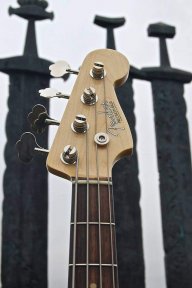
A shot of the headstock of my AmProPrecision. I love the way the grain seems to emanate out from the D-string tuning post. Going to string it up with flats in a couple of days.
[Invalid or Expired Link Removed]
[Invalid or Expired Link Removed]
Indeed, very nice!
I kind of like more the "CORONA, CA" than the "MADE IN U.S.A.".
I kind of like more the "CORONA, CA" than the "MADE IN U.S.A.".

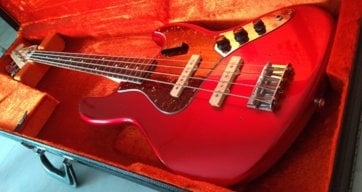
Your bass sounds and looks terrific -- congratulations!The Pro Precision antique olive green bass arrived today. Some initial observations; pic at the bottom.
Soundwise it's very similar to the recent American Standards, maybe a tad more high mids and growl but it could be my imagination. Here’s a quick sample, volume and tone full on: [Invalid or Expired Link Removed]
Fit and finish is good, although there's fine, small scratches all over the bass. These can only be seen when the light is just so, and this is something I see on many other basses. I know it's just the polishing but feel compelled to mention it because I don't see as much on my Olympic White American Standard pbass, because it's, well, white!
Love the color. This was a bit of an impulse buy because it's been a long time since we've seen an American Standard (professional in this case) bass color outside of a burst, white or black.
The neck profile feels really good and the frets are great. I barely notice the frets when playing; certainly less noticeable than the typical jumbo frets. And is it my imagination or are the pole pieces in the pickup a little smaller than the vintage ones in the American Standard?
The tuners and bridge are nothing we haven't seen before but the tuners are more fluted than before. I really like the new elite case.
I do my own setups but I do have to mention that the setup is great. I purchased this bass from Sweetwater and there's a card inside the case that indicates they went over the bass, so props to them for a job well done in that department.
[Invalid or Expired Link Removed]
G&L and Suhr provide neck specs on their websites.Fender is not the lone offender here. It’s not a wide-spread practice to provide complete neck and string-spacing info beyond nut width. Ibanez does well; few others do. Manufacturers provide information as if the purchase is made in a retail store when in reality the market is online. I find this frustrating.
If a bass is assembled and finished in America, they should be able to say made in America. Then in the manual say some parts were purchased from overseas.

The Pro Precision antique olive green bass arrived today. Some initial observations; pic at the bottom.
Soundwise it's very similar to the recent American Standards, maybe a tad more high mids and growl but it could be my imagination. Here’s a quick sample, volume and tone full on: [Invalid or Expired Link Removed]
Fit and finish is good, although there's fine, small scratches all over the bass. These can only be seen when the light is just so, and this is something I see on many other basses. I know it's just the polishing but feel compelled to mention it because I don't see as much on my Olympic White American Standard pbass, because it's, well, white!
Love the color. This was a bit of an impulse buy because it's been a long time since we've seen an American Standard (professional in this case) bass color outside of a burst, white or black.
The neck profile feels really good and the frets are great. I barely notice the frets when playing; certainly less noticeable than the typical jumbo frets. And is it my imagination or are the pole pieces in the pickup a little smaller than the vintage ones in the American Standard?
The tuners and bridge are nothing we haven't seen before but the tuners are more fluted than before. I really like the new elite case.
I do my own setups but I do have to mention that the setup is great. I purchased this bass from Sweetwater and there's a card inside the case that indicates they went over the bass, so props to them for a job well done in that department.
[Invalid or Expired Link Removed]
Regarding the poles, the tops look to have a heavy bevel, similar to the Fender Original (former 62RI). Probably gives the appearance of them being smaller.

I don't get the point of the '63 neck profile. Part of the magic of the '63-ish necks were both the profile, the width and the radius. Why didn't they make it 1 11/16" with a 7.25 radius instead?

I wish they offered the Antique Olive 5 string with a rosewood board.... I wonder why Fender limits their options with their 5 string offerings...!!


