
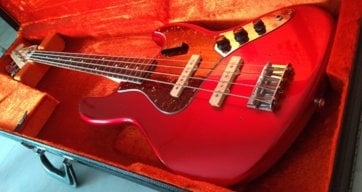
Here my CS Dakota Red. It’s also availableI vote Dakota Red, but the CAR also looks great. Can’t really go wrong either way.

TalkBass has been independent since 1998. Add your voice.
Create a free account to reply to discussions, view embedded media, and browse with fewer display ads.
Join free Log in
Want zero display ads or expanded classifieds tools? Compare plans.
Here my CS Dakota Red. It’s also availableI vote Dakota Red, but the CAR also looks great. Can’t really go wrong either way.


+1
I can truly say that out of all of the basses I've owned and currently own, there is something about the Pino that makes me not want to put it down after picking it up. All of the things mentioned above....plus I can't put my finger on it but it's got some sort of mojo, feel, and tone to it that no other bass has that I've ever played. I can confidently say that it's my #1 out of all of my basses. Here's a video of me gettin' down with it!
Midak, you're killin' me! (Where did I put that credit card?)

Search and see as many pictures as you can from your top color choices, then make your decision.Thanks guys! All those pics really screwed up my color choice!! I want them all!!!!! Based on what I have already I think Candy Apple or Dakota red is the best choice for now. And I think Midak just solidified a tort pickgaurd is the answer for me. Really appreciate the input!
But it was. I believe the color combo you have to opt for is the one that makes you smile on the vast majority of occasions; there will be times of drooling other finishes because of one nice photo or just you being accustomed to yours, but if eventually your choice dominates, you have played it right. 

I wanted to keep the list as short as I could, but 'Betsy' is always nice.


Your Aztec beauty is really unique, definitely one of the colors that one keeps with pride.It sure does, bro..! Watched that video so many times before getting my Jazz...can’t go wrong with any of the reds really, but I’ll never ever be regretful that I went for the gold...

Its shade is something in between Firemist and Shoreline Gold, so I say yes.

I am about ready to order a Fender Custom Shop Jazz Bass team build. I hope I'm in the right forum and sorry in advance if I'm not. I want to order the stacked knobs on the bass. Can anyone tell me the difference in tone from stacked vs V/V/T configuration? By your experience of course.

I'm getting that fizzing sensation!And now, some awesome pictures from CME, all featuring stacked-knobs Jazzes.
View attachment 3711321
I have a Flea Jazz that is also stacked pots, but sounds very different from the CS Jazz due to the pick-ups, body, etc., so a comparison is hard.
I always wondered what the hell was up with that Flea bass...it’s so aggressive sounding...more like a ‘70s jazz to my ear...if it’s the pickups I gotta say I think they got it wrong....that bass would be so much better if it had that darker ‘60s jazz sound...
I’m just referring to every demo I’ve seen of that bass and a very short demo I had with one...the bass sounded very bright when slapped and plucked, very similar to an AVRI ‘75 I used to own..the CS ‘64 nailed that darker timbre that I shoot for with ‘60s Fenders...that darker “that’s definitely an alder body with rosewood” Larry Graham tone...I played a Fender Select all passive that was great at it too..I was very surprised that the Flea sounded so different...not bad, but not what I would look for from a ‘60s Jazz...Not sure that the pink Fender Road Worn Flea I have actually sounds like Flea's pink Jazz. Could be, just don't know. Are you comparing basses, or recordings of basses?
I’m just referring to every demo I’ve seen of that bass and a very short demo I had with one...the bass sounded very bright when slapped and plucked, very similar to an AVRI ‘75 I used to own..the CS ‘64 nailed that darker timbre that I shoot for with ‘60s Fenders...that darker “that’s definitely an alder body with rosewood” Larry Graham tone...I played a Fender Select all passive that was great at it too..I was very surprised that the Flea sounded so different...not bad, but not what I would look for from a ‘60s Jazz...
perhapsThe pickups are very scooped. Can't seem to remember what they are, but they are not the same as the CS, MIA, Roadworn/Classic series—I think...???

Thanks Dr Jim! That is great info to digest. I also like the safety valve of being able to switch to a VVT if I don't like the stacked knobs.I've had 2 stack-pot Jazzes and 5 or 6 VVT Jazzes. The short answer is a good sounding set of strings on a good sounding bass is more important than the pot arrangement. VVT is easier to use, and thus IME, more flexible tone-wise.
It's simply more intuitive for dialing in a previously used sound—at least for me. Why?
The stacked pots interact in an unintuitive, even slightly chaotic manner. The position of any one pot (tone or volume) affects how the others all behave, and it doesn't seem linear. While it appears that it would be easier to adjust things by touching one stack pot, it often requires ALL four to be moved to get from one desired timbre to another.
I got a CS early '60s Jazz relic duotone (ash and alder body, pic below) in 2014. It is a great sounding and feeling bass, which came with stacked pots. I played it a lot that way for several years, but decided to switch to VVT because I liked how I could dial-in familiar tones on the VVT 64 AVRI Jazz and the Roadworn Jazz I also have. It wasn't just more familiar—I'd gotten used to the stack pots—it was faster to get what I want. Less adjusting to get to the tone desired, and more reliable to nail it with less twiddling and tweaking—as much as I love to twiddle and tweak, LOL.
The VVT set I got was from these folks: Guitar Parts for Madisons Music Store
Naturally, I can switch back when I wish. I have a Flea Jazz that is also stacked pots, but sounds very different from the CS Jazz due to the pick-ups, body, etc., so a comparison is hard.
Bottom line is that for me, the VVT is more useful musically, but not particularly different sounding.
Pics:
View attachment 3712040
Any thoughts on a compound radius on the neck? My guy tells me I can get lower action with this option?

Since strings are straight, I am not sure how that could true. Seems like a physics issue. Of course I could be wrong.Any thoughts on a compound radius on the neck? My guy tells me I can get lower action with this option?


