Awesome, G-Dog. Thanks for all you (and your minions^H^H^H^H^H^H^Hconsultants) do here!
Agreed! So much helpful info archived in one place, plus a helpful group of Rumblers on TalkBass!

TalkBass has been independent since 1998. Add your voice.
Create a free account to reply to discussions, view embedded media, and browse with fewer display ads.
Join free Log in
Want zero display ads or expanded classifieds tools? Compare plans.
Awesome, G-Dog. Thanks for all you (and your minions^H^H^H^H^H^H^Hconsultants) do here!


Awesome, G-Dog. Thanks for all you (and your minions^H^H^H^H^H^H^Hconsultants) do here!
Agreed! So much helpful info archived in one place, plus a helpful group of Rumblers on TalkBass!


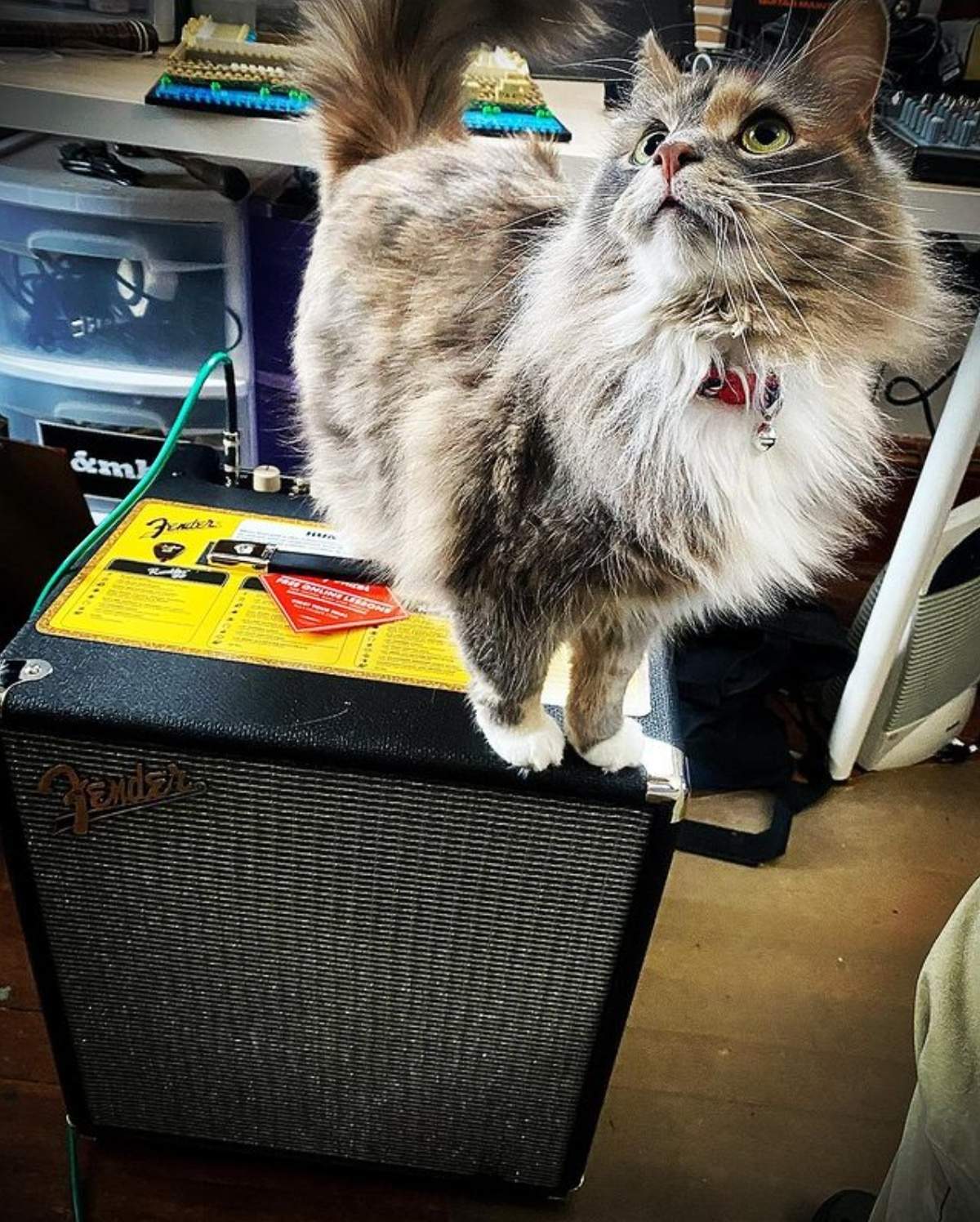
Fender Rumble 100 (Amazon Warehouse return, still factory sealed). Willow approves...
You can't fool me that easily. At least put the leftover Legos away. Clearly the amp and cat are both built from Lego bricks!
Well, the one I'm working on (Great Pyramid at Giza -- I build just a bag a day as to "savor the flavor") is big enough that I probably could make a whole cat out of it...
Fender Rumble 100 (Amazon Warehouse return, still factory sealed). Willow approves...
Check the Rumble Club Wiki referencing lining R100(and smaller)cabs.Hi there,
I’m currently using a modest Rumble 40 and unless i’m playing at very low volume i can hear the front port fart noise on the lowest E string notes around G/A...
Removing the grille i was surprised to find just 2 basic circular holes in the front wood panel...
What about the bigger Rumble models ? Do you guys have port noises too ? Are ports on those also simple holes in the wood or something crafted better to tune the cab ?
Check the Rumble Club Wiki referencing lining R100(and smaller)cabs.
Hi there, ... I’m currently using a modest Rumble 40 and unless i’m playing at very low volume i can hear the front port fart noise on the lowest E string notes around G/A... ... ...
Hi there, ... I’m currently using a modest Rumble 40 and unless i’m playing at very low volume i can hear the front port fart noise on the lowest E string notes around G/A...
Removing the grille i was surprised to find just 2 basic circular holes in the front wood panel...
What about the bigger Rumble models ? Do you guys have port noises too ? Are ports on those also simple holes in the wood or something crafted better to tune the cab ?

Aloha, 54! @54 RPM, you are now member #1580 in the Fender Rumble Club. Congratulations and welcome. Please put that number in your TalkBass Signature for safe keeping. Then make yourself at home here and on your Rumble Club Wiki page, the repository of all Rumbling wisdom and knowledge.
Have you tried "softening" around some of the edges of the offending port(s) with some acoustic material to see if that helps? The 200 & 500 come with acoustic lining already in them, but the 100 and smaller do not. The Rumble Modifications section of your Rumble Club Wiki page has a few links about adding acoustic fill or lining. One Rumbler there even stuffed socks into his R40 port(s) to good effect! You might try something like that as an experimental start.
How about telling us a bit about yourself, 54, such as your bass experience in general and your Rumble journey in particular? We have all kinds here, so you're bound to fit right in. But we all love to ... ... ...
Rumble On!
.



The Ampeg 210 AV is rated at 200 watts. The Fender Rumble 210 is rated at 700 watts (program), 350 watts (continuous). The Fender is going to handle nearly double the power going into it. It is going to handle the more power you are wanting to push it with with much, much less chance of ever hurting the speakers. It will also remain clean and clear at that higher volume. It was designed to magnetically hold either the Rumble 200 or 500 heads which shows you just how much faith Fender puts in the Rumble 210.I love my Ampeg 210 AV cabinet and it handles most of my gigs well. However, there are times when I need to push it right up to what it can take. I'm researching a better 210 option and would like some input on whether you all think the Rumble 210 cabinet would be an improvement in loudness or basically a lateral move in relation to the 210 AV. Thanks for any help.
Thanks for posting the pic, @G-Dog ! I was just about to pull the grill off my Studio 40 and take a look-see. You saved me the effort. Does the Studio 40 using a preset with the Ragin' Peg SVT amp and 8x10 Vintage cab sound just like an Ampeg SVT head with a fridge cab? Nope. But it ain't half bad! A Stage 800 plus 3 2x10 cabs might get close.54, I just now took this pic of one of the ports on my Rumble Studio 40 showing the rounded port edge, the ~1" long port tube, and the acoustic lining inside that it came with!! I was surprised, at first; then I remembered that the Studio also has a switchable horn that the regular 40 does not. In general, the main Rumbles are, after all, intended to be a low cost, "value line" of amps.
Excellent and thank you for taking the time,The Ampeg 210 AV is rated at 200 watts. The Fender Rumble 210 is rated at 700 watts (program), 350 watts (continuous). The Fender is going to handle nearly double the power going into it. It is going to handle the more power you are wanting to push it with with much, much less chance of ever hurting the speakers. It will also remain clean and clear at that higher volume. It was designed to magnetically hold either the Rumble 200 or 500 heads which shows you just how much faith Fender puts in the Rumble 210.
The Ampeg is also a sealed infinite baffle cabinet so you only hear the front of the speakers. The Fender is a correctly, scientifically, musically ported cabinet which allows the speaker to "breathe" and you will be hearing the back of the speakers as well as the front. The Fender will produce much better and smoother lows due to the porting. You might find yourself adjusting the eq on your amp just a little, which would be normal.
In a side by side comparison, the Fender would have a much better tone and be able to go louder. It will also fill the room with a much more satisfying bass feeling for a player and most definitely for the audience.