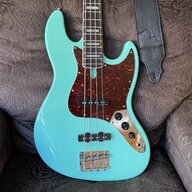
Sure looks like two basses in that pic!
Yep. I just got a G&L Tribute Series Kiloton 4S about a week ago. The black one in the pic. The natural/stained one is the Yamaha RBX350.

TalkBass has been independent since 1998. Add your voice.
Create a free account to reply to discussions, view embedded media, and browse with fewer display ads.
Join free Log in
Want zero display ads or expanded classifieds tools? Compare plans.
Sure looks like two basses in that pic!

You got a good deal. Yes, ol' Jim had a long and storied history. I went to college in Stevens Point and after bought a lot of stuff at Laabs and Jerry's Music in Wausau. I lived in Minocqua, but grew up in Merrill, where I live now.Wow, not much chance anyone on TB would ever mention Jim Laabs music. Not always easy to deal with back in my youth but I got a few things there over the years.
My dad and his brother both worked there giving accordion and piano lessons when they were in high school and college. I was there not to long ago and Jim is still there. He has to be in his 80's by now.
I actually got this amp from another UWSP student fir $75.
I thought(?)that you could small converters that plugged into the wall socket.When shipping via LTL container (I know you know what that stands for) by sea, volume is what you pay for, not weightll (I paid per cubic foot and it wasn't cheap). And power converters take space and cost money. I went from an 1800 sq ft townhouse to my current 550 sq ft apartment (big by French standards!). I'm happy to dedicate floor space to my basses, but I've got no space for converters. My MIDI keyboard controller is under my desk as it is. I'd love to have it out next to my desk like I did in the States, but that's life. Not even close to enough of a reason to get me to move back State-side.
Also on the plus side, I replaced the 40 with a Studio 40 and I replaced the 200 with an Italian-made GR Bass AT Cube 500 combo, which I LOVE! It weighs less than 19 lbs and is CLEAN. If I want some tone other than clean, I can use the Studio 40 preamp and modeler and plug its FX Send into the FX Return on the AT Cube like you'd chain 100's. It can do a pretty convincing Ampeg fridge.

Ft. Pierce?
We (60s/70s rock and country) played there once. We weren't what they wanted, plus it was about 45 degrees that night. Minimal crowd; not our fault.Yep. Tipsy Tiki
Maybe today, but I haven't used one in so long that I can only remember the heavy toolbox-sized ones with a big ol' transformer. With the amount of current an amp could draw, I'm not sure that a little socket converter would work more than once...for one second.I thought(?)that you could small converters that plugged into the wall socket.

We (60s/70s rock and country) played there once. We weren't what they wanted, plus it was about 45 degrees that night. Minimal crowd; not our fault.
Ours was a night gig. Windy and cold. If it wasn't for friends and family, I think we had 3 people in "the crowd". We do best at VFWs, Legions, Elks, etc.I have yet to see a big crowd there and we play once a month there. Sunday afternoon gigs.



The Fender Rumble 500 combo is a great gigging amp, but I would be looking at the Rumble 800. It's priced only a little higher but has a pre/post DI, low-power mode and weighs 29lbs verse the 500's 36.5lbs.
Actually kinda wish I'd gotten the 800 but that's just because I'm power mad! Bwahahahah!
I had a Rumble 500 for just in case I needed to use it out but I play silent stages only. At home it was too much for the rest of the family.


Hello chaps - me again I'm afraid!
Considering you guys / this thread to be the "blue team", I've been getting people to "red team" my choice of a Rumble 500 in a thread elsewhere. So far, as expected, and I'm largely undeterred.
A couple of comments came up there that I'd like to ask the folk in the Rumble club about though:
The thing that's most interesting me about these is the low-power mode. Reading elsewhere that:
I've come full-circle now. Starting with a hat-tip to G-Dog who actually remembered one of my really old posts on here about running amps at low power - which I appreciated but didn't publically recognize before - I now wonder whether I'm about to end up with an amp I can't use in the house.
So, in typical bassist fashion, to solve the problem, I think I may need a bigger amp(!).
Fender lists the "low power" mode of the Rumble 800 as being ¼ of the full power, which if the overall amp is 400W, I make 100W, which is nicely equivalent to the Rumble 100 I was considering earlier.
So:
Just trying to decide whether to move up, down, or stay where I am.
- Could someone confirm that the low power switch on the 800 is an attenuator rather than a limiter? Meaning, if I engage the switch, I've still got a volume control that works all the way up, but the max volume is like a 100W amp rather than a 400W amp? As opposed, say, to the volume increasing as you turn it up to "2½" and then getting no louder between there and "10"?
- Could anyone give me a two-sentence explanation of the value / usage of the pre-/post-DI? I assume this is used, for example, to take a line out of the amp into a stage box / mixer that's going to provide a signal for FoH or any foldbacks, but since I've never done that, a quick explanation would be appreciated.
Go "blue team"!

Hello chaps - me again I'm afraid!
Considering you guys / this thread to be the "blue team", I've been getting people to "red team" my choice of a Rumble 500 in a thread elsewhere. So far, as expected, and I'm largely undeterred. ... ...
... ... A couple of comments came up there that I'd like to ask the folk in the Rumble club about though:
mcrawfordmusic said: ↑
The Fender Rumble 500 combo is a great gigging amp, but I would be looking at the Rumble 800. It's priced only a little higher but has a pre/post DI, low-power mode and weighs 29lbs verse the 500's 36.5lbs.
bill81255 said: ↑
Actually kinda wish I'd gotten the 800 but that's just because I'm power mad! Bwahahahah!
The thing that's most interesting me about these is the low-power mode. Reading elsewhere that:
furym said: ↑
I had a Rumble 500 for just in case I needed to use it out but I play silent stages only. At home it was too much for the rest of the family.
I've come full-circle now. Starting with a hat-tip to G-Dog who actually remembered one of my really old posts on here about running amps at low power - which I appreciated but didn't publically recognize before - I now wonder whether I'm about to end up with an amp I can't use in the house.
So, in typical bassist fashion, to solve the problem, I think I may need a bigger amp(!). ... ... ...
Yes, there's enough choices, and information, and opinions, available to really make the head spin. And, while I've never found my R500c to be too much for home practice, I must admit to a modicum, actually a lot, of interest in the new R800c 1/4 Output Switch, myself!! 
... ... Fender lists the "low power" mode of the Rumble 800 as being ¼ of the full power, which if the overall amp is 400W, I make 100W, which is nicely equivalent to the Rumble 100 I was considering earlier. ... ...
... ... So:
- Could someone confirm that the low power switch on the 800 is an attenuator rather than a limiter? Meaning, if I engage the switch, I've still got a volume control that works all the way up, but the max volume is like a 100W amp rather than a 400W amp? As opposed, say, to the volume increasing as you turn it up to "2½" and then getting no louder between there and "10"? ... ...

... ...
- Could anyone give me a two-sentence explanation of the value / usage of the pre-/post-DI? I assume this is used, for example, to take a line out of the amp into a stage box / mixer that's going to provide a signal for FoH or any foldbacks, but since I've never done that, a quick explanation would be appreciated. ... ...

... ... Just trying to decide whether to move up, down, or stay where I am.
Go "blue team"!
 "I'll have a blue, blue, blue Christmas ... ... "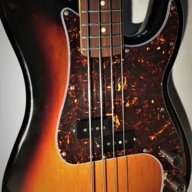
- Yes, some PA soundpersons prefer to receive a pre-EQ bass signal so they can EQ and mix it with the other instruments & vocals to their own taste, but I prefer to send them my carefully crafted post-EQ bass signal, as does every other instrument!
- Pre-EQ signals are most useful in recording, where the final tone can be crafted while mixing with the other instruments, or even a pre- (using a DI box) and a post-EQ signal (from the amp) may be recorded for blending during the mix.
. At least you are giving the sound person what you like, before he/she has a chance to mess it up. If you are the one doing the recording mix, it's all up to you anyway .
Which is why on the last gigs we had sound men(2015), I had them take a line out offa my amp. At least my amp put out what I wanted. IDK what they did to it in the mix.Makes sense to me
I hope this helps.
...
My first impulse is to check the R800c block diagram, from the manual. It shows the 1/4 Power Switch a good bit downstream of the Master control, but directly upstream of the Impedance Switch and the power amp. That indicates, to me at least (though I am no expert), that the Master would still have full range control over the signal going to that Switch & power amp. (Unfortunately, in this case, the manual doesn't elaborate on the specific circuit type of the switch.)