• TalkBass has been independent since 1998. Add your voice.
    Create a free account to reply to discussions, view embedded media, and browse with fewer display ads.
    Join freeLog in
    Want zero display ads or expanded classifieds tools? Compare plans.

Figuring-out the 5 String Concept

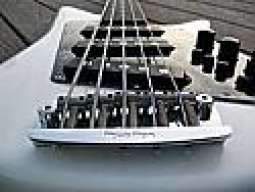
Sorry, rookie question, but I've been curious about 5 string basses and it seems a lot of people play them, and I searched but can't seem to find out what the concept is.
I have a couple questions.
1) Why is the low string a B, when it is next to the E string.
2) I know the extra string adds many more notes to the fretboard, but I see a lot of people playing in the E, A, D, G strings primarily.
Any info would be appreciated.
Sorry if this has been covered before.
Thanks.

Slackerprince
 
Since I feel more like typing instead of cleaning, I'll answer your question. :)

The 5th string is a B because it keeps the bass tuned in 4ths, AKA 5 frets apart. This means all of your fingering patterns will still work no matter where you start on the bass, so long as you still have enough strings and frets to complete the pattern.

Some people think it should be a D, like an "alternate E string with a different tuning", and there might be a few people who tune it like that, but it's a big handicap to have that E string (that you DON'T want to accidentally hit now) in the way.

Some people think that, as a B string, it should be a HIGHER string, like a guitar, and tuned to B above the G string. There are a few players who do this as well, but they're either converted guitar players who miss that weird little intervallic relationship between the G and the B, or they're bassists who play chords behind their band and PREFER the relationship, as it gives them lots of chord shapes to play with (Tim Bogert is one of these who does it with great success).

No, the lion's share of 5 string basses are strung with a LOW B. The Low B is tuned to about 31hz and is the same as the 2nd white key on a piano from the left.

The extra notes a B string gives you aren't always necessary for a given song - they're pretty stinkin' low! - so oftentimes you'll see players ignore that string for a few songs. But it's a very nice "room filling" effect when you want it.

A lot of people buy 5 strings because they think they're "better" - but my contention is, if you're not hearing notes down there, and you're not re-tuning your E string all the time wishing you could hit those notes, you probably don't need a 5 string. Lots of bassists play their entire careers without owning a 5er. It's not a big deal.
 
Prince,

Bass Guitar is tuned in fourths.... B is would be a fourth below E.

The additional string adds Eb D, Db C and B below low E. So your are adding only this amount of range (5 notes). Although it doesn't seem like a lot of range, those notes have mighty powerful low end associated with them and if used tastefully, add a great sonority to music.

Additionally, low E has a very different tone from 5th fret on the B string as opposed to the open low E. I think the fretted low E is more powerful sounding.

The additional string also provided many additional fingering options for playing lines.

Hope this sheds some light on the subject.
 
B string, 5th fret = E. That IMO is the most important thing to know as most people with 5ers rarely play on the first 4 frets on a B string.

As stated, a bass is tuned in 4ths, so a B string is logically a 4th (or 5 frets) lower than E. IMO is is too low to do much useful below low D (B string, 3rd fret) but I play quite a bit of metal that used low C.
 
B string, 5th fret = E. That IMO is the most important thing to know as most people with 5ers rarely play on the first 4 frets on a B string.

As stated, a bass is tuned in 4ths, so a B string is logically a 4th (or 5 frets) lower than E. IMO is is too low to do much useful below low D (B string, 3rd fret) but I play quite a bit of metal that used low C.

Allow me to respectfully disagree - I am very happy with the notes on my B string below the 5th fret on all 3 of my 5ers. So much so in one case that I added a Hipshot Xtender Key to the B so I could tune it DOWN to A on occasion... and I end up doing it more than I thought I would.

A lot of 5 strings just aren't built well enough to support the low frequency of a B string. The cheaper ones are hit-and-miss (my MIM Jazz V is a hit); the more expensive ones are more consistent. The new hip trend among boutique builders is to make a single cutaway neckthrough so that the bodywood can support the B string on that side, making the fundamental stand out more and not sound so "wooly".
 
Most of it has been covered above--it's a B because that's a fourth below E. It's useful when you need that extra low range. It's very handy if your band plays any songs in dropped-D. It's also handy for getting underneath a bass-heavy guitar player. In my current band I play a 6-string, and I use my B string as a root for every song in dropped-D, and there's one song that is actually in B, so I go all the way down to the open B-string to make the chorus really slam. I love the crowd reaction when we're at a venue with a good subwoofer in their PA--I hit that open B for the first time and I get a bunch of looks and smiles from the bass fans in the crowd.

And in case you're wondering why I'd play a 6-string and what the 6th string is for, it's a high C (fourth above the G), and I use it for melodic intros/outros where I'm either doubling the guitar or playing some melodic fills against the guitar part.
 
(...)I know the extra string adds many more notes to the fretboard, but I see a lot of people playing in the E, A, D, G strings primarily.

Those are the ones who bought a 5 string bass but still are 4 string players, lots of them out there...


(...)most people with 5ers rarely play on the first 4 frets on a B string.

Absolutely not true... Those are the ones we play most. All the notes after the 5th fret sound better on the E string, so we just use that...
 
Absolutely not true... Those are the ones we play most. All the notes after the 5th fret sound better on the E string, so we just use that...

"Better" and "worse" are awfully subjective terms, folks - let's be careful here.

Here's something we can agree on: The closer to the nut you play the note, the brighter and clearer it will sound. Going up 5 frets and dropping a string for the same note will yield a bigger but somewhat less defined sound. It's one of the great things about the instrument - you can choose HOW you want the note to sound by WHERE you play it. :)
 
The way you asked the question makes me think you are probably more familiar with the guitar than the bass. So, my answer would be to equate a 5-string bass to a 7-string guitar.

Fact is, most (I said most, not all) bassists have more use for a low D/C#/C than they do for anything higher than a G string would provide. In my own case, I have been known to tap chords up higher on the neck to fill in space where there would be a keyboard or 2nd guitar in some cases. The ability to tap the low E at the 5th fret on the B string is a huge help in that regard because its pointless to play the tapped part if you wind up losing the bottom end in the process.

And, of course, there is no law that says you have to tune a 5er to low B. Many folks do add the higher string instead and it works just fine if that is what you want. Or, you could just stick to 4. Its about what YOU want.
 
We can agree to disagree!:spit::D

I honestly believe that many musicians with 5ers use them as 4 strings but utilize the higher positions more often (and E in the 5th position on B). I don't see a lot of players using much below low D. Just IMO.

I personally rarely use open B and it is not due to owning cheap basses (I own or have owned 5ers by Sadowsky, EBMM, Fender, Lakland, etc.), I just find low B or even low A to be too low for the music I play.

Allow me to respectfully disagree - I am very happy with the notes on my B string below the 5th fret on all 3 of my 5ers. So much so in one case that I added a Hipshot Xtender Key to the B so I could tune it DOWN to A on occasion... and I end up doing it more than I thought I would.

A lot of 5 strings just aren't built well enough to support the low frequency of a B string. The cheaper ones are hit-and-miss (my MIM Jazz V is a hit); the more expensive ones are more consistent. The new hip trend among boutique builders is to make a single cutaway neckthrough so that the bodywood can support the B string on that side, making the fundamental stand out more and not sound so "wooly".
 
the 5 string . I have big hands and 4's feel uncomfortably narrow to me. I am a beginner so my playing certainly doesnt justify me having a 5'er. I do feel that a lot of the pro's w/5's and 6's rarely touch the B string at all. Infact a lot of them play a lot of high notes, like a lead guitar or something.
One of my goals in learning is to learn to tastefully utilize the B string so I can hold down the bottom playing some deep grooves you can feel as well as hear. Thats my dream anyway, lol.
 
I do feel that a lot of the pro's w/5's and 6's rarely touch the B string at all. Infact a lot of them play a lot of high notes, like a lead guitar or something.


You'd be surprised how many times a 5-string player is playing on the B-string but 5+ frets up for a smoother sound and easy access to higher frets. And part of the attraction to a 5-string 'for me' is that it 'can' be played without being obvious that you're lower than an E. It doesn't have to be obvious. If it adds to the song and doesn't stick out abruptly then it's appropriate.
 

Latest posts