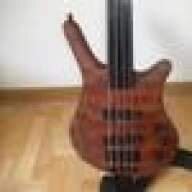
According to Jason this one is an authentic and real offer.
Well I never trusted ebay, looks like a god deal... but.... unlikely guy just put 2500 $ for this...

TalkBass has been independent since 1998. Add your voice.
Create a free account to reply to discussions, view embedded media, and browse with fewer display ads.
Join free Log in
Want zero display ads or expanded classifieds tools? Compare plans.
According to Jason this one is an authentic and real offer.

Well I never trusted ebay, looks like a god deal... but.... unlikely guy just put 2500 $ for this...
Can he not just cancle the order,rather than doing the risky ebay thing.?
A sick father sure seems a valid and good enough reason.
And the bass is only due quite some time from now.
Sure they haven't started building it yet(?).

Thank you for the kind words about the bass; I get a lot of compliments on how it looks and sounds so I'm very happy with it.IMO, this is not right. You can get ANY combination with a pan and a volume pot.
For example:
70/30 = pan: 70/30 vol: 80
70/40 = pan: 63.63/36.36 vol:88
It's just simple math. The trick is not to turn the volume up to 100% all the time.
BTW, your bass looks terrific!
I have read and re-read this many times to make sure I fully understand what you are saying, and I have given it some thought before writing this response.May be Tom7 can clear this up soon.
This is how I understand it: You are starting with a relation of 70% neck to 30% bridge at a certain volume. Let's assign the value of 80 to the volume. Now he wants to change his sound by turning up the bridge volume form 30 to 40. That actually means, that the bridge pup is now one third louder than before which also results in a higher overall volume. The volume goes up from 70+30 = 100 to 70+40 = 110. When you scale this down to 80 (the arbitrary value we have assigned to the initial volume) you eventually have a volume of 88 (10% increase). The ratio of the pups goes from 70/30 to 70/40 whereas the latter (= 1.75) scaled to 100 is 63.63/36.36.
BTW, I have my Fender Jazz modified the following way: The two volume pots have been replaced by two stacked volume knobs respectively. The tone pot has been replaced by a pull/push-pot. With the latter I can switch between the two stacked volume knobs. This gives me two presets which can be accessed very quickly.


I see what you mean,but given what seem to be the situation here some compassion might be called for.(?)
I could see a lot of people saying a "few" untrue things to get out of that because of poor budgeting and planning.
However, turning down the master volume 10% doesn't just turn down the bridge pickup, it also turns down the neck pickup as well, thus preserving the balance (ratio) of the pickups in the process, therefore all you will get is a quieter 70-30 tone and you will never get a 70-40 tone.

For me, your first sentence was the most profound, and probably the reason I have always preferred volume - volume controls over volume - pan.Of course you can achieve any ratio of the pickups related to 100%. But 50/50 is probably not the same as to get 100% out of both pickups !
Common balance pots provide the following characteristics:
Link Removed
In centre detent both ways are slightly attenuated, because the resistors in the stacked pot are effective through the whole turn ! Due to the log curve it is not 50%/50% obviously, but not 100%/100% either. Although it is 50/50 as a ratio...
To achieve a zero attenuation in the centre position you need special balance pots which are effective only on HALF of the turn. Then you can get full signal out of both pickups - as with a VOL/VOL combo.
As far as I know Joey/Mike use these special pots for the Pope pre, is that true ?
 ) basses that likewise have pan knobs, their center dent position actually represents a slightly attenuated tone from BOTH pickups, so no matter what they never have the true, full tone of their basses.
Yeah, I missed that point entirely, although I don't think it was your fault that I did.Maybe I didn't make it clear enough, but I did not say that the volume should be turned down. My crucial point was that it has to be INCREASED by 10% (80 -> 88) to obtain that 70/40 ratio.
However, there is one disadvantage with a balance/volume configuration: You have to turn two knobs instead of only the bridge volume pot in a vol/vol configuration. I could live with that.
Rats. Thank you, Mike, I was truly hoping you would answer but didn't want to impose on your time with a direct question, especially if others could answer it as well.True. Special pots. The pickups are both fully on when the balancer is centered.
The primary difference going to vol/vol as compared to vol/bal is the loading on the pickups, as vol/bal is 3 resistive loads and vol/vol is only 2. That said, the way the Fodera preamp is set up, when you're in active mode, the pickups see only balancer and tone before they hit the preamp's input buffer.
There is no way mathamatically to make a vol/bal setup behave the same way as a vol/vol setup given a totally passive environment.
It would take MUCH MORE than your average guitar tech to reverse engineer the preamp in your bass and make everything work right. And I imagine it would void the warranty. I could make you an alternative board that would give you 2 volumes, but you'd be in test pilot land on your own at that point. Reason being, the preamp is very wide bandwidth and low noise as battery powered circuits go. In order to achieve that level of performance, it counts on certain conditions in the source signal to always be present. Given the current design the conditions are always met with all the pickups Fodera uses. In your case they would not always be met.
Long and short is, it's probably not a good idea. The preamp of mine they use in the NYC bass will do volume/volume, but it won't do some of the other things you can do now.

Maybe I didn't make it clear enough, but I did not say that the volume should be turned down. My crucial point was that it has to be INCREASED by 10% (80 -> 88) to obtain that 70/40 ratio.
However, there is one disadvantage with a balance/volume configuration: You have to turn two knobs instead of only the bridge volume pot in a vol/vol configuration. I could live with that.
It is WAY more complicated than just "volume levels".
#24? That would be Kobe Bryant. Amar'e Stoudemire's jersey is just #1.Actually, 24 is the highest number.....
It is WAY more complicated than just "volume levels".
Many thanks for the information!