• TalkBass has been independent since 1998. Add your voice.
    Create a free account to reply to discussions, view embedded media, and browse with fewer display ads.
    Join freeLog in
    Want zero display ads or expanded classifieds tools? Compare plans.

Fodera Club Part XIX

Status
Not open for further replies.
I didn't use steel wool, instead going with the instructions on the web site of using a soft cloth. I had to wipe it down fairly hard first (without oil) to get rid of accumulated gunk as this bass gets played a lot. Then wipe on, let sit for a few minutes, wipe off. I went across the grain but since I was using cloth instead of the steel wool I didn't notice any issues.
The reason steel wool is nice is it tends to scrape off the gunk whereas pressure with a cloth may tend to press some down into the grain.

There's a few ways I prefer to deal with gunk on an unfinished board...

1.) Don't let it build up in the first place, by cleaning the board every so often with a safe cleaner oil.

2.) Clean it off with light pressure steel wool with/without cleaner oil. Just watch out for steel fibers around pickups.

3.) Clean it off with light pressure cloth with cleaner oil.

In all three cases, however, do NOT let the cleaner oil sit on the board. Always wipe it as clean/dry as possible as soon as the gunk removal is complete.

And don't forget to also use an actual board conditioning oil as needed as well. All open grain boards will need oil at some point, and even being quick to avoid letting cleaner oils sit on the board, they will tend to accelerate the need for re-oiling.

IMHO/IME!

 
The reason steel wool is nice is it tends to scrape off the gunk whereas pressure with a cloth may tend to press some down into the grain.

There's a few ways I prefer to deal with gunk on an unfinished board...

1.) Don't let it build up in the first place, by cleaning the board every so often with a safe cleaner oil.

2.) Clean it off with light pressure steel wool with/without cleaner oil. Just watch out for steel fibers around pickups.

3.) Clean it off with light pressure cloth with cleaner oil.

In all three cases, however, do NOT let the cleaner oil sit on the board. Always wipe it as clean/dry as possible as soon as the gunk removal is complete.

And don't forget to also use an actual board conditioning oil as needed as well. All open grain boards will need oil at some point, and even being quick to avoid letting cleaner oils sit on the board, they will tend to accelerate the need for re-oiling.

IMHO/IME!

Vic, I might of missed it, but do you use boiled linseed oil? Tom B. turned me on to this in another thread. Great stuff.

In any case, I never use steel wool as I thoroughly clean my FBs with oil and a clean cloth every time I change strings (usually every 1-2 months). Very hard for gunk to build up in this timeframe IME.
 
Boiled linseed oil is used on natural finishes. A friend of mine here has a shop that specializes in Koa woodworking and is part of his finishing process. It's great stuff for natural finishes but watch out for painted stuff as a precaution.
 
What's the name of the cleaner?

The reason steel wool is nice is it tends to scrape off the gunk whereas pressure with a cloth may tend to press some down into the grain.

There's a few ways I prefer to deal with gunk on an unfinished board...

1.) Don't let it build up in the first place, by cleaning the board every so often with a safe cleaner oil.

2.) Clean it off with light pressure steel wool with/without cleaner oil. Just watch out for steel fibers around pickups.

3.) Clean it off with light pressure cloth with cleaner oil.

In all three cases, however, do NOT let the cleaner oil sit on the board. Always wipe it as clean/dry as possible as soon as the gunk removal is complete.

And don't forget to also use an actual board conditioning oil as needed as well. All open grain boards will need oil at some point, and even being quick to avoid letting cleaner oils sit on the board, they will tend to accelerate the need for re-oiling.

IMHO/IME!
 
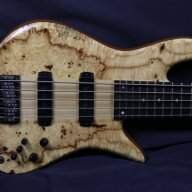
The bass is on hold :) Thank you guys for helping me with the decision!! Here is one more pic:

Link Removed

YEAH Gridchin!!!! Congratulations!! I am SOOOO jealous! Really, I'm thrilled for you. I know you're going to love that bass. And, as had been noted here, you're going to have a bass with some increasingly rare woods, which is only going to increase its value in the future (if that is even a consideration for you)! I know thats got to be the last thing on your mind, right now. We want a tone report, ASAP! When do you get it?

Wow!! VERY cool :hyper::hyper::hyper:
 
Curt, thanks for the info. Seems like quite a few species will be added to the rare list in the near future. Holly is a great looking wood and I personally have no qualms about it yellowing with age and agreed it adds a little character. I hate to throw figures around but I suspect your looking at around 3k for a Holly top? Worth every penny/cent if you really want and love it.

Easy..

Lugzy,

Not sure about prices, but I would guess that a holly solid top would be approaching $3K, maybe even more. As Jason said, narrow pieces of holly are available all day long, but not pieces as needed for a solid top bass.
 
This Holly talk is killing me, guys. I put a deposit down about a month ago for a bolt-on Monarch 4 string, black hardware (though I might go chrome), Holly top, P/J (EMGs now, but might go straight passive with Lollars, as the P pup is killing on my Fender and they overwind the J so it's matching) with Pope pre electronics, Rosewood board (but leaning Kingwood now).

*sigh*

It's gonna be a looooong 10 months.
 
...Q, Have you polished the body of your basses and given that you have a YYD (half Holly-half Ebony) will that require more care?

Lugzy,

Fodera suggests using Minwax wax. I have used it on my YY Deluxe. I must say, though, that it would be best to do it when you have strings off the bass, because it's difficult to reach every spot on the top otherwise. If you don't get everywhere, a very slight difference in gloss is left, particularly on the ebony part. It's not something you would notice unless you look REALLY closely, but it is there. There wouldn't be any issue at all if you got the wax over the entire top, equally. Hope that answers your question!
 
Do any of you guys use lemon oil on your fretboards? I have a nine year old bass with an ebony board that has been treated with butcher's wax every four years. the board is in good condition with no cracks and doesn't look dry. I was reading that lots of guys oil their fingerboards once every three months, I started feeling sorry for this bass, and my fretless (made in 2007 and butcher's waxed once in 2011) and my StingRay 5 (a 1994 and I've never put anything on the rosewood). The boards on all these basses look fine but I was feeling a bit worried so I bought some lemon oil last week. Will lemon oil be ok? Is it just for cleaning or do I need to moisturise the boards?

I also have an older five string I bought and a mid '80s Fender Jazz Bass Special. The boards on these (the custom has ebony and the Fender rosewood) are looking a little dry. Lemon oil or something different?

I should mention that I look after my basses carefully and don't sweat much. It's always nice not to sweat a lot.
 
Thank you!!! I'm really exited :bassist: I should get the bass in 3 weeks (too much time jejee). I'm not really concerned about it's value in the future, I really hope to keep it for many years and kill my GAS ;)

YEAH Gridchin!!!! Congratulations!! I am SOOOO jealous! Really, I'm thrilled for you. I know you're going to love that bass. And, as had been noted here, you're going to have a bass with some increasingly rare woods, which is only going to increase its value in the future (if that is even a consideration for you)! I know thats got to be the last thing on your mind, right now. We want a tone report, ASAP! When do you get it?

Wow!! VERY cool :hyper::hyper::hyper:
 
Talking about ebony; I've been seeing more and more people talk about the scarcity of it and how the pure black stiff is getting harder and harder to find. Well, I spent New Year this year in Sri Lanka. Wonderful country, beautiful place, amazing animals and friendly people. I highly recommend a visit. But I digress. There were loads of shops selling ebony knick knacks aimed at tourists. Little carved elephants and the like up to really big pieces. It was really quite sad to see this wonderful rare wood being wasted like this. Most of the tourists buying it had no idea of its endangered status. I have two basses with pure black ebony fretboards and one with Macassar which I understand is less threatened, but I probably wouldn't buy another due to conservation issues. At the same time, I appreciate the Sri Lanka, and other countries where ebony grows are poor and it is the people's livelihood to sell this stuff to tourists. Quite sad, as the population is growing and tourism is really starting to boom there and so I can only see the situation with ebony getting worse in the future.
 
Talking about ebony; I've been seeing more and more people talk about the scarcity of it and how the pure black stiff is getting harder and harder to find. Well, I spent New Year this year in Sri Lanka. Wonderful country, beautiful place, amazing animals and friendly people. I highly recommend a visit. But I digress. There were loads of shops selling ebony knick knacks aimed at tourists. Little carved elephants and the like up to really big pieces. It was really quite sad to see this wonderful rare wood being wasted like this. Most of the tourists buying it had no idea of its endangered status. I have two basses with pure black ebony fretboards and one with Macassar which I understand is less threatened, but I probably wouldn't buy another due to conservation issues. At the same time, I appreciate the Sri Lanka, and other countries where ebony grows are poor and it is the people's livelihood to sell this stuff to tourists. Quite sad, as the population is growing and tourism is really starting to boom there and so I can only see the situation with ebony getting worse in the future.
It's not "wasted" like that. Those people are just trying to make a living using materials that are readily available to them and highly valuable to their customers. Also, I'm betting there's lots of that wood that came from chunks that would not be suitable for a fingerboard for whatever reason(s), but are just fine for those objects.

I don't see a problem here.

IMHO!
 
Boiled linseed oil is used on natural finishes. A friend of mine here has a shop that specializes in Koa woodworking and is part of his finishing process. It's great stuff for natural finishes but watch out for painted stuff as a precaution.

I use it only on fretboards obviously.:D I believe it is Mike Tobias that swears by the stuff.

For bodies and back of neck, I use Gibson instrument polish but lately I have been using Ernie Ball Wonder Wipes instrument cleaner. Both work great but the wipes are super low maintenance. Packaged like a wet wipe and cheap.
 
Talking about ebony; I've been seeing more and more people talk about the scarcity of it and how the pure black stiff is getting harder and harder to find. Well, I spent New Year this year in Sri Lanka. Wonderful country, beautiful place, amazing animals and friendly people. I highly recommend a visit. But I digress. There were loads of shops selling ebony knick knacks aimed at tourists. Little carved elephants and the like up to really big pieces. It was really quite sad to see this wonderful rare wood being wasted like this. Most of the tourists buying it had no idea of its endangered status. I have two basses with pure black ebony fretboards and one with Macassar which I understand is less threatened, but I probably wouldn't buy another due to conservation issues. At the same time, I appreciate the Sri Lanka, and other countries where ebony grows are poor and it is the people's livelihood to sell this stuff to tourists. Quite sad, as the population is growing and tourism is really starting to boom there and so I can only see the situation with ebony getting worse in the future.
is that celyon ebony? It's repalced by macassar or garbon because of the high price
 
Well, if that Taylor Guitar video is accurate, the only place on earth from where ebony can be currently, legally, imported is Cameroon. The video states that every other country has had its supply of the wood harvested to the point that there is no more to be had from anywhere else. I find that difficult to believe, but I can't claim any other knowledge that's different. The video also implies that Taylor is the owner of a company that imports 75% of all the ebony that comes in to the U.S., if I understood his statements correctly, that this supply is what goes to most all of the guitar manufacturers. Again, amazing to believe that giants such as Gibson would allow Taylor to control their wood supply...
 
Status
Not open for further replies.