• TalkBass has been independent since 1998. Add your voice.
    Create a free account to reply to discussions, view embedded media, and browse with fewer display ads.
    Join freeLog in
    Want zero display ads or expanded classifieds tools? Compare plans.

Double Bass Fretless Acoustic Bass Guitar?

yes, I have one, they are louder than most abgs but the low e is still weak and lacks a lot of fundamental. Tuned up to A they are a little better.. however a guitarrone is louder and has more fundamental than a 1/8 size bass even if you rig it to have a low string...

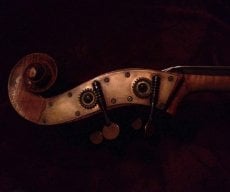
Here is a picture of size difference for fun.

one extra bit I will add... IMOP if the 1/8 bass have a very lively carved top vs plywood I'm pretty sure the low e would be better.. but how much?

IMG_0105.jpg
 
Here is a picture of size difference for fun.

one extra bit I will add... IMOP if the 1/8 bass have a very lively carved top vs plywood I'm pretty sure the low e would be better.. but how much?

View attachment 4156643

It’s all physics, and the volume of the sound chamber will directly impact the frequencies which project. There’s probably nothing wrong with most E-strings on ABGs etc - It’s just that once the sound gets into the top and resonates in the sound chamber, it doesn’t find a nice resonant “41 hz” in that chamber to provoke into speaking out.

All of this is “in comparison to”, of course. Most good cellos have a beautiful low end - by the standard of cellos. Double basses, of course, were invented to “double the bass” – which was the cello :) - an octave lower, necessitating a far larger resonant chamber. No real surprise that something that doesn’t have the physical volume of a double bass body won’t necessarily sound as full as a double bass.

Having said that, much smaller instruments than that - like the tabla - can put out those low frequencies. They just can’t do it loud (case in point – that Acme Low B speaker). So my own approach is to get it in balance across the frequency spectrum - then turn it all up.
 
  • Like
Reactions: KUNGfuSHERIFF
It’s all physics, and the volume of the sound chamber will directly impact the frequencies which project. There’s probably nothing wrong with most E-strings on ABGs etc - It’s just that once the sound gets into the top and resonates in the sound chamber, it doesn’t find a nice resonant “41 hz” in that chamber to provoke into speaking out.

All of this is “in comparison to”, of course. Most good cellos have a beautiful low end - by the standard of cellos. Double basses, of course, were invented to “double the bass” – which was the cello :) - an octave lower, necessitating a far larger resonant chamber. No real surprise that something that doesn’t have the physical volume of a double bass body won’t necessarily sound as full as a double bass.

Having said that, much smaller instruments than that - like the tabla - can put out those low frequencies. They just can’t do it loud (case in point – that Acme Low B speaker). So my own approach is to get it in balance across the frequency spectrum - then turn it all up.

Again this is all known and had nothing to do with what I said. I am really stating to think that most people on this form don't actually know how to read a full post and think about it before the need to nerdsplain...
I understand the relationship between body size and freq. But sadly for you that is not the point I was making.
First you go [when you can due to plague] to a double bass shop. You play all the sizes they have and different constructed basses. then report back and we can talk about body size vs soundboard efficiency and effect on freq.
 
Again this is all known and had nothing to do with what I said. I am really stating to think that most people on this form don't actually know how to read a full post and think about it before the need to nerdsplain...
I understand the relationship between body size and freq. But sadly for you that is not the point I was making.
First you go [when you can due to plague] to a double bass shop. You play all the sizes they have and different constructed basses. then report back and we can talk about body size vs soundboard efficiency and effect on freq.

Wow.

[clicks “ignore” button]
 
Last edited:
This discussion occurs regularly on the bass guitar side of forum, but only rarely on the DB side. It tends to go all over the place. I think there are a bunch of different problems that people are trying to solve. There’s the sound quality problem, the sound volume problem, the portability problem, the skill problem, the appearance problem, the electric power problem.

The volume problem is that there is really no ABG loud enough to be heard in any situation louder than perhaps a single quiet acoustic guitar player. The unplugged ABG is a great solution for bass guitar practice without being tethered to an amp, or jamming with one polite friend.

The portability problem is potentially solved with a foldable bass or a 1/4 size or 1/8 size bass, but that still begs the volume problem. Once you admit that you need amplification, the EUB is a viable solution to the portability problem, too.

The electric power problem can be solved with a battery-powered amp, of which there are a handful at various price points, or a big battery pack with a power inverter if you aren’t also trying to solve the portability problem.

The appearance problem is “I’m playing ‘unplugged’ with some acoustic guitar players, and my electric bass just looks out of place.” For these people, the plugged-in ABG is the unplugged solution. You might get away with a low-key natural finish electric bass. Some might go with the upright, but that bumps into the skill problem. The other appearance problem is “People expect to see an upright bass for this style of music.” Modern audiences expect to hear the bass, too, so almost every performance situation includes amplification, and you get to deal with feedback along with having a big bass and an amp to carry around.

The sound quality problem is “How can I make my bass guitar sound more like an upright bass?” The simple answer is usually something like “P bass with flats, roll off the treble, reduce sustain.” The more complicated answer is “Fretless Rob Allen or Rick Turner or Veillette or …” and maybe a fretless ABG with tape wound strings is a cheaper solution, and of course this still leaves the volume problem.

The skill problem is generally posed as a snarky response “If you want an upright bass sound, play an upright bass.” Yes, of course, and no doubt that leads many (myself included) to break down and pick up an upright bass. That’s a commitment that exceeds the desire for most players, though. (For the DB players, this is not a problem, but it makes me wonder how many upright players can’t play bass guitar at all. None that I know personally!)

If you’re a bass guitar player and you want to play with a folk, bluegrass, gypsy jazz or small swing band, learn to play the upright. You can do it! It is a rewarding pursuit. In those situations, you’ll be playing unamplified a lot. If you want to play in an early jazz band, maybe you should learn to play the tuba, but that’s an entirely different adventure. If you want to play in a modern mainstream jazz group, you might get away with a Rob Allen or the like, depending on the group. You’ll still need amplification even if you’re playing upright. You might need an upright to solve the appearance problem. Jazz audiences expect to see the big bass and might be disappointed to see an electric bass.
 
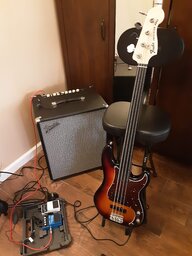
I do what the OP is starting to do. I tried a lot of things and nothing really worked, as several in this thread have stated. What I use now, that gets me as closes to what the OP is looking for, is an Ibanez UB804 and Fender Rumble 40.

I regularly transport both in a Mazda Miata, BTW :)
 
  • Like
Reactions: paulhenry
I will add that I am in the process of defretting a guitar-scale ABG. I will use flatwounds tuned up a bit from standard to get the right tension. The real secret sauce, however, is that my Rumble Studio 40 amp has 6 Acoustic Sim models that REALLY have the capacity to make things sound like DB. I literally cried when I played my EUB through model #3, because it reminded me of my DB that I played for 15 years before donating it to a local school. Digital trickery has come a LONG WAY. Fender ought to put those acoustic sims in a pedal - but they don't need me to tell them how to make money.
 
I do what the OP is starting to do. I tried a lot of things and nothing really worked, as several in this thread have stated. What I use now, that gets me as closes to what the OP is looking for, is an Ibanez UB804 and Fender Rumble 40.

I regularly transport both in a Mazda Miata, BTW :)

My five-string Rob Allen MB-2 is by far my favorite non-upright bass, for just about any situation. That, with my Acoustic Image Coda and a shoulder bag full of odds and ends, is a one-trip load and unload. I wouldn't mind taking them on public transit.
 
My five-string Rob Allen MB-2 is by far my favorite non-upright bass, for just about any situation. That, with my Acoustic Image Coda and a shoulder bag full of odds and ends, is a one-trip load and unload. I wouldn't mind taking them on public transit.

The Arco is a big beast but reasonably light; with my Streamliner on my shoulder and the 30 pound Acme Low B in hand it’s a fairly easy one-trip. But I’ve taken to accessorizing (a collapsible mic stand for my iPad holder, a music stand, etc) and that’s been enough to make a separate trip with the Arco prudent so I don’t jostle the bridge. Maybe someday I’ll McGyver some sort of bridge guard for the Arco during travel.

Actually, you got me thinking - maybe this, chopped down a bit:

9CB49FA1-1969-4A5A-8BC6-D2486DF5684C.jpeg

Link Removed
 
Last edited:
The Arco is a big beast but reasonably light; with my Streamliner on my shoulder and the 30 pound Acme Low B in hand it’s a fairly easy one-trip. But I’ve taken to accessorizing (a collapsible mic stand for my iPad holder, a music stand, etc) and that’s been enough to make a separate trip with the Arco prudent so I don’t jostle the bridge. Maybe someday I’ll McGyver some sort of bridge guard for the Arco during travel.

Actually, you got me thinking - maybe this, chopped down a bit:

View attachment 4157973 View attachment 4157973

Link Removed
I got a mooradian 1/8 size gig bag with shoulder straps for my Arco. Amp goes on a luggage cart. Conversely, I can put the Arco on a Bass Buggy, and put the smaller amp ( PJB PB-100) in a hard shell drone backpack with accessories. Voila!
 
Last edited:
  • Like
Reactions: kerryg
In my experience, plucking way over the fingerboard is a big part of what gets you close to an upright sound on a bass guitar... That is not going to project well though. I don't have any advice other than hiding one of those little phil jones amps nearby - they are so small and light it isn't a big deal to bring it with I guess.
 
  • Like
Reactions: Neon Scribe
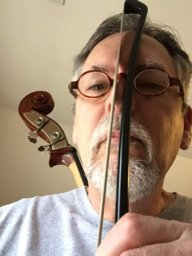
Well, I missed the source of the argument there, but I would point out that the "Arco" instrument pictured appears to be roughly the size of a cello or a 1/8 bass so it's not surprising it can yield more volume than the usual ABG. The player is also playing it in an upright position with what looks like double bass or cello technique, so it doesn't look like it's a slam-dunk for electric bass players who want to get close to the upright.

The picture of the guitarron with (what I believe is) a 1/8 bass does not show you the key point with the guitarron which is its very deep body with turtle back construction. This adds resonant chamber volume without adding length. I would point out that while guitarrones in mariachi can be darn loud, their technique is not electric bass technique or double bass technique. Mariachi players typically hold the thing with the top at something like 45 degrees to the ground and pluck two strings at a time, generally in octaves, by pulling them straight up from the board with thumb and index fingers (when I see these guys I can't imagine how they don't all come down with wicked carpal tunnel syndrome). I suspect that if you try to play guitarron with electric bass technique it won't be loud like it is when real guitarron players play it.

Guitarron tuning is also not bass tuning - in fact it's the intervals of guitar tuning but starting on A.

Really, the P bass with flats and a small battery amp passes all the criteria except for appearance.
 
  • Like
Reactions: paulhenry
The Arco is a big beast but reasonably light; with my Streamliner on my shoulder and the 30 pound Acme Low B in hand it’s a fairly easy one-trip. But I’ve taken to accessorizing (a collapsible mic stand for my iPad holder, a music stand, etc) and that’s been enough to make a separate trip with the Arco prudent so I don’t jostle the bridge. Maybe someday I’ll McGyver some sort of bridge guard for the Arco during travel.
A bridge guard??? Just be careful. Whacking a bridge guard will probably damage your top.
 
Last edited by a moderator:
@KUNGfuSHERIFF

On weak Pirastro E string

Lesser tension string, producing lowest notes, on the edge of the fingerboard and pulled towards the player. At least for me weak Pirastro E is more about pizz playability than the quality of the instrument. A weak Pirastro E is weak on a weak bass just as much as it is on a great bass. If my memory serves, you always want to mention that there`s " science " to the Pirastro E, so where`s the actual research, data and numbers to this science?

You know, it`s not only me. I read and hear top professional orchestral and jazz players with superb instruments mention " notoriously weak Pirastro E`s ". A player and a bass can like or dislike Pirastro tension configuration but IME and IMO it`s just that, a matter of preference, and about differences of individual players and instruments.

Sorry for partial derail.
 
Last edited:
Sure thing. As far as I can tell after trying just about every string that’s been on the market for the last 70 years or so, light Pirastro Es are an institutional throwback to the gut days, when overly heavy Es and Ds sounded like a timpani played pizz.

People who’ve been around will tell you that your average 3/4 bass simply doesn’t have a corpus big enough to pump fundamental, but if you’re lucky enough to have something really resonant like this remarkable old German thing I have that’s been played half to death, an E that feels too light for the set will pump bass while still producing a free, open sound.

I don’t have the equipment to measure it, but I hear what I hear. Fair enough?
 
Another ABG I found that seems in the style of the Tacoma...unfortunately list is $1800, which is significantly over the OPs target.

Model Furch Bc 61-CM 4 - Bass Guitar Models - Furch Guitars

FWIW I have no $ target. My goal (and thank you all very much!) was to get opinions from fellow players. I have lots of info to follow up on now. In my OPost, I mentioned the price as one of the attractive features of the Breedlove. That was all!
 
  • Like
Reactions: DrMole and Wasnex

Latest posts