Here's what ken's link goes to, for those of you who didn't click on it. it's a good post, with some good followup you might want to look at as well...
snip kens' post:
This is a copy & paste of a post of mine done elsewhere. It was my response to the question, "Can skijump be permanently repaired?"
But first... Some may not know what skijump is, so a brief description is in order. Skijump is an abnormal forward bow/bend in the neck at roughly the neck/body joint, which is usually about the 12th fret. This bend results in action that is very high at the 12th fret. The instrument is usually playable up to about the 9th or 10th fret, with unplayably high action until about the 18th or 19th fret. Trussrod and saddle adjustments cannot compensate for skijump.
Can skijump be permanently repaired? Sometimes maybe, but everything I've read and learned says that it's pretty much permanently disfigured. It can usually be repaired, and the repair may last for several years, but the repair rarely is permanent over the life of the instrument.
The root of the problem is that the wood of the neck isn't as strong as it needs to be, particularly in the area of the neck/body joint. This basically means that it can affect ANY neck type - bolt-on, set, or thru, though it's most often seen in bolt-on necks due to human involvement. This is not a problem that will affect all necks, and is actually unusual. However, for those necks that may be more susceptible to skijump, the problem's onset can be hastened and/or exacerbated by improper neck tilt adjustments, whether via adjuster or shim.
3-bolt necks with the MicroTilt (Fender) or Precision Tilt (G&L) are, by design, really no more susceptible to skijump than non-adjustable necks. Where they run into problems is when users over-adjust the tilt then over-tighten the neck screws, which can force a skijump through the mechanical clamping action of the neck screws. It's a matter of where the neck screws are located relative to the position of the outboard end of the body pocket and the tilt adjuster. If you raise the neck heel enough with the adjuster then really crank down on the 2 neck screws nearest the outboard end of the body pocket, it is possible over time to draw the neck into a skijump bend. While a bunch of people over-adjust the tilt (at least at first), the lion's share of the problem here is the over-tightening of the neck screws. I've bought (and sold off) a badly skijumped bass where this was exactly the cause of the problem. I currently own a 25 year old bass where the 3-bolt neck has been properly adjusted using a fair amount of tilt and just enough tightness on the screws to keep the neck perfectly in place and there is zero skijump in evidence.
Shimming can create the same sort of problem as adjusters but it takes a little more effort to screw things up. In my experience, it's best to place shims at neck screw locations (with holes punched in the shims). Then the neck screws are carefully tightened, but not over tightened. If shims are placed outboard of screw locations and the neck screws are over tightened, the same clamping action described above can cause problems. It's also worth noting that the middle screws on 6-bolt necks especially need to be carefully tightened. Perhaps a thinner shim can be placed there in addition to the shim used to create the tilt.
In the end, it's just a mechanical problem stemming from the strength (or lack of enough strength) of the neck wood. The bad part is that humans sometimes don't help much. There is no way of knowing ahead of time, or during the manufacturing process, if a given neck may be susceptible to skijump. It is literally the luck of the draw. It's also worth noting that even with a neck that may be susceptible, proper use of tilt adjustments and neck screw tightening will probably help avoid the problem all together.
Michael Dolan is a well respected luthier in Santa Rosa, CA, USA. What he many times does to repair skijump is plane a little bit extra from the fingerboard from about the 11th or 12th fret to the end (23rd or so). This allows for the skijump to return, which it will do, and still leave the instrument in more-or-less playable condition. He then re-frets the board and re-finishes what needs refinishing.

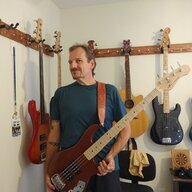


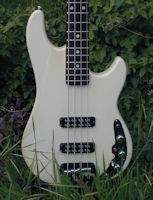


 All 6 G&Ls I owned but one were early 80s and they all set up the same. I have the g saddle nearly bottomed out, the rest set to fingerboard radius, and just a touch of tilt to get the action where I like it.