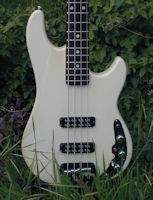
This post could easily go under "Hardware", but the work was done to my L2500 and I figured I'd share it here first...
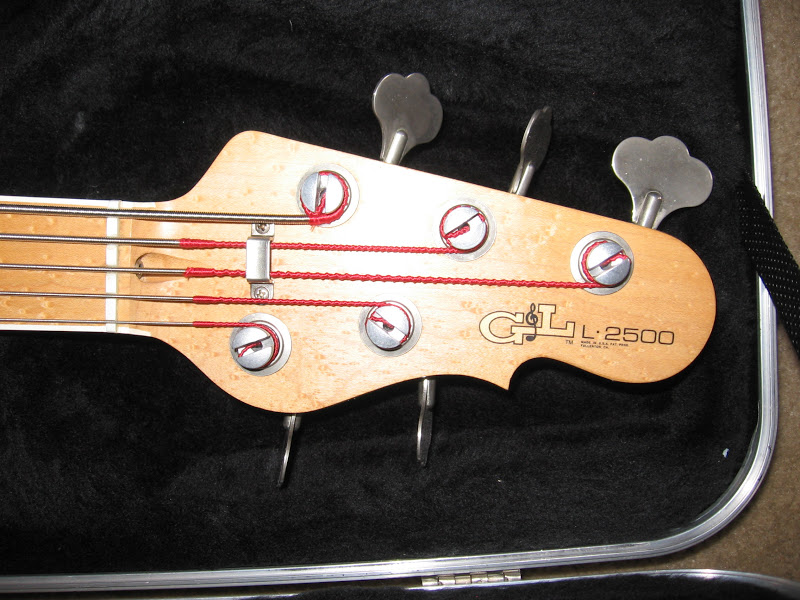
I've had my fretted L2500 a little over a year and I really loved everything about it but one thing: a previous owner somewhere down the line had really screwed up the plastic nut. It was low on all the strings, but the A-string was too low (always buzzing on the first frets) and the D-string was cut so badly that the witness-point was farther back than it should have been, making intonation a chore (I could intonate with decent accuracy off the first fret position - sorta). It was pretty obvious that someone tried to build up the slots with super-glue and white plastic dust, but it just wasn't working. I've done my own work for years, so I finally decided that it was time to put the hours into this bass, since it is a keeper. So about 2 weeks ago I pulled the old plastic nut - which was already cracked and broke into about 4 pieces - and gave it fret leveling and recrown. I also ordered a couple of nut blanks and some new nut files from Warmoth. Today I finally got to spend the necessary time to make it work. Here's a pick of the old nut on the bass:
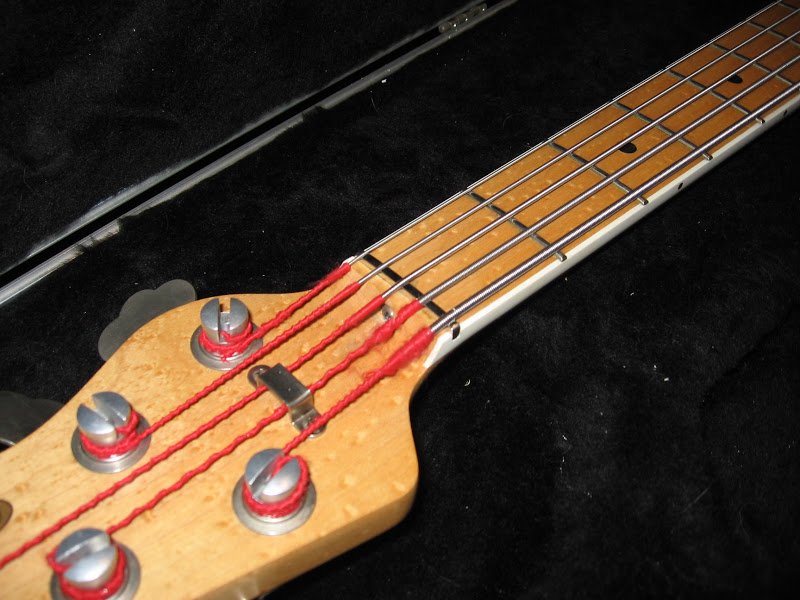
I don't have a picture of the nut blank, but it was about 1.75" long, .25" high, and .125" wide - rectangular. I used an oscillating spindel-sander to shape the bottom of the nut to match the 12" radius of the nut slot, then I laid out the slots so that the spacing between each string would be nearly the same (instead of center-to-center). I used a hack-saw to cut some meat out of the slots, then did the rest of the work with my nut files. When the slots were close, I gave it a good setup, adjusting the neck to be nearly flat, and the saddle height to feel good up high without any buzzing. Then I slowly eased each slot down, one at a time with full tension on all the strings, save the one who's slot was being cut. The last thing I did once it was exactly where I wanted was to grind off the excess material from the top such that the top of the nut is chamfered back toward the headstock and bisects each string as it sits in it's slot. Then I sanded it all down (very carefully) from about 320 to 800 grit, then used a Dremel with a polishing wheel and compound to buff it out. Here's the final result:
Sonically, it's hard to say if the nut made a difference. I do notice that the open strings sound VERY much like the low-fretted notes, though. I'm using the strings that were on before I made the changes, BTW. The intonation is MUCH better now (I use a Peterson, and now my ears agree), and the playability is much improved. Even though it had great action before the new nut, it's even better now. I was able to get the neck flatter with no buzzing on open strings AND no buzzing of the strings behind a fretted note. That happens when the neck is too flat and the nut is too low and the strings vibrate on the frets - the rattling always comes through the pickups.
It may be overkill, but it's functionally perfect, and it looks REALLY nice. Especially with the polished frets (which the picture doesn't really show as I polished them after this picture was taken). No way I'd pay someone to do it cause I know how much work is involved, but I don't mind putting the effort into it for a little "bling" on my own bass.
I've had my fretted L2500 a little over a year and I really loved everything about it but one thing: a previous owner somewhere down the line had really screwed up the plastic nut. It was low on all the strings, but the A-string was too low (always buzzing on the first frets) and the D-string was cut so badly that the witness-point was farther back than it should have been, making intonation a chore (I could intonate with decent accuracy off the first fret position - sorta). It was pretty obvious that someone tried to build up the slots with super-glue and white plastic dust, but it just wasn't working. I've done my own work for years, so I finally decided that it was time to put the hours into this bass, since it is a keeper. So about 2 weeks ago I pulled the old plastic nut - which was already cracked and broke into about 4 pieces - and gave it fret leveling and recrown. I also ordered a couple of nut blanks and some new nut files from Warmoth. Today I finally got to spend the necessary time to make it work. Here's a pick of the old nut on the bass:
I don't have a picture of the nut blank, but it was about 1.75" long, .25" high, and .125" wide - rectangular. I used an oscillating spindel-sander to shape the bottom of the nut to match the 12" radius of the nut slot, then I laid out the slots so that the spacing between each string would be nearly the same (instead of center-to-center). I used a hack-saw to cut some meat out of the slots, then did the rest of the work with my nut files. When the slots were close, I gave it a good setup, adjusting the neck to be nearly flat, and the saddle height to feel good up high without any buzzing. Then I slowly eased each slot down, one at a time with full tension on all the strings, save the one who's slot was being cut. The last thing I did once it was exactly where I wanted was to grind off the excess material from the top such that the top of the nut is chamfered back toward the headstock and bisects each string as it sits in it's slot. Then I sanded it all down (very carefully) from about 320 to 800 grit, then used a Dremel with a polishing wheel and compound to buff it out. Here's the final result:
Sonically, it's hard to say if the nut made a difference. I do notice that the open strings sound VERY much like the low-fretted notes, though. I'm using the strings that were on before I made the changes, BTW. The intonation is MUCH better now (I use a Peterson, and now my ears agree), and the playability is much improved. Even though it had great action before the new nut, it's even better now. I was able to get the neck flatter with no buzzing on open strings AND no buzzing of the strings behind a fretted note. That happens when the neck is too flat and the nut is too low and the strings vibrate on the frets - the rattling always comes through the pickups.
It may be overkill, but it's functionally perfect, and it looks REALLY nice. Especially with the polished frets (which the picture doesn't really show as I polished them after this picture was taken). No way I'd pay someone to do it cause I know how much work is involved, but I don't mind putting the effort into it for a little "bling" on my own bass.