I just got word my custom Jazz bass finally shipped. Took many months.

TalkBass has been independent since 1998. Add your voice.
Create a free account to reply to discussions, view embedded media, and browse with fewer display ads.
Join free Log in
Want zero display ads or expanded classifieds tools? Compare plans.

Yup.
There's a capacitor wired to the parallel/OMG switch.
Remove the capacitor, there's your normal series mode.
I did this to both my Wunkays.
No regrets.

Anything to do with Lockheed L-2000 - Wikipedia ?And the '000s ? Does it just sound cool? Seems kind of odd when you consider most of Leo's instruments have a name like precision, stingray etc rather than a numerical type
I don't know for sure, but the SB in SB1/2 could mean Simple Bass, or Simply Bass, as in just turn it up and play, no tone to mess with. Or, since the idea of no tone control originated (I think) years ago with Timothy B. Schmit and Carvin, maybe the SB means Schmit Bass. Of course, all this is speculation from someone who knows nothing. Take it with a grain of salt. I just like to hear myself type!Is there a reason behind the names L1000 and L2000? I heard somewhere SB1/2 was meant to mean 'student bass'

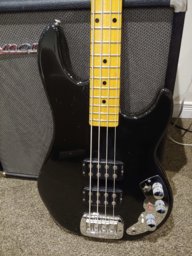
Sacrilege?don't know if I just committed sacrilege, but I did make my '96 L2500 a little bit easier to handle sound wise.

Just because it sounds cool sounds reasonable. They chose the ASAT name based on the USAF's anti-satellite program at the time because "it sounded cool."And the '000s ? Does it just sound cool? Seems kind of odd when you consider most of Leo's instruments have a name like precision, stingray etc rather than a numerical type

Just because it sounds cool sounds reasonable. They chose the ASAT name based on the USAF's anti-satellite program at the time because "it sounded cool."

I've also heard it called Standard Bass and Small BudgetI'd need to check but I think George Fullerton's book confirms the idea of "student bass". The concept was to make something simpler that could be sold for less money to entry-level players. I recall (not sure where, either Fullerton or Bechtold) that the empty digits in the 000 series would leave room for modifications to adopt new models in the professional line, which they did: 1005, 1500, 2500, etc.
They did something similar with early serial numbers, I have read . The first production numbers were B000500 and up. The idea was to reserve the first 500 numbers for "special" basses. I'm not sure if those numbers were ever used.
I'm inclined to go with George Fullerton, the "G" in G&L.I've also heard it called Standard Bass and Small Budget
Does that mean that you have followed up on your "need to check"?I'm inclined to go with George Fullerton, the "G" in G&L.

I found this on the internet, so it must be true.I'm inclined to go with George Fullerton, the "G" in G&L.
Standard Bass makes more sense than Student Bass when you consider that an SB-2 sells for about $1,450, and the Tribute version sells for $600. What student trying to learn would spend that kind of money on an instrument? But even Standard Bass is confusing. Does George give a reason why it was considered the "Standard Bass?" I'm sure there was one at the time. It'd be nice to know what their thinking was. Maybe they thought, "Let's pick two letters and we'll drive everybody crazy trying to figure out what they mean after we're dead." Whatever the reason, my SB-2 is a monster of a bass. I'm always proud and happy to play it.I found this on the internet, so it must be true.
'SB' stands for Standard Bass, according to George Fullerton on p. 124 of "Guitars from George & Leo: How Leo Fender and I Built G&L Guitars".
Found on this site which has some other cool G&L info.
'The Real Ones' - A history of G&L

I'd need to check but I think George Fullerton's book confirms the idea of "student bass". The concept was to make something simpler that could be sold for less money to entry-level players. I recall (not sure where, either Fullerton or Bechtold) that the empty digits in the 000 series would leave room for modifications to adopt new models in the professional line, which they did: 1005, 1500, 2500, etc.
They did something similar with early serial numbers, I have read . The first production numbers were B000500 and up. The idea was to reserve the first 500 numbers for "special" basses. I'm not sure if those numbers were ever used.
Yup.I think you're right. If memory serves, TB member "dukeplaysbass" has an L-1000 with a serial number below B000500. It's Cherry Burst that looks like it may be the original finish, which was not offered in the early years. I've offered to buy it from him in the past, but he declined.
I think the same (or similar) numbering system was used on the early MM Stingrays, too. I got a Stingray from the first batch in '76, but couldn't understand why it didn't have a correspondingly low serial number. IICR, its number was ~ 500-520. The take away is that Leo's seemingly odd numbering system didn't begin with G&L. Cheers.
No. Thanks for checking.Does that mean that you have followed up on your "need to check"?


Regardless of what the S means, My SB-2T is my favorite of all my basses. I consider it the ultimate PJ. And even though I've been playing for 47 years, I still think of myself as a student.I've also heard it called Standard Bass and Small Budget