

Enjoy the benefits of a premium membership!
Upgrade Account
-
TalkBass has been independent since 1998. Add your voice.
Create a free account to reply to discussions, view embedded media, and browse with fewer display ads.
Join free Log in
Want zero display ads or expanded classifieds tools? Compare plans.
You are using an out of date browser. It may not display this or other websites correctly.
You should upgrade or use an alternative browser.
You should upgrade or use an alternative browser.
More options
Who Replied?


Have you experimented with pickup height? Maybe your MFDs are too far from the strings to produce their usual aggression. I recall lowering the MFD on my old L-1500 to mellow it out a little. I haven't done this on my M-2500, and it's a beast.Like I said, 80% on all the knobs is great for the way I use it, more mellow. Wide open it's certainly more powerful but still not in the realm of a Stingray, in terms of power, unless heavily doctored at the amp.
I have an empress Sandberg that's below 7 pounds, and for awhile I didn't understand all the complaints about neck dive with these basses. But then I wore a synthetic shirt with the slippery side of the strap going over my shoulder, and I learned all about it! I was able to flip the strap around so the shirt contacted leather instead of nylon, and it was fine. As long as there's any appreciable friction between strap and shirt, neck dive isn't a problem.I've only had 1 experience with an empress GL, my L1k, and I love it. It's about 7+ pounds.
It has a substantial #12 neck on it, so you'd think it would be a neck diver, but I haven't experienced that.

Have you experimented with pickup height? Maybe your MFDs are too far from the strings to produce their usual aggression. I recall lowering the MFD on my old L-1500 to mellow it out a little. I haven't done this on my M-2500, and it's a beast.
This from an email I got from Memo regarding setting pickup height:
"Normally we set the pickup height to 3/32" from the top of the pole piece to the bottom of the string with the last fret fretted. As for string height, we also measure at the 17th fret E and A string is 6/64"(3/32") the D and G strings are set to 5/64".
I set my L2K up with those specs and it really sounds great. Hooray for adjustable pole pieces!
I just raised my pickups a bit to meet that 3/32", they were a tad lower but honestly I'm not hearing a discernible difference. Here's a couple of clips, recorded straight DI, all knobs wide open on the L2000, neck pickup on the Jazz. To me, the L2000 is sitting closer to my Jazz bass with flats, where the Jazz with rounds has a lot more dynamic range, brighter highs and more powerful lows. The L2000 sounds very muted and compressed to me.

Lord Ken of the sadly-deceased Basses By Leo Forum had this advice for MFD pickups: to start, drop them low, and then gradually raise them until the sound satiates.
My two thoughts: (1) these pickups are so responsive that when you set them too high, your startled ears inhibit your normal touch (2) their sensitivity to touch render general rules about how they should be set pointless
My two thoughts: (1) these pickups are so responsive that when you set them too high, your startled ears inhibit your normal touch (2) their sensitivity to touch render general rules about how they should be set pointless

He said 2024:
A lot of people know that our basses had a big issue with snapping truss rods. Very few people actually understand why it happened. A ton of people guess incorrectly (including the McLarens) that the rod itself was the problem. This was not the case.
So you want to buy an instrument in the era before I fixed the program (pre-March/April 2024) and you want to know what to look for, Besides the obvious of the adjustment nut just already being broken.
It's immediately obvious if you have a bad one. You have a neck with way too much relief, so the action is a mile high, and as you try to tighten the rod it does nothing to straighten the neck until you inevitably max it out and it snaps the adjustment nut off the threads. The rod turns and turns, then eventually you over torque the threaded rod the nut is welded to and it snaps off with a loud pop.
Basses have a lot more tension than guitars. That coupled with the longer overall neck length makes these very obvious to anyone that knows how to check neck relief.
The issue ultimately came down to an error in the CNC programming for the depth of the truss rod channel, on the bass program specifically. (Guitars and Fallout Basses were not affected by this error.)
Someone made it too deep, which allowed the rod to pull in on itself. Truss rods work because they are firmly anchored between the fingerboard and neck shaft with as little wiggle room as possible. Ours had upwards of .020-.050" of room, depending on a few variables. The woodshop manager prepped all the neck blanks by putting them through a thickness sander from the 70's. It was desperately in need of maintenance, so it didn't give consistent thickness results. The guy would check one of them and see it was close to spec (.800") and then send them all through. The problem was, the machine would give you variance of +/- .020" on a good day.
So out of a batch of 10-15 necks, the blank thickness could be off by as much as .020" too thick. Add that to the depth being wrong, and you get a wild swing in depth from neck to neck. Some were only off by about .020", which is close enough to get by when you factor in glue squeezing into the channel to fill the gap. It's still not great, but it can work a little bit. When you add in the other discrepancy it becomes untenable.
Our CNC worked by basing "zero" off the flat surface of the fixture the blank was mounted to, so it went to the same exact depth every time assuming we've properly thicknessed the blank to spec. We could have zero'd the piece every time, but that would grind production to a halt. It's a tedious process to do that on our older HAAS machines.
The workaround was to have the machine "fly cut" the entire surface of the blank to .800" based off the fixture during the truss rod program, so we knew it was perfect. It stopped the issue completely after that.
I ultimately got tired of seeing them returned or seeing them pop in final assembly, and I said "shag it" and ripped several in half with the bandsaw. That allowed me to see the problem with the rod still in place.
I'll also reiterate, because I personally prepped every body and neck blank for Custom Shop builds during my time there, and ran the CNC programs for those cuts in about 90-95% of them, I was able to avoid the issue on our builds by properly spec'ing blanks using a different thickness sander in our shop, and checking every single one with calipers. We also worked in much smaller batches than standard production, so it was easier to spot discrepancies
I read that, too. Also, the person who checked then coming out of the woodworking shop only checking 1 and then sending the rest through when there was a variance in the depth of the channel on a lot of them tells me why some have had problems and others haven't. I'm one of the lucky ones who haven't had trouble so I look on that as a blessing. Then again, none of mine have needed much adjustment at all. My JB MFD was made after the fix so it should be OK. I have 2 Fullerton made ones that were made in '21 and '22. I'm hoping they continue to be as solid as they've been so far.
Here is a link to the post for others to read:
Thank you all very much for posting this info.
If I am understanding the explanation correctly, this is good news for those with USA G&L basses that currently have a functioning truss rod.
My attempt at a summary:
The issue was with the manufacturing of the bass necks, and it is specific to an individual neck.
For some necks, the truss rod channel was cut too deep, which allowed too much space for the truss rod to move around. When you tighten the truss rod nut, rather than the truss rod bending the neck, it kinks up inside the channel. Eventually, if you keep tightening, the nut will break off.
But, for basses where the channel is not too deep, and the truss rod functions as it should, then you don't have to worry about the truss rod nut breaking off someday out of the blue.
So, not every USA G&L bass is a ticking time bomb where the truss rod may fail at any time.
I had been wondering whether I should hang on to my G&L instruments out of fear of random truss rod failure, but after reading this explanation from the guy who ran the G&L custom shop, I feel more comfortable about keeping them.

My current L2000 is a beautiful candy apple red empress and I love it. Just over 7lbs and sounds like my old ash L2000.I've only had 1 experience with an empress GL, my L1k, and I love it. It's about 7+ pounds.
It has a substantial #12 neck on it, so you'd think it would be a neck diver, but I haven't experienced that.
As far as body wood affecting tone, it has about the same effect as polishing your instrument.
Pics, Richwag, pics!My current L2000 is a beautiful candy apple red empress and I love it. Just over 7lbs and sounds like my old ash L2000.
As far as body wood affecting tone, it has about the same effect as polishing your instrument.

I used my wunkay a lot for band rehearsal/gigging. My BL really liked the sound of it compared to my Ricks.
I had to agree it was really more direct sounding on the fundamentals.

I recall the first time I saw G&L basses, late 1980, Wurlitzer Music in Boston. I must have come on a good day. Candy Apple red, blue and green all in display cases. As I had been shopping for a new Precision in vain (not Fender's finest vintage), my heart sang! I probably should have just bought the red one. I eventually (Feb '81) got a natural L-1000 in Chicago that I still have today. Yes,pics of the candy apple L-2000, pleasePics, Richwag, pics!
I used my wunkay a lot for band rehearsal/gigging. My BL really liked the sound of it compared to my Ricks.
I had to agree it was really more direct sounding on the fundamentals.
 !
!Edit: Look who's talking! But for some reason I can't add photos to this post. Hmm…
Last edited:
The Tribute L-2000 has arrived. It's been a long day so I haven't unboxed it yet. It's probably going to be a long day tomorrow. Maybe Friday evening... Fish, chips, clean hands, bass.
I had a few minutes. On parallel with the bass control 70% rolled off, it's around the sound of my old Tokai Jazz Bass or Squier Standard Precisions. Bright it is not by default. I'll compare against the PLyte tomorrow.
I'll see if I can work with it. Then it's herd thinning time.
It can take a low action, although I pushed it a little too far, perhaps, as I also changed that 105 to 45 D'addarios for a set of 100 to 40s of unknown provenance in my strings box, but most likely Rotosound RB40s, so almost my usual SM66Ns. I'll measure the action properly when I've tweaked a little more.
I'll see if I can work with it. Then it's herd thinning time.
It can take a low action, although I pushed it a little too far, perhaps, as I also changed that 105 to 45 D'addarios for a set of 100 to 40s of unknown provenance in my strings box, but most likely Rotosound RB40s, so almost my usual SM66Ns. I'll measure the action properly when I've tweaked a little more.
Last edited:

I suppose it's a bit ironic, since G&L went out of business, that I purchased my first new G&L bass in over 10 years this week.
I found a mom and pop music store while visiting Alabama and there on the wall was the last G&L they had ordered before G&L shut the doors. I needed a passive jazz 5 to replace my Fender Jazz Pro V that I sold to start a custom build last year.
The look (Shoreline Gold) and playability of the JB-5 just drew me in.
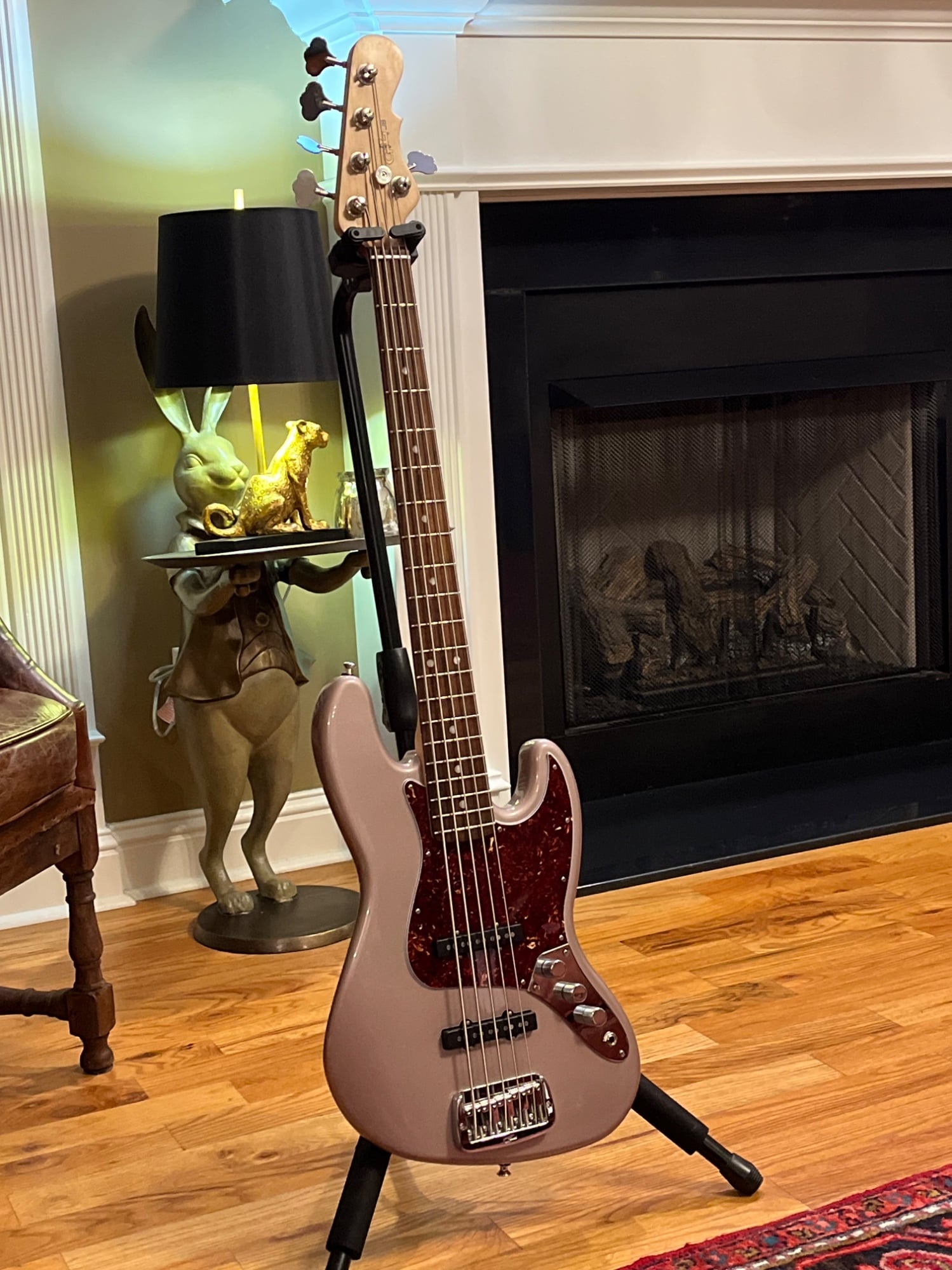
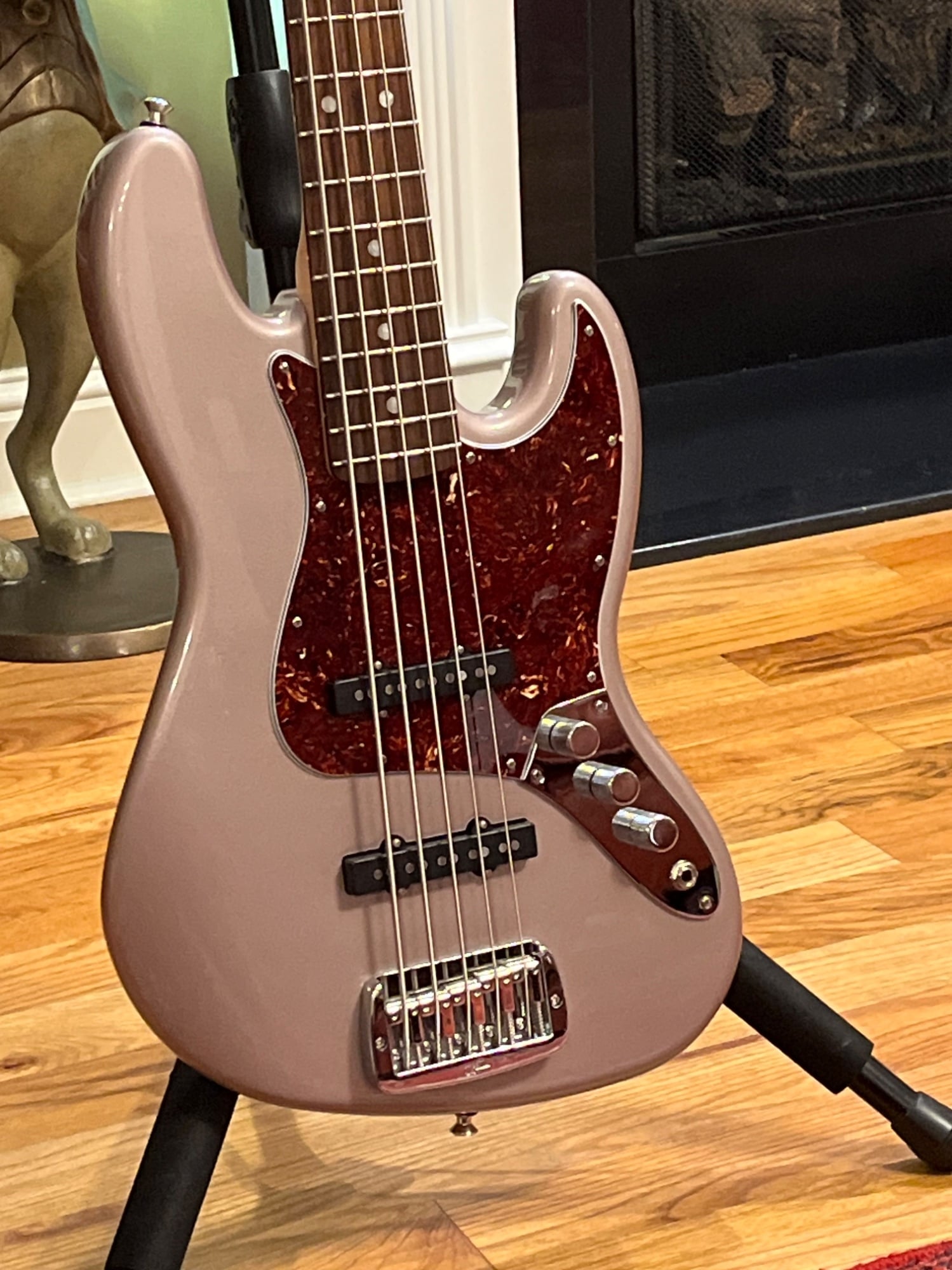
I found a mom and pop music store while visiting Alabama and there on the wall was the last G&L they had ordered before G&L shut the doors. I needed a passive jazz 5 to replace my Fender Jazz Pro V that I sold to start a custom build last year.
The look (Shoreline Gold) and playability of the JB-5 just drew me in.

I'm still tweaking the set up to get it just so. Ultimately, I am likely to do a fret level and crown. It's not bad, just not quite perfect yet. It came with zero relief, so I've added a touch. The nut could stand lowering a bit. Nut width I'm not having an issue with. I haven't measured it but I assumed 42mm. The Fender Player Plus I had felt quite chunky, but that had more depth to it. It's still not the thin front to back dimensions of a 1984 Precision I had, or JV Squier.I had a few minutes. On parallel with the bass control 70% rolled off, it's around the sound of my old Tokai Jazz Bass or Squier Standard Precisions. Bright it is not by default. I'll compare against the PLyte tomorrow.
I'll see if I can work with it. Then it's herd thinning time.
It can take a low action, although I pushed it a little too far, perhaps, as I also changed that 105 to 45 D'addarios for a set of 100 to 40s of unknown provenance in my strings box, but most likely Rotosound RB40s, so almost my usual SM66Ns. I'll measure the action properly when I've tweaked a little more.
I'm still working through the sounds. Through my interface's "high impedance" input it's ok. Not as bright as other bases I have. It's nearly as bright with active on - the high impedance input is more medium impedance. Using a DI box helps. It's still not as bright as several others a flat amp EQ. Using the treble boost adds harshness more than treble.
Getting a standard "rolled off P sound" requires tweaking both tone controls, it seems.
I'll continue to work with it. I will probably replace the knobs with ones with indicators on to make settings easier to see.
I might like to add single coil operation, but that's a special switch and too much soldering to contemplate right now.

I must be one of the more oddball G&L buyers out there. I still have an ASAT Special which I've had for years now. Always wanted one as contrast to my Teles. Then I bought an L2500 bass. Great bass, nice neck feel, gorgeous sunburst finish. But I could never get exactly what I wanted tonally out of it. Probably needed a K mod and I had planned on having the done.
On a whim I bought a used M2000 that I could return if it didn't suit me. I found l liked it more than the L2500 and ended up selling it. The 3 band EQ, the blend pot, and the PBass width 1 5/8" neck were the reasons why. Since G&L had stopped producing them long ago they're are probably not as many of them "in the wild" as L2000s.
Then I just bought a Comanche. Probably one of Leo's oddest looking guitars with it's Z-coil pickups but it's a wonderment of different tonalities. A real Swiss Army Knife guitar. So my herd of G&Ls tends to run towards the odder models and that OK with me. They just seemed to fit more of what I was looking for as alternatives.
On a whim I bought a used M2000 that I could return if it didn't suit me. I found l liked it more than the L2500 and ended up selling it. The 3 band EQ, the blend pot, and the PBass width 1 5/8" neck were the reasons why. Since G&L had stopped producing them long ago they're are probably not as many of them "in the wild" as L2000s.
Then I just bought a Comanche. Probably one of Leo's oddest looking guitars with it's Z-coil pickups but it's a wonderment of different tonalities. A real Swiss Army Knife guitar. So my herd of G&Ls tends to run towards the odder models and that OK with me. They just seemed to fit more of what I was looking for as alternatives.
Nothing wrong with liking odd stuff. So says Mrs Holdsg. Variety is the spice of life.

NBD content.
Found this supposedly refurbished beauty in on of the places which got G&L remains to sell.
It's basically new BTO, still has a film on the pick-guard.
Inspected it all with UV light, no signs of repair.
Bound ebony neck, blocks, midnight blue metallic body.
What's funny is while being passive it drives my amp harder than L2500. Did they wind Kiloton pickups differently?
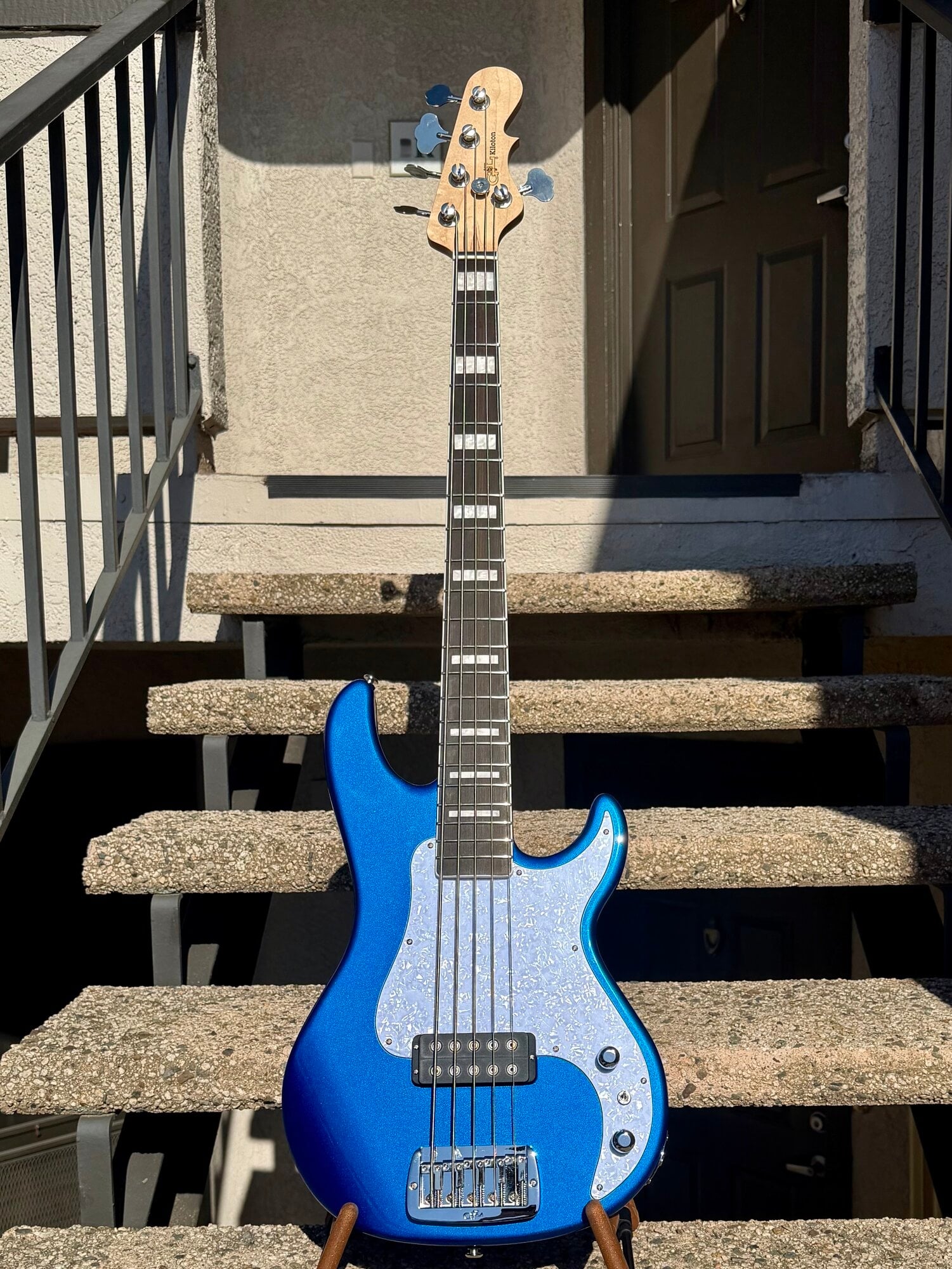
So glad I found it. During G&L demolition I snatched last Kiloton from SW but it turned out to be a dud with non-functioning truss rod (55 point inspection my ass). Returned and was looking another one since.
Found this supposedly refurbished beauty in on of the places which got G&L remains to sell.
It's basically new BTO, still has a film on the pick-guard.
Inspected it all with UV light, no signs of repair.
Bound ebony neck, blocks, midnight blue metallic body.
What's funny is while being passive it drives my amp harder than L2500. Did they wind Kiloton pickups differently?
So glad I found it. During G&L demolition I snatched last Kiloton from SW but it turned out to be a dud with non-functioning truss rod (55 point inspection my ass). Returned and was looking another one since.
Last edited:
Beauty! I still want a Kiloton 4, even though I'm not playing with anyone. I had one, and unfortunately sold it.
I loved the sound of the MFD pickup, and it stood out in gtr bands I was in. I can't recall having to turn the volume down,
like most people suggest.
I always used a tech21 vt di pedal to preamp, so I could set up the sensitivity there.
I loved the sound of the MFD pickup, and it stood out in gtr bands I was in. I can't recall having to turn the volume down,
like most people suggest.
I always used a tech21 vt di pedal to preamp, so I could set up the sensitivity there.
After tweaking the new G&L for a few days l'm totally loving it.
One last change this morning totally completed it.
Can you spot what that change was?
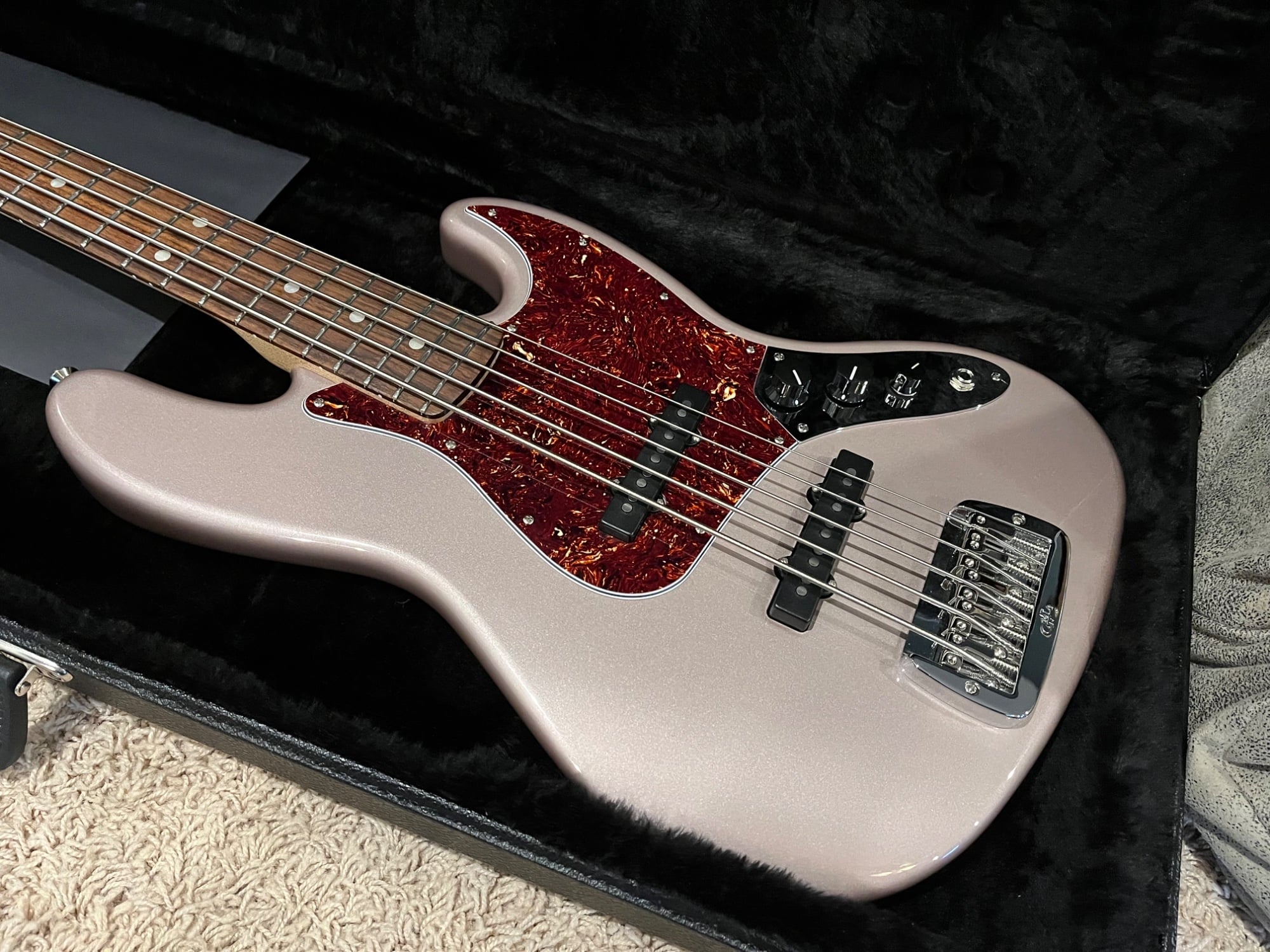
One last change this morning totally completed it.
Can you spot what that change was?

The knobs. And yes, I like the knobs you put on there better than the chrome ones.After tweaking the new G&L for a few days l'm totally loving it.
One last change this morning totally completed it.
Can you spot what that change was?
View attachment 7545889


