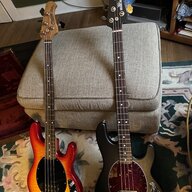
I'll try this, it's a bit frustrating because I've seen people and videos and people are able to get such warm punchy sounds. And for me it's either too much bass and it farts out or too high and it distorts as well. And this is the first bass in years that the body and neck wise just feels right.

here's an article going over it an another thread with helpful info on the L2x00
G&L L2000/L2K tone controls - think boost not cut
Relativistic tone control
It's All Relative: Notes on passive tone ciruits in electric basses.
What are passive and active circuits?
- A passive circuit is one where no amplification is applied to the signal at any point within the instrument. You will not find a battery in these instruments and the tone controls will normally be very simple and seldom consist of anything more than treble and bass controls, and usually just a treble or "Tone" control.
- An active circuit, conversly, has an amplifier (or more properly, a preamp) of some sort that is normally able to apply any number of effects to the signal. Gain (an increase of signal), advanced tone control, and special voicing are capabilities that may be added with an onboard preamp. These basses typically have one or two onboard 9V batteries.
- There are also hybrid circuits, notably G&L L series basses, that are a combination of both passive and active circuitry.
The electronic heart of an electric bass is its pickup or pickups. These electromagnetic devices are little more than tiny generators that make the electricity that is the signal that gets amplified by our amps to make the sound. You can literally connect the pickups directly to the input of an amp and the bass will, in nearly all circumstances, work just fine. When you connect your bass' pickups directly to your amp (via jack & cable), you will be getting EVERYTHING that the pickups can give you. You get ALL the volume and the ENTIRE frequency spectrum (or range) that they are capable of giving you.
IMPORTANT NOTE #1 above
You can
reduce the frequency response.
A tone control, whether a treble control, a bass control, or a single "tone" control, is a simple R-C filter. Using a combination of Resistance (the pot) and Capacitance (the tone cap or caps), certain frequencies are filtered out of the signal. The width of the filtered frequency band and how much of the frequency's signal to be filtered is determined by the values of the R-C circuit at a given point in its range of adjustment. If a treble control is turned all the way up to full treble, almost no filtering is taking place. The same is true for a bass control, respectively. This means that if both controls are turned up all the way, the signal that is sent to the amp is essentially the same as if the treble and bass controls didn't exist.
You'll note above that I said, "almost no filtering is taking place". The reason that it's "almost" instead of "absolutely" is that the R-C filter in question is still circuit; it's just that its values are such that it's essentially ineffective. To actually remove the R-C filter from the circuit requires "no-load" pots or a modification to normal pots so that when the control is turned all the way off (full treble or full bass), the R-C filter is removed and isolated from the circuit. Setting up no-load pots provides little to no benefit to bass players. Guitars, on the other hand, will usually see a slight increase in treble with a no-load treble pot and possibly a slight increase in bass response with a no-load bass pot.
If one of these controls is turned to a setting other than wide open, filtering will take place based upon the R-C filter values being used. These filters are subtractive only. The frequencies they filter are shunted to ground.
IMPORTANT NOTE #3
Refer to IMPORTANT NOTE #1 above
Where does "relative" enter into this?
Everything I've described doing to the signal from the pickups is relative to that signal in its unaltered state, which is nice because it gives us a more-or-less known starting point. At the user level though, relative starts to slide around into perceptions based on what the user hears, what he expects, and what he has learned. For example, some basses, such as certain G&Ls, have a switch that brings additional filter caps into play. Called a "Bass boost switch" or sometimes referred to as the "OMG switch", it is in reality a secondary filter (sometimes in addition to coil switching) that cuts treble beyond what the treble control can do. What the user perceives is the low frequencies appearing louder relative to what was previously heard, but what is actually going on is the high frequencies being cut. Remember that any of these filters in a passive circuit are subtractive only.
IMPORTANT NOTE #4
Refer to IMPORTANT NOTE #1 above
Summary: It's all about perceptions.
You may have noticed that throughout this whole ordeal we have not added to the signal. We've only taken away some or all of the signal, depending on which control we move and how much we move it. The reason we haven't added to the signal is that we have some hard limits placed on the output, and those limits are the maximum output voltage and the native frequency spectrum of the pickup(s). We can only subtract from these things. What we perceive to be additive to one thing is really our ears and brain fooling us into thinking that we're getting more of thing "A" when we're actually getting less of thing "B".