

Enjoy the benefits of a premium membership!
Upgrade Account
-
TalkBass has been independent since 1998. Add your voice.
Create a free account to reply to discussions, view embedded media, and browse with fewer display ads.
Join free Log in
Want zero display ads or expanded classifieds tools? Compare plans.
You are using an out of date browser. It may not display this or other websites correctly.
You should upgrade or use an alternative browser.
You should upgrade or use an alternative browser.
Genz Benz Streamliner Part 9
- Thread starter Chef
- Start date
- Status
- Not open for further replies.
More options
Who Replied?
- Feb 12, 2006
- 60,963
- 5
- 220,647
- Disclosures
- Development Engineer-Mesa Boogie, Development Engineer-Genzler (pedals), Product Support-Genz Benz
Their spec sheet shows 30dB of boost (separate from the EQ).
The boost or gain isn't the potential problem, it's the maximum undistorted output level.
Unfortunately, the manufacturer doesn't list this important spec. on their website so you will need to call them and ask.
I have mine rackmounted too. The Genz Benz mount is a little heavy. Im going to try to fab a light weigh one to keep some of the weight down.rack mounted awesomeness ...




Just back from an early evening jazz gig.
62 ri P-bass into Streamliner 900 into Berg HS210 cab, bass @ 10 o'clock, mids and treble @ noon.
Fat and juicy tone on stage but super clean in the crowd.
Check out this clip from last week, around 6:30 for bass solo.
Woolysock - Jody Grind.mov - YouTube
IMHO the Streamliner rocks ;-)
nice...very nice....
goes to show you can p-bass and still play jazz...

Just wanted to show TBers the GB Streamliner isn't necessarily boomy or wooly or mushy. It's a punchy juicy old-school in-your-face funk machine ;-)
Woolysock Soul Jazz Vancouver - YouTube
Woolysock Soul Jazz Vancouver - YouTube
Same settings: Bass at 10 o'clock, mids at noon or just slightly boosted (2.5K setting) treble at noon. Difference is room acoustics and mic placement. Mics for all three clips are just the built-ins with small digital cameras, nothing fancy...

- Feb 16, 2008
- 21,240
- 23,633
- Disclosures
- John K Custom Basses
i've been A/B'ing between my STM900 and one of my SVT's to try and capture more of the SVT's vibe, and i'm having good success by putting a presonus EQ3B in the effects loop. the EQ3B doesn't add any noise and doesn't change any of the punch of the amp, just gives it more precise tonal shaping. here's the setting that i'm using right now and it's pretty darn close:
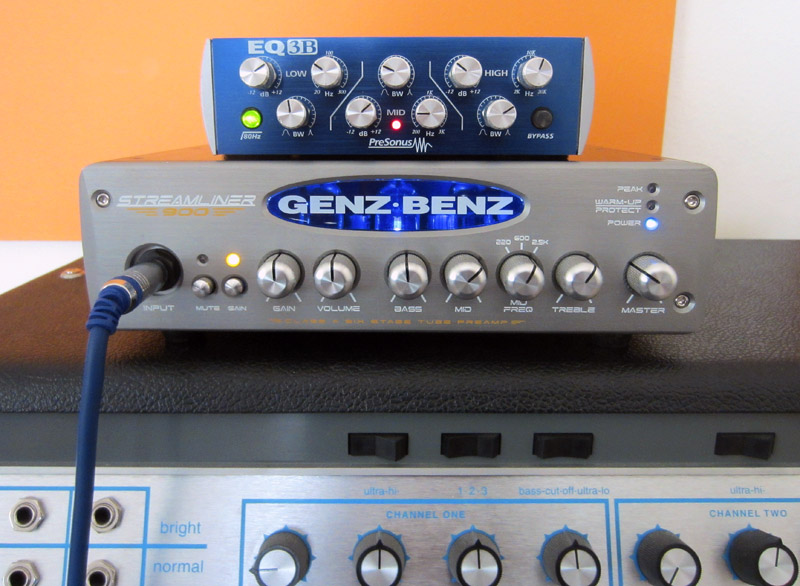
for me, it gives the 900 a bit more of the SVT mid punch that i feel that is sometimes lacking when using different cabs.
for me, it gives the 900 a bit more of the SVT mid punch that i feel that is sometimes lacking when using different cabs.
I wonder if an Empress Para-EQ would adequately drive a Genz power amp section?
Tested it out this morning.
Setup as follows:
- The 5-string in my avatar- EMG P-bass voiced active soapbars (40P5's), no onboard EQ, D'Addario nickel rounds, medium-high action.
- Empress ParaEQ powered by a Dunlop ECB-004 150ma 18V wall wart.
- Streamliner 900 powering a 4-ohm AudioKinesis Thunderchild 112AF.
- Bass into ParaEQ, ParaEQ into the SL900's effects return jack. This bypasses everything but the Master Volume control.
- Neck pickup volume dimed on the bass, Master Volume dimed on the Streamliner.
- Fingerstyle with a moderately light touch.
With the EQ set flat on the Empress, setting the boost at 1:00-2:00 o'clock was enough to get the Peak light flashing steadily on the SL900. If I pushed the boost much further on the ParaEQ, it started to clip when I dug in on the B string. Ditto if I dialed up a lot of bass boost without adjusting levels to compensate.
Conclusion: The ParaEq's output is hot enough to drive the Streamliner to maximum volume, but only just. This may be a moot point, since driving the amp much harder would probably push it into protect mode.
Regardless, the ParaEQ appears to be enough by itself for typical club or jazz work, but in a high-pressure situation like an outdoor rock gig with a monster cab or cabs, or for heavy slapping without a compressor, I'd want a full-on rack preamp, just for insurance.

...The ParaEq's output is hot enough to drive the Streamliner to maximum volume, but only just. This may be a moot point, since driving the amp much harder would probably push it into protect mode.
PS: The power stage on recent Genz Benz micro heads, has to be one of the nicest designs on the market.
Even using an Empress ParaEQ pedal with the EQ controls set flat to bypass the 900's internal tube preamp and drive the SL900's SS power stage directly, my Streamliner was giving me big, fat notes, with a tight low end and an extended, but not harsh treble range.
I would choose the 900 or one of the new .2 series Shuttles over any lead sled, without a moment's hesitation.
- Feb 16, 2008
- 21,240
- 23,633
- Disclosures
- John K Custom Basses
PS: The power stage on recent Genz Benz micro heads, has to be one of the nicest designs on the market...................
............I would choose the 900 or one of the new .2 series Shuttles over any lead sled, without a moment's hesitation.
i agree, and even without the EQ3B in my effects loop, i'm very happy with the 900's tone. the external eq just allows me to dial it in a little bit more to sound like an SVT, but i could see myself easily gigging without it.

svtb15
Inactive
- Mar 22, 2004
- 13,004
- 4,741
- Disclosures
- I play it all. Whatever works for the gig. Q+
That just looks Freaking Great
i've been A/B'ing between my STM900 and one of my SVT's to try and capture more of the SVT's vibe, and i'm having good success by putting a presonus EQ3B in the effects loop. the EQ3B doesn't add any noise and doesn't change any of the punch of the amp, just gives it more precise tonal shaping. here's the setting that i'm using right now and it's pretty darn close:
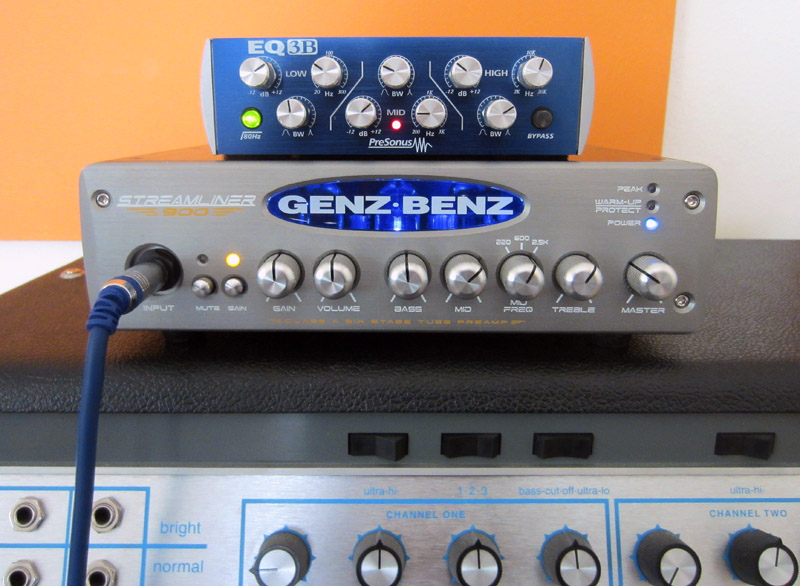
for me, it gives the 900 a bit more of the SVT mid punch that i feel that is sometimes lacking when using different cabs.
I don't know. It seems like forcing a round peg into a square hole at this point.
I use the Empress ParaEQ to fine tune my SL900. Really tightens the low end when paired with an LDS 12/6 and lets you adjust to precisely fit each environment. There's a lot to be said for using a separate EQ unit like the ParaEQ to easily fine tune settings if you use multiple amps. I also use the ParaEQ with my EA Micro when paired with an acoustic bass. Each amp provides unique characteristics as a power section. Both are excellent at what they do. Total weight is minimal. These are happy days to be a bass player.
I don't know. It seems like forcing a round peg into a square hole at this point.
I've heard that before, but from my perspective both as a musician and an audio technician, it makes no sense at all. Ever been in a recording studio where they preserve a strict one-to-one relationship between each microphone, preamp and recording interface? Round peg my @xx...
The same goes for MI amplifiers. If companies like Genz Benz can pair the same output stage with various front ends (or vice-versa) in order to build up a model line, why shouldn't users to do it, too? In fact, some companies (Markbass and Randall come to mind) have actually offered modular rack systems, where you could pick and choose your components. After all, pretty much any hybrid head with an effects loop, is basically nothing more than an integrated preamp and power amp combination.
The break jacks between the two stages are there for a reason, and over the years, I've used various bass amps for everything from amplifying acoustic stringed instruments and keyboards, to supplementing my PA gear. If the EQ section doesn't do what you need for a particular gig, you simply bypass it.
The right preamp feeding the power stage of a Streamliner and driving a really nice full-range loudspeaker, will knock the socks off just about any commercial combo amp. That's regardless of whether you're talking about amplifying a fine acoustic guitar, a big keyboard workstation, or even just tailoring your electric bass tone to suit different gigs.
For me, this is partly about stretching a dollar, but also about practicality. I had a real "a-ha" moment about this a few years ago, when I bought a Bose L1 system, and discovered that it quite nicely replaced not only the bass rig I was using at the time, but a Fender acoustic guitar amp, a brutally heavy keyboard amp, and a raft of PA gear. It used to take me 6 trips to bring all my gear into the hall every year at music camp, but after getting the Bose, I was able to do it in two, and have better sound.
Aside from wanting to ease the load on my back, I don't make a ton of money off my music. Why should it all go to line the pockets of companies like Roland, Fishman, et al, when I can make a single piece of gear do multiple duty?
- Feb 16, 2008
- 21,240
- 23,633
- Disclosures
- John K Custom Basses
FWIW, last night, i ran my Focusrite ISA 430 MKII into my streamliner's aux in, bypassing the ST900's preamp and it sounded awesome. i intend to try it with my UA 6176 too.
I've heard that before, but from my perspective both as a musician and an audio technician, it makes no sense at all. Ever been in a recording studio where they preserve a strict one-to-one relationship between each microphone, preamp and recording interface? Round peg my @xx...
The same goes for MI amplifiers. If companies like Genz Benz can pair the same output stage with various front ends (or vice-versa) in order to build up a model line, why shouldn't users to do it, too? In fact, some companies (Markbass and Randall come to mind) have actually offered modular rack systems. After all, pretty much any hybrid head with an effects loop, is basically nothing more than an integrated preamp and power amp combination.
The break jacks between the two stages are there for a reason, and over the years, I've used various bass amps for everything from amplifying acoustic stringed instruments and keyboards, to supplementing my PA gear. If the EQ section doesn't do what you need for a particular gig, you simply bypass it.
The right preamp feeding the power stage of a Streamliner and driving a really nice full-range loudspeaker, will knock the socks off just about any commercial combo amp. That's regardless of whether you're talking about amplifying a fine acoustic guitar, a big keyboard workstation, or even just tailoring your electric bass tone to suit different gigs.
For me, this is partly about stretching a dollar, but also about practicality. I had a real "a-ha" moment about this a few years ago, when I bought a Bose L1 system, and discovered that it quite nicely replaced not only the bass rig I was using at the time, but a Fender acoustic guitar amp, a brutally heavy keyboard amp, and a raft of PA gear. It used to take me 6 trips to bring all my gear into the hall every year at music camp, but after getting the Bose, I was able to do it in two, and have better sound.
Aside from easing the load on my back, I don't make a ton of money off my music. Why should it all go to line the pockets of companies like Roland, Fishman, et al, when I can make a single piece of gear do multiple duty?
I understand where you're coming from. I was just looking at it as if someone was in general not happy with the SL sound and used a separate pre amp all the time. In that case they bought the wrong amp for them IMO. But yes, I can see where this is a cool option for the times when you need something that the SL can't deliver.
- Status
- Not open for further replies.


