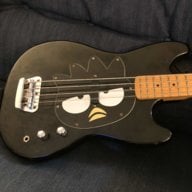
Yes. 2 are spoken for, possibly a 3rd, so I guess we have 2 left t anyone who wants that finish. I'll get some better renders up this weekend.
1) The binding won't be a hard 90 degree edge. We're going to radius the body for those just a little and try to make it feel more like a PRS style edge, but it's still a binding and will be sharper that a regular roundover bass. If you're sensitive to it, best to stick to the non-bound bodies.
2) The NAMM bass was "old barnboard brown", at the request of Jesse Keeler who those two were built for. Our 2TSb will not be the usual black edge, as we're shooting for more of a dark-contrast violin burst. Will update with better renders/pics this weekend.
3) Our OEM is really trying to narrow us to fewer choices as opposed to more. We're doing the maple only with blocks for the White Tux version since the headstock is a light color. I don't want to be doing maple necks with matching dark color headstocks, which is what all the other finishes are.
4) It won't be exactly the same, but close. For the protos, we used the exact same neck (as in wood) and just fretted them differently. In production, the 30" neck will be about 3/8" shorter than it is now (removing all that extra after the 24th fret) and the 33.25" neck will be about 3/8" longer, to allow for the 21st fret to be added. The difference in reach to 1f will be about 3/4" different, with the other 2.5" made up by moving the bridge forward. I realize this isn't perfect for some, but keep in mind it's already a very compact bass and that the 30" scale will probably have a reach/feel more like a 32" bass, with tighter/easier fret spacing of the 30". This was done because we need the clear access to 24 frets and a forward bridge to emulate the Dan Armstrong acrylic bass. It's possible we do a different 30" scale later that is 21 frets total, which shifts both the neck and bridge further "inwards" by another 1.5" or so. I just can't run 10 different necks this time around.
Hope that helps.
.






 )
)