I've never really paid attention myself. So, how heavy do they get?
Does double necks counts? With more than 4 strings? Or extended range basses?
Mind you that 6 stringers weights a lot more than their 4 string counterparts, given all else equal. Or 12 string, or 18 string. But the one that first comes to mind.. is Chris Squires Triple neck WAL:
The story is that they tried to make one of the necks 8 string, but that would be too heavy. In that is was not to heavy for a human to bear, but it would cave in on itself, and collapse. You know the same thing that you can detect, with too frail, or skimpy designed basses, when you intonate and tune them up in playing position, and then right after it, lay it down on a table, and string buzz, and intonation goes out the window, due to it's not able to bear its own weight without flexing in the material. But on this one, thousandfold. This one, you could only play for maximum 2-3 numbers a night, and not in a row, and Chris only used it on "Awaken". Owned, ordered, and paid for by Rick Wakeman originally.
A HISTORY OF WAL BASSES: "Chris Squire" Custom Triple Neck Wal feature - "Bassist" magazine 1999
You said, in the headline "heaviest bass I'd seen". I took the word 'seen' literary, as I never ever tried that one, or similar. If we narrow down your headline to a much more handy, plausible one with:
1. Having tried, played myself, even owned.
2. 4 string restriction. Not even 5ers.
3. No double, or more necks.
4. Headstocked basses. No headless.
5. Regular 34" scale (mind you, increasing scale increases weight all else equal).
Well, going for the run-of-the-mill
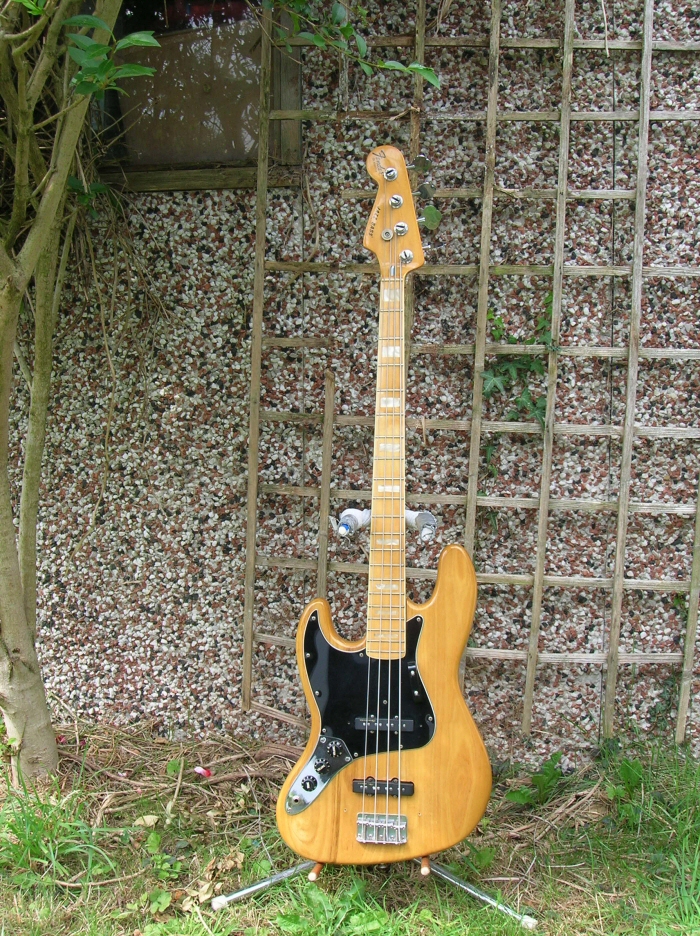
Fender J and P basses from the mid 70s and a bit forward, they were all boat anchors. Didn't neck dive though which made them not feeling that heavy. Recently I've played the
Hagström Beluga bass to great results, and while that one is a boat anchor too, it balances perfectly with no neck dive, or body dive, when standing up or setting down equally. That one weighs quite a lot for such a diminutive body design.
I think the 70s where brimming with those extra heavy basses, all they aimed for was sustain forever, like on the guitars. Yamaha 2000 series guitars like used by (or really, just endorsed) by Santana, where boat anchors as well. They got on to these brass bridges and nuts, and went nuts with the weight just because they thought that increased, density, and "heavy" wood, would increase every tone aspect of the basses no matter what. I've tried some early regional luthier attemps at mimicking Alembic basses from that time, and the decade of 70s from around mid 70s towards 1983-84 showed some of the more, or even most, heaviest ones in the business. Jeeez, such boat anchors they where! The darker the wood, the better it seemed. And heavier the brass bridge... I did bicker about it even then. That there was some "race" going on, to see how much weight we can tolerate, or where the upper limit really hit.
These days, is quite opposite, with lightweight basses BUT with neck diving to no end, occurring instead. And people don't think a 6 stringer is that heavy, but they whine about the same weight of a 4 stringer. Beats me. Either an instrument weighs too much, or it doesn't.