Enjoy the benefits of a premium membership!
Upgrade Account
-
TalkBass has been independent since 1998. Add your voice.
Create a free account to reply to discussions, view embedded media, and browse with fewer display ads.
Join free Log in
Want zero display ads or expanded classifieds tools? Compare plans.
You are using an out of date browser. It may not display this or other websites correctly.
You should upgrade or use an alternative browser.
You should upgrade or use an alternative browser.
How do I fix the mid scoop on a PJ?
- Thread starter Elmstreet
- Start date
More options
Who Replied?

I really never had a problem running PJ or J pickups with loud obnoxious guitar players. I favor the j pickup slightly for cut. I also use amps with parametric EQ's so I can dial in the mids for better scoop and cut. If your amp doesn't have one, you could get the Yamaha NE1. Thats on all the time though. Better pickups can help. Get a Spector or a Warwick bass. Those will cut and sound huge. For pickups EMG's are great but I don't love them in alder for some reason. SD actives, Delano's are very nice. Just mess with stuff. Side note, I don't like onboard mid controls when I have amp parametric. I get into the weeds in the mids. Everything sounds good until you play with other people. I prefer to use my blend for the mid controls on my instrument.

When I get to rehearsal or to a gig I just disappear in my band that has 2 distorted guitars. I end up just favoring the P pickup for the gig or rehearsal.
When playing with two distorted guitars (I'm assuming heavy music here) I lean into the scoop. It creates clarity in the overall mix by not fighting with the guitars to occupy the same space.
To get more cut I'll maintain full lows and boost around 2-3k. That'll have the clack/clank cut through and give you attack and note definition without creating a volume war with the guitarist for the midrange.
Using new strings go a long way here as you'll want the highs and harmonics to generate that definition.
The problem I had with a passive bass was that I had to constantly feed it new strings to keep up. Switching to active I could boost the highs more, which cut back on my string consumption.
Agree with this 100%. I tried switching to nickels at one point and was going through a set a week. DR high beams/low beams are my go to now.When playing with two distorted guitars (I'm assuming heavy music here) I lean into the scoop. It creates clarity in the overall mix by not fighting with the guitars to occupy the same space.
To get more cut I'll maintain full lows and boost around 2-3k. That'll have the clack/clank cut through and give you attack and note definition without creating a volume war with the guitarist for the midrange.
Using new strings go a long way here as you'll want the highs and harmonics to generate that definition.
The problem I had with a passive bass was that I had to constantly feed it new strings to keep up. Switching to active I could boost the highs more, which cut back on my string consumption.
Lower the height of the bridge pickup a bit, to favor the neck pickup. This should reduce and shift the scoop up in frequency a bit.

How do I fix the mid scoop on a PJ?
When I'm at home practicing and messing around with my tone, I like the clarity and the way drive/grind sounds when P and J are both on full.
When I get to rehearsal or to a gig I just disappear in my band that has 2 distorted guitars. I end up just favoring the P pickup for the gig or rehearsal.
The problem with this, is that my overall tone and drive sound way different with just a P pickup, so all time I've spent messing with my tone and getting my "grit" just right is all changed. Everything gets muddy, I have less note definition, it's like I turned on a fuzz pedal and increased the gain.
I'm learning about the "scoop" that happens with J basses and PJ basses, which makes sense as to why I'm disappearing in the mix. As I'm doing research on how to potentially fix this issue, I've come across a few different potential solutions, but I would love some feedback.
- Series / Parallel switch mod
- Swapping to mid heavy PJ set (Dimarzio Model PJ)
- Increase mids on amp/preamp to counteract the scoop
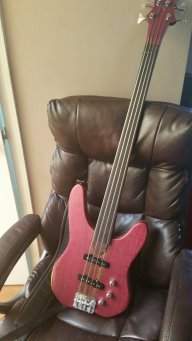
For context, I'm referring to a parts bass that has EMG Geezer PJ pickups.
I was just about to order a set of Dimarzio Model PJ pickups thinking that was the problem but I figured I better ask the experts.
Any and all feedback would be appreciated.
It's your amp/rig, not your bass.
If you have a disappearing bass due to mid scoop, flat the bass on the amp and boost around 160-170hz until you can hear yourself in the mix, then dial in a tad of bass to smooth it out. Roll off some treble on your bass if too bright.
Other option, bring a baseball bat and have a (ahem) conversation with said guitarists about volume levels….
Last suggestion, I hope you all are wearing ear protection, like ear filters for instance.
FullumMusic
Commercial User
- Oct 13, 2022
- 2,010
- 5,689
- Disclosures
- Audio/Music software developer, contracted with a company you've heard of and deving my own stuff.
If there is a frequency range in the signal that is lower than the rest of your signal, use an EQ to boost that frequency range. That's literally what EQs were designed to do. Equalize the frequency response across the spectrum. Boost the mids you're missing, and lower the frequencies you have too much of.How do I fix the mid scoop on a PJ?
When I'm at home practicing and messing around with my tone, I like the clarity and the way drive/grind sounds when P and J are both on full.
When I get to rehearsal or to a gig I just disappear in my band that has 2 distorted guitars. I end up just favoring the P pickup for the gig or rehearsal.
The problem with this, is that my overall tone and drive sound way different with just a P pickup, so all time I've spent messing with my tone and getting my "grit" just right is all changed. Everything gets muddy, I have less note definition, it's like I turned on a fuzz pedal and increased the gain.
I'm learning about the "scoop" that happens with J basses and PJ basses, which makes sense as to why I'm disappearing in the mix. As I'm doing research on how to potentially fix this issue, I've come across a few different potential solutions, but I would love some feedback.
- Series / Parallel switch mod
- Swapping to mid heavy PJ set (Dimarzio Model PJ)
- Increase mids on amp/preamp to counteract the scoop
For context, I'm referring to a parts bass that has EMG Geezer PJ pickups.
I was just about to order a set of Dimarzio Model PJ pickups thinking that was the problem but I figured I better ask the experts.
Any and all feedback would be appreciated.
The other two options are kinda using a screwdriver as a hammer. It'll work (or help mildly, or not really help at all), but they're not really the solution to the issue, and they're not the right tool to do the job. If you need to hammer in a nail, just use a hammer.
If you need to equalize the frequency response, use an equalizer. The other two options can supplement this primary fix.
Also, another part of the issue is gonna be a harder sell:
The guitarists need to pull back a little in a portion of the spectrum to allow the bass through there. Good luck convincing them to do that.
When guitarists are at home alone, they go from clean or slightly overdriven to distorted, they need to fill up all the sonic room to sound huge. And alone they do sound huge. But the second they do that with other instruments, it's taking up all the sonic space, and it's gonna make the band as a whole sound small.
When i'm mixing, if i want all the instruments to come together to sound big, they all need to live in their sonic space. No one thing can be too big. The guitars need to be pulled back in the frequencies where i want to bass or vocals to be present, and vice versa. Everything needs a home. It doesn't need to be drastic EQ scoops that completely remove or boost things. A few dB in either direction gives enough sonic space to play nice.
Either that, or i remove things to make it bigger. Generally that means kick, snare, and huge bass synth (making electronic music.) If i put too many instruments at that moment it'll get smaller. Either everything needs to have a nice little home to sound huge, or things need to be pulled out so one thing can be huge.
"Mids cut through the mix" isn't true. Mids only cut through the mix if there's sonic space in the mids. Everyone in the bands wants to cut through the mix, and they're all boosting their mids to try to be heard, and if everyone is trying cut through the mix in the mids, nobody is gonna cut through the mix. It'll be too loud but you can't "hear" anything.
But, good luck getting a guitarist to turn down or pull back part of their signal.

Last edited:

Turn down the guitars whenever they're not looking.

So… the olde story of Jazz basses sounding great at home and Precision basses sounding great in a band mix…
check to make sure those pickups are not out of phase. I had the same issue when i blended the bridge pickup which was sounding hollow and muddy..Just a swap of a hot wire on the potentiometer fixed it...Sounds much fuller, there is a thread on it if it applies.
https://www.talkbass.com/threads/pickups-out-of-phase.1201922/
https://www.talkbass.com/threads/pickups-out-of-phase.1201922/
IMO you have to just accept the real-world results with a band as opposed to what sounds good by yourself, the live mix is what actually matters
(and what that usually means with any instrument is less top and bottom and more mids; it might sound less pleasant by itself but that kind of tone is what works live)
This!
I highly recommend people listen to isolated bass tracks from songs where they love the bass tone. Use those as your frame of reference to start shaping your tone.
The series mod might get you somewhere you like. On the two jazz style instruments I have (One is a custom with nordstrand's, the other is a dearmond Jetstar), I put in a series switch and use these basses mostly in series because of the volume and perceived mid-range increases help cut through a dense mix.
Go to your amp and select the "low-mid" control in your EQ. Anywhere between 250Hz (where I normally set mine) and 550Hz will work. Now boost it to about 1:30 and give it a try.
The reason that "mid-scoop" sounds OK by yourself is that you are not playing at gig level and the mids are easier than the bass or treble to hear at lower levels. To get that same sound at higher levels, especially when playing with a group, you need to boost the low-mids a bit. If you boost them too much, your sound will honk at you. If that happens just slowly dial the boost down until the honk disappears. I use a passive Jazz with all my controls on the bass dimed and typically run my Eden or DNA amps flat with the exception of some small boost in the low mids.
If I have semi-parametric controls, I'll boost the low mids up to about 1:30 right around 250Hz because I like the sound I get. I'll do that with my Big, class AB, Eden WT500/800, and also my class D, Eden TN-226 amp. If I'm using my DNA-800 amp or my WTDI which is a DI stompbox with a built-in Eden WT preamp, I'll boost it at 500Hz because that's the only low mid frequency available to me with those two. If I am recording at a pro studio, I will put that slight boost of the low-mids at 500Hz because my bass records freaking great on the raw takes like that.
Before you start swapping out electronics, try adding a little boost in the low-mids. Those low-mids are what gives the bass presence and definition in the mix. The bass drum owns the lows, the guitars and keys eat up the high-mids and highs and the bass owns the low-mids...so use them! Also, just as FYI, adding distortion to your bass makes it much harder to hear you in the mix. So try it without the overdrive or distortion with just the low-mids boosted and after you get a good listen to that, go ahead and add the distortion. I think you'll see that you are much easier to hear in the mix with a clear sound and a little boost in the low-mids.
Below is a clip from a few years ago where I'm playing with the J Badders Band at Evelyn's Tavern near Clear Lake. We're playing "Somebody to Love" by the Jefferson Airplane, which has a fairly active bass part. I'm playing my '82 Jazz through an Eden WT500/800 into two 4Ω Eden EX-112 compact cabs. This amp is a dual powerblock amp, so I have one cab plugged into each power channel of my amp. I strive for a clean, clear, and articulate sound and this rig delivered it nicely for me for a couple of years before I got my DNA Endorsement.
You'll see that the bass is well defined and easily heard without the need to raise the level up so high it buries the rest of our 5-pc band. The recording was from a friend's iPhone, so it's not a great recording but you can easily hear every note I'm playing throughout this song. The only boost was 250Hz in the low mids up to 1:30 on the boost/cut dial. Everything else is set flat, the compressor is bypassed and the Enhance control (Shape) is turned to the off position. Unfortunately the vocalist, Joan, is on the other side of the stage and you might get a glimpse of her every now and then between myself and our lead guitarist. This was just the second time we'd performed it. But that is what a slight boost in the low-mids can do for you.
That is great! I like your singer. Great tone from you too Rip.
Is there some reason why you're looking to change your pickups and not just change the balance of the EQ on your amp?I was just about to order a set of Dimarzio Model PJ pickups thinking that was the problem but I figured I better ask the experts.
You can't run both pickups and not have a midrange dip. Physics demands it. It is phase cancellation due to having the same signal (string motion) sampled at two different locations (pickups) and combined. The sampled signals will be out of phase at some frequencies and those will cancel each other.
The only way to truly get rid of it is to get rid of one of the pickups by reducing its volume so it no longer contributes in a meaningful way. Turn one down, lower it, filter it so it only produces highs or lows.
Play with just the P pickup and adjust your sound accordingly. Get your guitar players to leave some room for you in the low mid region (thin out their sound a bit). Adjust your signal to not produce gobs of top end clanky highs. Fit together like puzzle pieces. You know, like a band where each person contributes part of a song.
Or do like some, and have each person dial in their favorite bedroom tone then fight volume wars at practice because nobody can hear themselves as well as they want.
The only way to truly get rid of it is to get rid of one of the pickups by reducing its volume so it no longer contributes in a meaningful way. Turn one down, lower it, filter it so it only produces highs or lows.
Play with just the P pickup and adjust your sound accordingly. Get your guitar players to leave some room for you in the low mid region (thin out their sound a bit). Adjust your signal to not produce gobs of top end clanky highs. Fit together like puzzle pieces. You know, like a band where each person contributes part of a song.
Or do like some, and have each person dial in their favorite bedroom tone then fight volume wars at practice because nobody can hear themselves as well as they want.
The problem with this, is that my overall tone and drive sound way different with just a P pickup, so all time I've spent messing with my tone and getting my "grit" just right is all changed. Everything gets muddy, I have less note definition, it's like I turned on a fuzz pedal and increased the gain.
Aside from the P/J issue, this is why I basically treat any knob-twiddling at home as purely for fun and exploration, with the expectation that I'll dial in my actual sound at rehearsal, soundcheck, etc. Once I have a good sound dialed in for a particular band or project I don't mess with it at home at all, but rather start back in the same place at the next practice or gig and make more adjustments there if needed.
Otherwise, I too significantly prefer the tone of a two-pickup bass with both pickups full-on, so if I have problems with midrange I'll generally start with a little EQ tweaking on the bass, amp, and possibly pedals if needed. So far I've always been able to get a tone that I like that way and that fits will in the band mix. In a pinch, slightly adjusting the balance knob or dual volume knob so that one pickup is fractionally higher than the other seems to have a pretty significant impact on midrange (I tend to favor the neck pickup more often than the bridge), although to my taste it does also impact the overall character of the sound moreso than EQ adjustments, so I tend to avoid it when possible.
I'll also join with others who shy away from this option. I don't think a pickup swap is likely to help unless possibly it is for pickups that are specifically noted to have increased midrange response. I've changed the pickups on a couple of jazz style basses and also swapped out the bridge pickup on my PJ for a stacked humbucker, and none of those made a huge difference on this specific front (nor did I intend it to), although I've had great results from pickup swaps for other reasons. For example, the purpose of the the PJ pickup swap is mainly to avoid hum and to accordingly make it more practical to move the pickup blend off center if I want to do so.
- Swapping to mid heavy PJ set (Dimarzio Model PJ)

Just roll the neck pup back a touch maybe 10-20%, you'll hear the mids popping out. Nope never sounds good on its own but big difference when the band and especially drums kick in!

The original Fender PJ (if not the OG production PJ) on the Japan Fender Jazz Specials are all wired in series. at least the one with the TBX tone pot do I also think that with a EMG GZR set and one of their switches you have a solderless error free series installation if you wire it right. My Fender Jazz Special original pickups were very hot and wired in series with the TBX would cut through guitar sludge. That is why I got the EMG Geezer wired in parallel so I have something useable for other uses. My friend Pat said that the Fender TBX are not so great - their is a better TBX alternative. I am thinking to put them back with a series parallel switch.