

Enjoy the benefits of a premium membership!
Upgrade Account
-
TalkBass has been independent since 1998. Add your voice.
Create a free account to reply to discussions, view embedded media, and browse with fewer display ads.
Join free Log in
Want zero display ads or expanded classifieds tools? Compare plans.
You are using an out of date browser. It may not display this or other websites correctly.
You should upgrade or use an alternative browser.
You should upgrade or use an alternative browser.
I hate switching basses...who's with me?
- Thread starter JimmyM
- Start date
More options
Who Replied?

- Apr 18, 2008
- 16,015
- 1
- 31,729
- Disclosures
- I'm highly opinionated and extremely self-assured
Does that include the time it takes for the sound guy to adjust or is there no FOH? If there is do you spend time with him go over those changes?
Why would you assume that there's any FOH adjustments needed?
Levels wildly different? Nope. And in the odd case that they are, that's what volume knobs are for. I'll sound check with both, and level set for the quieter one, and use the volume knob for the louder one. But usually the levels are close to equal.
Sonic signature different? Well yes, that's kind of the point. One of the points, anyway.
Edit: After reading Jimmy’s excellent post below, I realized that my doubling is almost always with two solid bodies, and not with any hollow body or upright basses. So the differences just aren’t that pronounced.
I did double one gig with my new EUB right before lockdown, and that one does have a wildly different volume level (I need to work on those piezos….). For that gig I used a Tech21 VT Deluxe, and programmed one bank of presets for each bass.
Last edited:

You say that like it's a bad thing!Other than other bassists, no one cares what bass you're playing, and they just want to brag that theirs is better.
So this has been a great thread with a lot of input from doublers and people who bring basses that sound significantly different, and how they cope. And we all do different versions of the same thing. But we had to start somewhere and figure out how to do it without throwing mixes into a tizzy when our basses were so radically different. On some gigs, I juggled a PJ with new rounds, an upright, and a violin bass with old flats (those gigs had an actual reason for it), and I had to do it seamlessly and quickly. It's hard and it takes lots of prep and practice and experimentation.
If I may, I'd like to pass on a lot of what's been mentioned as well as a few of of my own experiences, and gather it up into a little newb's guide for those who want to do it and never have. And I don't care if you're an electric/upright doubler or doing it for the glamour, I don't judge. I love showbiz.
HOW TO SWITCH BETWEEN VASTLY DIFFERENT SOUNDING BASSES QUICKLY AND NOT SCREW THE POOCH (errr....) SHOW:
1. Learn everything you can about the different frequencies and what they do to the sound of your basses. Plug them into 31 band EQ's or plugins and work those sliders in every direction one at a time, then remember what happens and keep doing it until you can recognize and reference those frequency centers.
2. The lows and low mids determine how successful you are. Uprights and hollowbodies can throw a whole lot more low end out there than a typical P or J, and if you don't get that under control, your sweet and gentle Hofner tones will make the band sound like a Kanye show, and blow the subs to boot!
3. For every bass you use that sounds vastly different from your main player, you need an EQ and volume control (programmable EQ's come in handy because you can save presets and not have to start from scratch at every gig) , and you need to be able to switch silently. Some folks use AB (or more) switches, and it helps, though not impossible to do without it, except for uprights.
4. Practice it at home as much as you can till you're reasonably sure you're close to being set and can change quickly. Practice with music tracks that don't have bass thru decent headphones if you can.
5. Work out the bugs at a thorough rehearsal or soundcheck before an audience ever hears you. If the sound tech or other members of the band have any advice or critique for you, listen to them.
Once you get through that, then it can be more automatic at soundchecks as you go, but always soundcheck every bass if you can.
Last edited:
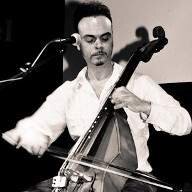
I have 3 basses & 3 cellos, each with a different character. Different compass (nr + type of strings), fretted/fretless, different string length - but for any gig I take just one (plus anything needed in case something goes wrong, i.e. strings, cables, batteries, etc). This has been fine for a few decades and presumably will be beyond, barring a nuclear explosion or something along those lines but I'm guessing in those cases the gig will be off anyway. So the gig determines what I'm bringing & within those bounds, I make sure I've something that'll work across most of what is needed - and if it goes beyond you improvise or compromise.
Anthony Jackson wrote a column about just this topic in Bass Player magazine, May 1991, and I still happen to have that lying around, so I'll share it. He's responding to a previous column by his colleague Randy Jackson (no relation) whose argument was that you needed to be ready for anything the producer/gig/song needed, the keyword being preparedness, with the consequence that Randy would cary a whole load of instruments around while Anthony managed to work & be successful over the years with just one.
Anthony used to cary a load around at one point, but his decision was to seek refinement on one instrument instead. I think, even though I do have several at my disposal, that that is the basic way to go - certainly for any particular gig. I have in fact found myself being drawn towards one bass & one cello. The only thing that keeps me picking one or the other is big differences like fretted or fretless - but then again I know Pino Palladino could hold down an entire soul & funk gig on fretless so then you just go out trusting your instincts if you decide to take the fretless out.
The implicit message is this: your main instrument of choice, whatever it is, will, in the end, end up determining your sound, and I think this is what counts.
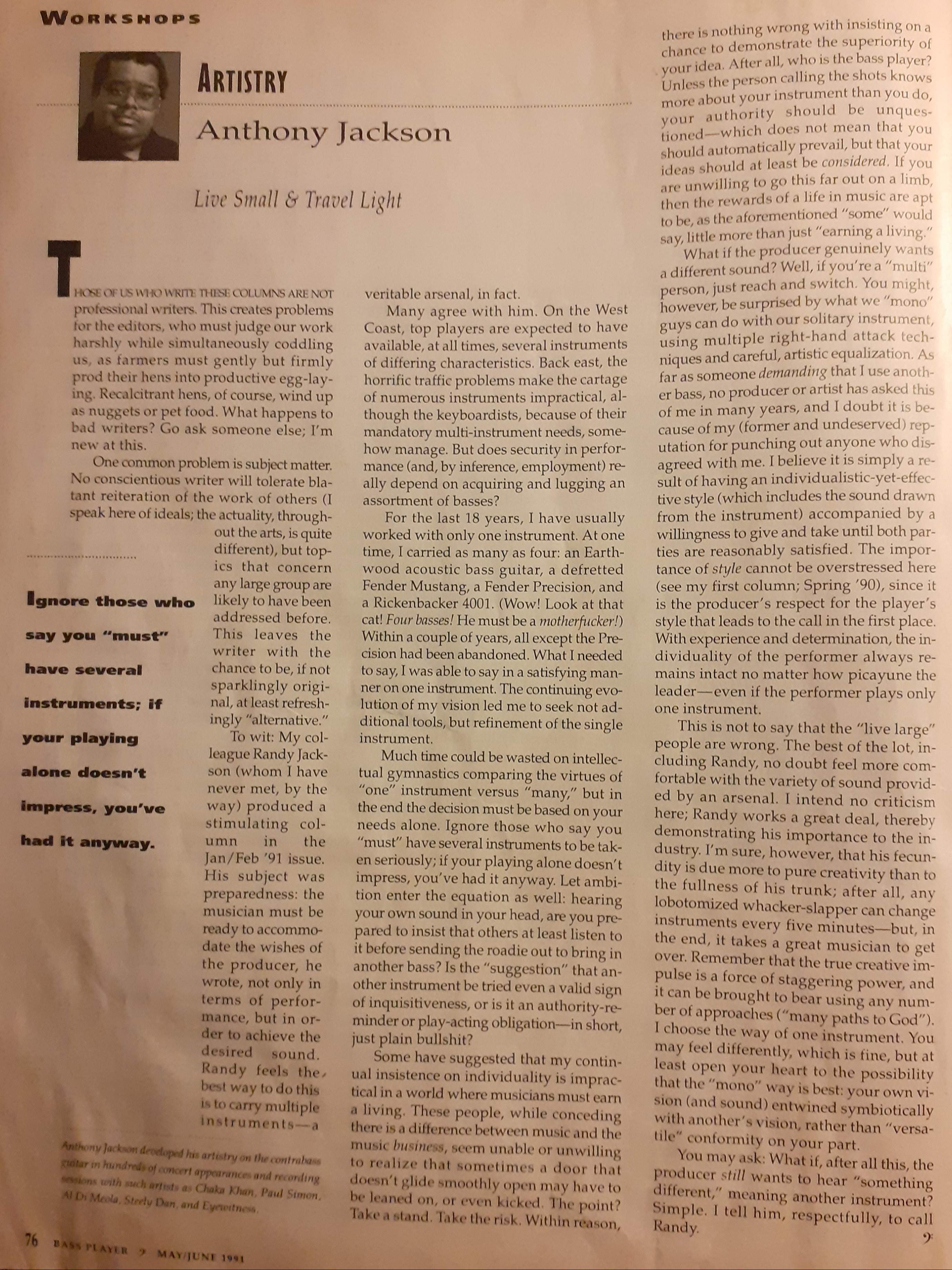
Anthony Jackson wrote a column about just this topic in Bass Player magazine, May 1991, and I still happen to have that lying around, so I'll share it. He's responding to a previous column by his colleague Randy Jackson (no relation) whose argument was that you needed to be ready for anything the producer/gig/song needed, the keyword being preparedness, with the consequence that Randy would cary a whole load of instruments around while Anthony managed to work & be successful over the years with just one.
Anthony used to cary a load around at one point, but his decision was to seek refinement on one instrument instead. I think, even though I do have several at my disposal, that that is the basic way to go - certainly for any particular gig. I have in fact found myself being drawn towards one bass & one cello. The only thing that keeps me picking one or the other is big differences like fretted or fretless - but then again I know Pino Palladino could hold down an entire soul & funk gig on fretless so then you just go out trusting your instincts if you decide to take the fretless out.
The implicit message is this: your main instrument of choice, whatever it is, will, in the end, end up determining your sound, and I think this is what counts.
Last edited:

I make sure of my levels and tones are ridiculously close, so FoH doesn't notice. At least, I've never had issue in my past. I run a few of our smaller gigs' sound. Along wit members of my band. On bigger gigs, we have a main an monitor sound tech. We're all friends. We work together. On road shows, opening for nationals, I explain my situation, work with the techs within THEIR selected techniques of balancing sound. I know my basses and gear intimately. I can work within any framework they suggest. But usually, in my experience, I've rehearsed the Change facet of my game well enuff that techs have never said a word to me after shows. And, any feedback they give I take into great consideration. And apply it going forward.
I don't do major shows that often. Tho I have. And, I do take the Scale of the show into consideration. If I must use two, which is rare, I take every opportunity to know when, where, and how. And map that using a sound tech's help. If channel space allows, I have two D.I.s I can use to send to separate channels, and sound check both basses.
I want Techs to enjoy working with me. So, I do my homework. I rehearse all my game. And I haven't had issue yet.
Sound like a true pro there!! Cool deal! Thanks for the response.
Why would you assume that there's any FOH adjustments needed?
Levels wildly different? Nope. And in the odd case that they are, that's what volume knobs are for. I'll sound check with both, and level set for the quieter one, and use the volume knob for the louder one. But usually the levels are close to equal.
Sonic signature different? Well yes, that's kind of the point. One of the points, anyway.
Edit: After reading Jimmy’s excellent post below, I realized that my doubling is almost always with two solid bodies, and not with any hollow body or upright basses. So the differences just aren’t that pronounced.
I did double one gig with my new EUB right before lockdown, and that one does have a wildly different volume level (I need to work on those piezos….). For that gig I used a Tech21 VT Deluxe, and programmed one bank of presets for each bass.
if there is no difference between bass A and bass B, why switch?

- Apr 18, 2008
- 16,015
- 1
- 31,729
- Disclosures
- I'm highly opinionated and extremely self-assured
if there is no difference between bass A and bass B, why switch?
I never said there were no differences. I said the levels were largely the same.
- Apr 18, 2008
- 16,015
- 1
- 31,729
- Disclosures
- I'm highly opinionated and extremely self-assured
No EQ difference?
Your question is a bit cryptic, but I’ll answer by again stating that the different basses have different tones, which is one of my primary reasons for switching.

As much as I’d like to (I have a couple of nice basses that are fun to play and I wish I could play them more) my main gigs call for a certain bass. I hope to find another to get the others out more. But really, when you start switching, it usually means more gear, more to go wrong, more to haul, and more to maintain. I bring a backup bass for out of town gigs but it stays in the case and in the car.
Your question is a bit cryptic, but I’ll answer by again stating that the different basses have different tones, which is one of my primary reasons for switching.
Not cryptic. My thought is that when you change instruments, usually something is different with the sound, which you just clarified, is different. In my initial post, of which you called me out for assuming something is different, what your are doing from a sound man’s perspective is different and it does effect the overall sound of the band, hence effects what he needs to do.
- Apr 18, 2008
- 16,015
- 1
- 31,729
- Disclosures
- I'm highly opinionated and extremely self-assured
Not cryptic. My thought is that when you change instruments, usually something is different with the sound, which you just clarified, is different. In my initial post, of which you called me out for assuming something is different, what your are doing from a sound man’s perspective is different and it does effect the overall sound of the band, hence effects what he needs to do.
Well by that logic the sound man needs to adjust something any time I switch from neck pickup to bridge pickup, or middle pickup to middle & bridge, or roll the tone knob down, or pluck over the neck, or pick near the bridge, or …
Do sound guys really do that?

My only decision prior to most gigs is whether to bring my one and only five-string or one of my half-dozen or so four-string basses. I like to strip down the gear I have to schlep to the absolute smallest amount possible. One bass, that's it—whether for a rehearsal, for a recording session, or for a gig. I would rather ask the band to hold up between songs to I can quickly re-tune. It beats switching basses as far as I am concerned.

My band leader counts of songs quickly and I have learned to switch basses like a NASCAR pit crew changes tires. I have my basses situated exactly as I need them and can swap and be ready to go in about 5 seconds if I'm focused and about 10 seconds if I'm not. Really the only time I don't like to change basses is if I'm wearing a blazer- which is rare. Also I never bring more than two - and even then I bring only one about 75% of the time. ymmv.
Because it's showbiz and showbiz is coolif there is no difference between bass A and bass B, why switch?
 I'm not against the idea at all...I just don't enjoy doing it.
Usually I take two basses to a gig, one fretted and one fretless. I use the fretted for most songs. Sometimes I’ll bring a 5-string if I feel like getting fancy, but it’s the same make/model as the others so not a lot of difference in sound. Mostly though I’d be happy playing one bass all night. I only change if the song demands it.
Not cryptic. My thought is that when you change instruments, usually something is different with the sound, which you just clarified, is different. In my initial post, of which you called me out for assuming something is different, what your are doing from a sound man’s perspective is different and it does effect the overall sound of the band, hence effects what he needs to do.
A good sound engineer should understand when a band changes their sound. It's not usually a great experience (IMO) when a band sounds the exact same throughout an entire show. I want the band to be able to produce different tones and the sound engineer shouldn't really need to do all that much to accommodate that. Guitar players change instruments all of the time, keyboard players change patches, etc. Everyone might be playing with dynamics which also affects the tone. There's a lot that goes in to the total band sound so just changing a bass really shouldn't be of much concern to the sound engineer.
Fun article, but what Anthony doesn't mention, he's Anthony Jackson, he was pretty successful by the time he committed to his 6-string(s), and came along with it at a time when custom builders were making some very nice stuff that was gaining acceptance. By that time, things were getting more relaxed over non-Fenders and new ideas, and new builders were becoming commonplace. And he didn't care if you liked it or not, whereas Randy did. But both of them made bank in the music business and were happy about their choices, so it's all good.I have 3 basses & 3 cellos, each with a different character. Different compass (nr + type of strings), fretted/fretless, different string length - but for any gig I take just one (plus anything needed in case something goes wrong, i.e. strings, cables, batteries, etc). This has been fine for a few decades and presumably will be beyond, barring a nuclear explosion or something along those lines but I'm guessing in those cases the gig will be off anyway. So the gig determines what I'm bringing & within those bounds, I make sure I've something that'll work across most of what is needed - and if it goes beyond you improvise or compromise.
Anthony Jackson wrote a column about just this topic in Bass Player magazine, May 1991, and I still happen to have that lying around, so I'll share it. He's responding to a previous column by his colleague Randy Jackson (no relation) whose argument was that you needed to be ready for anything the producer/gig/song needed, the keyword being preparedness, with the consequence that Randy would cary a whole load of instruments around while Anthony managed to work & be successful over the years with just one.
Anthony used to cary a load around at one point, but his decision was to seek refinement on one instrument instead. I think, even though I do have several at my disposal, that that is the basic way to go - certainly for any particular gig. I have in fact found myself being drawn towards one bass & one cello. The only thing that keeps me picking one or the other is big differences like fretted or fretless - but then again I know Pino Palladino could hold down an entire soul & funk gig on fretless so then you just go out trusting your instincts if you decide to take the fretless out.View attachment 4355725
OTOH, it's certainly an issue most of us don't need to worry about


