
Enjoy the benefits of a premium membership!
Upgrade Account
-
TalkBass has been independent since 1998. Add your voice.
Create a free account to reply to discussions, view embedded media, and browse with fewer display ads.
Join free Log in
Want zero display ads or expanded classifieds tools? Compare plans.
You are using an out of date browser. It may not display this or other websites correctly.
You should upgrade or use an alternative browser.
You should upgrade or use an alternative browser.
InLace liquid inlay
- Thread starter wentworthk
- Start date
More options
Who Replied?
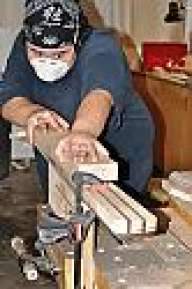
Fantastic from this POV. Take a picture at the most acute angle your camera can get to show how well the frets are seated. like place the camera on the body and snap a pic down the length of the fb, preferably with a good light source behind the camera to add clarity. Any reflected light/ shadow underneath the fret is an indication of how well its seated...
If they all look seated then keep on going Do you have your fret rocker?
If they all look seated then keep on going
Do you have your fret rocker?Hapa, sorry i fell off the face of the planet a bit. I've installed the rest of the frets, and have trimmed them and filed them flush to the edge of the fretboard, its really coming along!

I still have some that are minutely unseated, but I'm talking just barely, just need to get after them a touch more with the hammer. I also need to get you a picture of them looking down the way with an intense light source from behind to see what you think.
after that, comes beveling right? I'm thinking about making this:
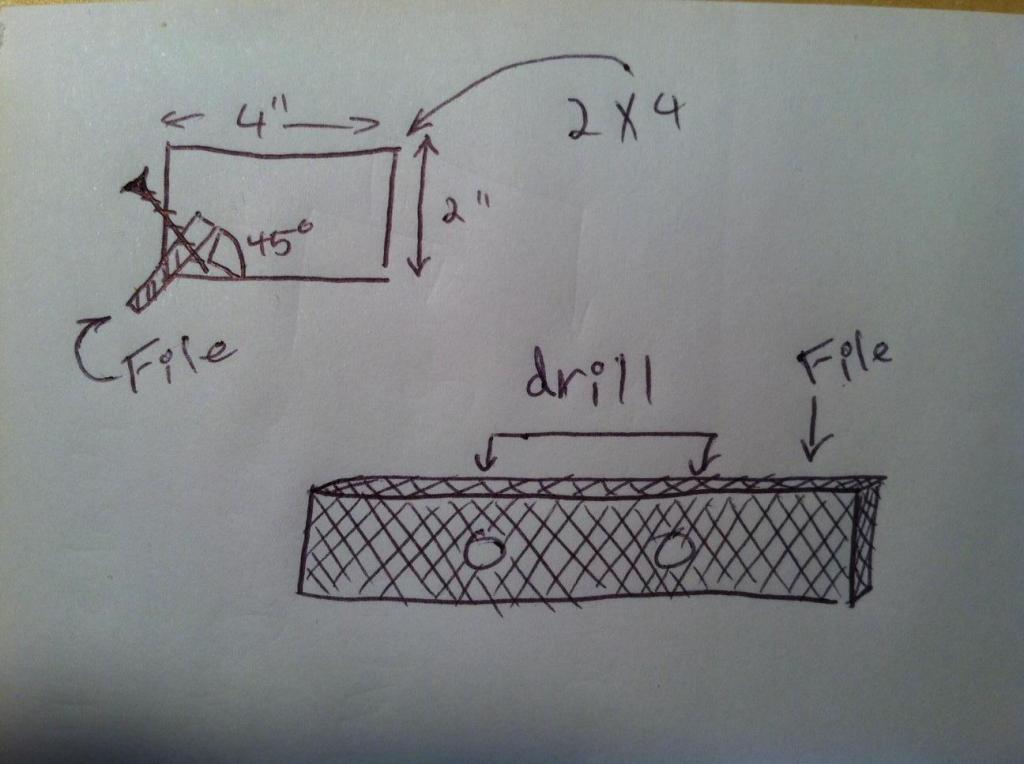
basically cutting down and drilling two holes into a file, then ripping a channel the same width as the file on a 45 degree angle in a 2x4, and popping the file in and bolting it into the block and using that to bevel the edges of the. do you think that will work?
also, is there a way to make a fret rocker? get a cheap straight edge and cut it down to an appropriate length?
I still have some that are minutely unseated, but I'm talking just barely, just need to get after them a touch more with the hammer. I also need to get you a picture of them looking down the way with an intense light source from behind to see what you think.
after that, comes beveling right? I'm thinking about making this:
basically cutting down and drilling two holes into a file, then ripping a channel the same width as the file on a 45 degree angle in a 2x4, and popping the file in and bolting it into the block and using that to bevel the edges of the. do you think that will work?
also, is there a way to make a fret rocker? get a cheap straight edge and cut it down to an appropriate length?
Cool, If you can I would do 30-35 degree's if you want to make a beveler. Otherwise a mill file flat on the block works too, down the road you can use it for compound radius'd boards. Making a fret rocker...is exactly what you described but getting all the edges flat and square is going to be the trick. They are cheap.
If you can see metal under the fret, (the tang) then it is not seated correctly...This matter more to some than others. It can be corrected later in the fret job, $30 for the guitar may warrant this, but if you got some seated correctly then you can get them all to seat correctly...patience.
If you can see metal under the fret, (the tang) then it is not seated correctly...This matter more to some than others. It can be corrected later in the fret job, $30 for the guitar may warrant this, but if you got some seated correctly then you can get them all to seat correctly...patience.

I made a beveling file the other day. I was planning on doing what you describe here. In the end I just screwed two blocks of wood together with the file clamped between them. One of the blocs had a straight side (for filing down the fret ends) and a bevel on the other. The bevel make the entire block tilt which create the bevel. Much easier than cutting a slot in a block and trying to drill holes in a file.
Much easier than cutting a slot in a block and trying to drill holes in a file.Angle on the block is no issue at all, just a twist of the knob on the table saw, I'll update the design to that spec.
I can't actually see any of the tangs, the shadow on some is just ever so larger on some as opposed to others- kind of trying to follow the .001 percent margin you mentioned earlier. I'm pretty sure if I had a press with a caul and what not, that would be enough to make it uniform, sadly, I don't have that though, so it just means more hammering...
I can't actually see any of the tangs, the shadow on some is just ever so larger on some as opposed to others- kind of trying to follow the .001 percent margin you mentioned earlier. I'm pretty sure if I had a press with a caul and what not, that would be enough to make it uniform, sadly, I don't have that though, so it just means more hammering...

- Apr 18, 2008
- 16,002
- 1
- 31,693
- Disclosures
- I'm highly opinionated and extremely self-assured
I'm thinking about making this:
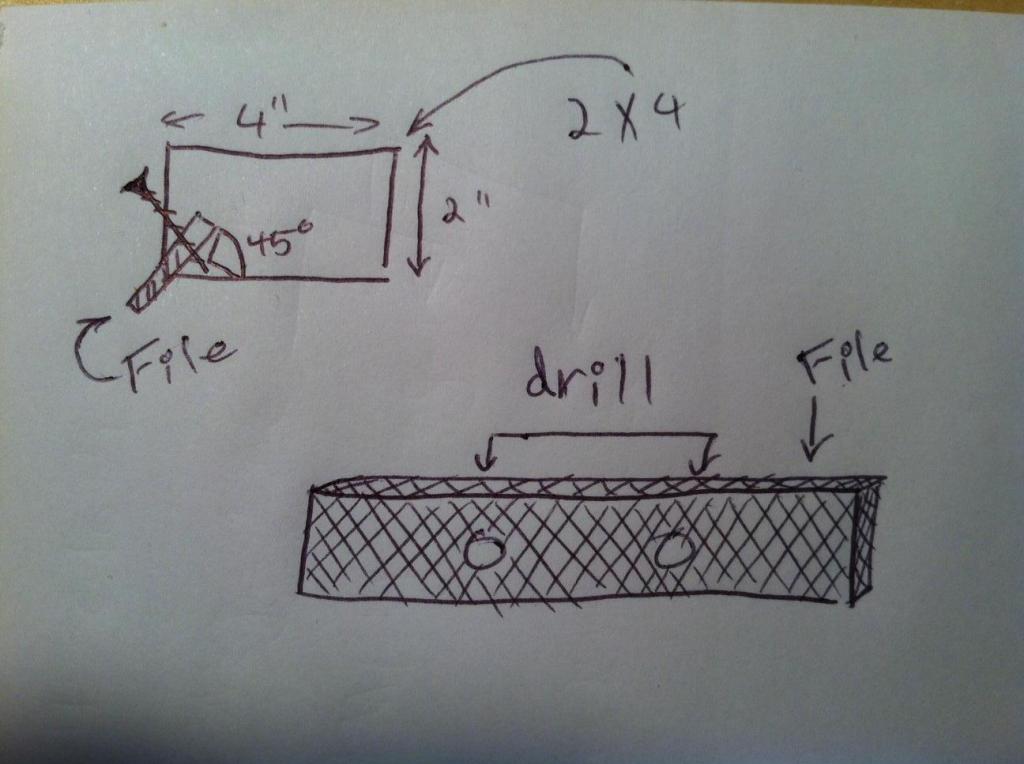
That's what I made, except without drilling for screws. My mill file fits very tightly in the kerf made with my table saw.
Angle on the block is no issue at all, just a twist of the knob on the table saw...
Yup. Easy peasy.
Angle on the block is no issue at all, just a twist of the knob on the table saw, I'll update the design to that spec.
I can't actually see any of the tangs, the shadow on some is just ever so larger on some as opposed to others- kind of trying to follow the .001 percent margin you mentioned earlier. I'm pretty sure if I had a press with a caul and what not, that would be enough to make it uniform, sadly, I don't have that though, so it just means more hammering...
Cool. My old boss would say, can you fit a razor blade's sharp edge underneath? If is a matter of a splitting that hair its an educated guess of your own skill: If I pull the fret to pound in another how much do I risk damage vs taking a little more off in the fret leveling. I am very glad to see the determination for accuracy, its very hard to do by hand. If there is a fret you can move by pressing down with something hard, or a shadow that lets more than the edge of a razor then re do that fret. If not, don't fret (pun very intended).

Whacking the fret at this point might help but likely not. Another question, What is the bass neck resting on when hammering those frets? How solid is whatever it is. Much of the energy you give is bounced right back into the hammer/hand if your neck can flex or whatever it is fixed to. Use a bag of lead shot under the neck, an anvil if you have one, open area of a table saw, right over the supports/ legs of a wooden table, etc.
Caul press/ arbor style do not assure perfect fretting, just consistent. Perfect fretting comes from the hammer in hand hand, light, and shadow.
I am assuming by you saying that you may try to re-hammer...you didn't use any glue, did you?

I use a bag of sand as a neck support, it absorbs the hammer shock and doesnt damage the back of the neck.
For those realy bouncy frets, I have been known to ease the fret into position with a g clamp or a quick clamp on each end with a little superglue, and a G clamp in the middle.
Maybe you could fashion your own fret caul
For those realy bouncy frets,
I have been known to ease the fret into position with a g clamp or a quick clamp on each end with a little superglue, and a G clamp in the middle.Maybe you could fashion your own fret caul
also, a month ago or so i made the cavity cover and pick guard with my buddy, I had no idea he was taking pictures... or that they were good...


Musiclogic
Commercial User
- Aug 6, 2005
- 6,505
- 73
- 60
- Disclosures
- Owner/Builder: HJC Customs USA, The Cool Lute, C G O
Your angle on the beveling block is too much. The angle needs to be between 31 and 36 degrees maximum or the angle gets into the playing area
Hey Wentworthk you are doing a great job with that neck, more importantly you have learnt how to do it, and I bet you are proud of the results, you should be!
Looking back to your earliest posts on here, I bet you didnt imagine you would be going this far. Thats the beauty of this forum everyone helps out, and are happy to pass on their advice and techniques. Great Job man
Looking back to your earliest posts on here, I bet you didnt imagine you would be going this far. Thats the beauty of this forum everyone helps out, and are happy to pass on their advice and techniques. Great Job man
Your angle on the beveling block is too much. The angle needs to be between 31 and 36 degrees maximum or the angle gets into the playing area
Sharp eyes man, I didn't even notice that...


