

Enjoy the benefits of a premium membership!
Upgrade Account
-
TalkBass has been independent since 1998. Add your voice.
Create a free account to reply to discussions, view embedded media, and browse with fewer display ads.
Join free Log in
Want zero display ads or expanded classifieds tools? Compare plans.
You are using an out of date browser. It may not display this or other websites correctly.
You should upgrade or use an alternative browser.
You should upgrade or use an alternative browser.
Innovative bass technology
- Thread starter Ron Johnson
- Start date
More options
Who Replied?
I think Roland's Midi pickup is a pretty big step forward. Or Manson Guitars midi synth bass effect/ modulator thing is pretty interesting. I feel like those options introduced to the bass realm would allow a lot of cool low end stuff to go on. That stainless steel bass that looks like an axe is unique and interesting. or the introduction of graphite necks is pretty cool too. That eliminates a lot of the previous warping in necks.
Active electronics and new construction materials like. Acrylic or metals, LEDs or whatever else seems good also seem pretty forward thinking
Active electronics and new construction materials like. Acrylic or metals, LEDs or whatever else seems good also seem pretty forward thinking

The 6 string bass. Still widely used and the low B gave a lot of navigation over alternative tuning and the high c makes chording and soloing even easier.


Exactly. And the 3 string bass... and the 7, 8+ string basses as well!The 6 string bass. Still widely used and the low B gave a lot of navigation over alternative tuning and the high c makes chording and soloing even easier.

Phillip Kubicki worked on the Leo team and was quite the innovator himself. Particularly his Ex Factor 4 and 5 Bass Guitar designs. I'll point out the innovations tomorrow when I can get back to my iPad.
I bought an Ex Factor "just because" and it has now pretty much become my very favorite bass, and I thought I was a dedicated 5-string guy primarily stuck on Pedulla 17.5mm spacing. Not to say i'll give up the others I own, but I never thought i'd ever embrace a 4 string bass, particularly a medium scale. And probably would not were it not the Kubicki.
Talk about innovation coupled with design execution, just about everything on the Ex Factor is still way ahead of most basses today, or if not "innovative" extremely well executed. Especially as a package. Not to take your thunder away, but let's list a few:
- the rotary cut, multi-laminate neck -- going to be hard to warp that baby
- the D-tuner "flip" design -- a stroke of genius!
- the body shape -- seriously, there is no other bass I would rather play sitting down. It just folds into you!
- the actual headless tuners -- they are practically "micro-tuners" they are so easy to adjust.
- no need for double ball end strings like some other headless modles out there
- strategically recessed jack
- multiple passive/active play settings (depending on which model year) along with an OFF setting which I believe all basses should have...
- a fast neck with a relatively tight radius board
- clearly designed with the idea of slap bass in mind beyond regular play
- easy access truss rod adjustment
- perfect weight balance with no neck dive

Road worn basses! I don't know who invented them but they are very popular these days. 
[Invalid or Expired Link Removed]
[Invalid or Expired Link Removed]




The Babicz bridge with cams rather than tiny screwposts for string height adjustment makes sense, and has been well received.
And speaking of re-engineered bridges, this interesting angled construction was on the Japanese-made 1982 prototype Hagström
that was solicited by the Canadian importer, but rejected by the Swedish manufacturer. I've not seen it anywhere else.
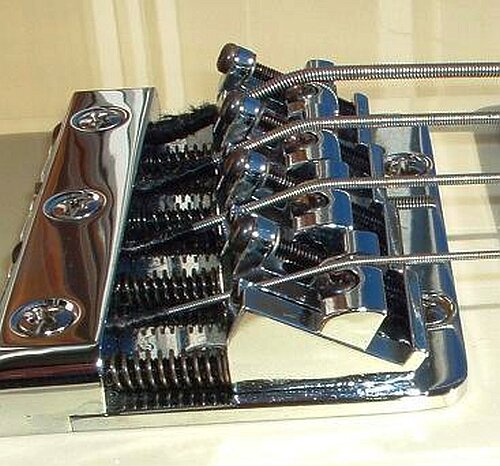
And speaking of re-engineered bridges, this interesting angled construction was on the Japanese-made 1982 prototype Hagström
that was solicited by the Canadian importer, but rejected by the Swedish manufacturer. I've not seen it anywhere else.
Last edited:
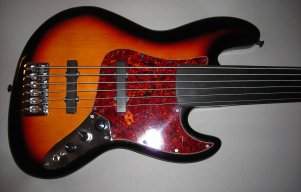
The Lightwave pickup system is pretty nifty in theory, but it reduces/eliminates certain factors, such as pickup placement and type (P,J,HB, MM) to pull different sounds. It seems like you just get one flavor with the Lightwave system. I wonder if it is possible to interfere with the interaction between the IR sensor and the string with a pick, your hand, etc. It's right on the bridge, so probably not an issue.
Aside from that, I think that LED side dots for playing dark stages/shows is a great innovation. The aftermarket options aren't great; it's basically a "do or don't" option when a bass is built. However, I think we'll see more LEDs on basses as time goes on.
Yes the problem with lightwave is the pickups are not only near the bridge (like a Wishbass) but are AT the bridge. So you not only get one sound (apart from EQ) but it's totally bridge pickupy!
I suppose you could have those light pickups in other positions but the problem is unlike magnetics which are away from the strings the light waves go around the sting and probably would get in the way.
I agree that we'll see more LEDs on basses. Especially if more people start using the TRS phantom power instead of batteries. I built my own, but people have been selling the systems for some time too. I have no idea why they haven't caught on. I LOVE mine. And the beauty of external power is that you don't have to worry about battery life and can add fret markers or light your instrument like a Christmas tree is you want!
I agree that we'll see more LEDs on basses.
Ever see the Luminlay side dots? Phosphorescent Fluorescent Lumi guitar and bass position mark Luminlay Products
Got these in my latest Cliff Bordwell bass. Put the bass in some light or use the light charger and you have dots that don't need a power source.
Ever see the Luminlay side dots? Phosphorescent Fluorescent Lumi guitar and bass position mark Luminlay Products
Got these in my latest Cliff Bordwell bass. Put the bass in some light or use the light charger and you have dots that don't need a power source.
I've looked them up before, but I'm not impressed with fluorescent things you have to charge. Like I said I've got power to the bass so LEDs are no problem.

pablomigraine
Commercial User
Yes the problem with lightwave is the pickups are not only near the bridge (like a Wishbass) but are AT the bridge. So you not only get one sound (apart from EQ) but it's totally bridge pickupy!
I suppose you could have those light pickups in other positions but the problem is unlike magnetics which are away from the strings the light waves go around the sting and probably would get in the way.
I agree that we'll see more LEDs on basses. Especially if more people start using the TRS phantom power instead of batteries. I built my own, but people have been selling the systems for some time too. I have no idea why they haven't caught on. I LOVE mine. And the beauty of external power is that you don't have to worry about battery life and can add fret markers or light your instrument like a Christmas tree is you want!
Thanks for putting us on the list guys! We're obviously very proud of Willcox Guitars and the Powered By LightWave Optical Pickups. Pickup "technology" has remained materially unchanged since their inception and, while Optical Pickups perform the same job as traditional Magnetic Pickups, *we think* they do a much better job!
Regarding pickup placement, yes, for the time being ;-) our pickups sense string movement exclusively at the bridge. One benefit is that they sense the vibration of the string not only side to side, but up and down as well.. creating a "3D" picture of the string's vibration.
Something we have always known, but is being discovered more and more by our players and artists... is that the "inherent tone" of a pickup placed very close to the bridge, or very close to the neck, or in the MM "sweetspot".... has only a very little to do with the actual placement of the pickup, and far more to do with the fact that, wherever the pickup is placed, that's where most bassists rest their thumbs, and thereby where they pluck the string. While it is of course true that a string vibrates differently at different points along its transmission length, those differences have really only to do with the distance traveled from apex to apex of the string's range of motion: greatest at it's centerpoint (12th fret or thereabouts) and least at it's anchor points.... but the differences in TONE originate to a far greater degree from the player's right hand position. With a Willcox Bass... the more you play towards the neck, the more "P" like the sound is, the more you play towards the bridge, the more "J" like the sound is. So, to please the purists, we'll say it's 50/50 playing position and pickup position.
All that being said.... you're simply never going to get a true "J" bass or any other "traditional" sound from a Willcox bass. The great news is, if that's what you're after.... there are literally HUNDREDS of really great P and J basses out there to choose from, and we have no doubt you'll find one that suits you, if that's what you're after. On the other hand, if you're after something different, and want to see what a bass sounds like without the inherent tonal imprint and shortcomings various types of magnetic pickups color your sound with, then a Willcox might be a bass for you to check out. We're definitely not for everybody, and we aren't trying to be. Our little club is suddenly growing at an exponential rate lately.... Some people say its people finally getting fatigued with the seemingly endless "Classic - Reissue - Vintage - Relic - Closet - Reimagining - Reboot - '52 - '72 - '77 - Whatever" rehashing of the same 3 or 4 designs going back 60 years. Some others say we're weirdos. And we dig both points of view.
Thanks again for putting us on the list of cool innovations! We're honored!!
Eh, I actually usually rest my thumb on the pickguard edge, or the edge of the body, not the pickup.Thanks for putting us on the list guys! We're obviously very proud of Willcox Guitars and the Powered By LightWave Optical Pickups. Pickup "technology" has remained materially unchanged since their inception and, while Optical Pickups perform the same job as traditional Magnetic Pickups, *we think* they do a much better job!
Regarding pickup placement, yes, for the time being ;-) our pickups sense string movement exclusively at the bridge. One benefit is that they sense the vibration of the string not only side to side, but up and down as well.. creating a "3D" picture of the string's vibration.
Something we have always known, but is being discovered more and more by our players and artists... is that the "inherent tone" of a pickup placed very close to the bridge, or very close to the neck, or in the MM "sweetspot".... has only a very little to do with the actual placement of the pickup, and far more to do with the fact that, wherever the pickup is placed, that's where most bassists rest their thumbs, and thereby where they pluck the string. While it is of course true that a string vibrates differently at different points along its transmission length, those differences have really only to do with the distance traveled from apex to apex of the string's range of motion: greatest at it's centerpoint (12th fret or thereabouts) and least at it's anchor points.... but the differences in TONE originate to a far greater degree from the player's right hand position. With a Willcox Bass... the more you play towards the neck, the more "P" like the sound is, the more you play towards the bridge, the more "J" like the sound is. So, to please the purists, we'll say it's 50/50 playing position and pickup position.
All that being said.... you're simply never going to get a true "J" bass or any other "traditional" sound from a Willcox bass. The great news is, if that's what you're after.... there are literally HUNDREDS of really great P and J basses out there to choose from, and we have no doubt you'll find one that suits you, if that's what you're after. On the other hand, if you're after something different, and want to see what a bass sounds like without the inherent tonal imprint and shortcomings various types of magnetic pickups color your sound with, then a Willcox might be a bass for you to check out. We're definitely not for everybody, and we aren't trying to be. Our little club is suddenly growing at an exponential rate lately.... Some people say its people finally getting fatigued with the seemingly endless "Classic - Reissue - Vintage - Relic - Closet - Reimagining - Reboot - '52 - '72 - '77 - Whatever" rehashing of the same 3 or 4 designs going back 60 years. Some others say we're weirdos. And we dig both points of view.
Thanks again for putting us on the list of cool innovations! We're honored!!
pablomigraine
Commercial User
IME ... that puts you in the minority. I play in a variety of different styles, but I do have the optional GraphTech thumbrests on all my Willcox basses...Eh, I actually usually rest my thumb on the pickguard edge, or the edge of the body, not the pickup.
I'm already in the minority, as I don't play Fender or Fender style basses, mostly.IME ... that puts you in the minority. I play in a variety of different styles, but I do have the optional GraphTech thumbrests on all my Willcox basses...
I do move my thumb anchor point around depending on what I'm playing. Sometimes I rest it on the pickup surround when what I'm playing is fast but I'm still playing finger style. Sometimes I use the neck. Mostly it's body edge or pickguard edge, though.
I find the need for different and changing of tunings during a gig with any drop tuning songs very unwieldy and cumbersome using the HipShot Drop D-tuner.
These days, as fanned frets has started to catch on lately (it seems), it's due/thanks to people are more prone to drop down to silly tunings as F# on the bottom strings, which requires much more thought at the other end amp/cab low end projection and so on.
When I have played my HipShot Drop-D tuner, even on the Headless variants the DB-tuner which drops it at the bridge, PLUS retuning manually from E to D, temporarily, I've always detected that mid-way during the tune the string wants to drag its way up to E again. So you must fine tune and touch it up manually midway in the middle of a song. Companies such as Germanys EVERTUNE (already mentioned) should've come up with an evertune bridge for bass that allows the string to KEEP that dropped tuning once set.
My solution (stated in other threads) has been to buy a fan fret 4 string bass of the 34" - 36.25" scale range, and tune to BEAD, AND USE A CAPO ON FIFTH FRET. Then I can "tune down" at least to D, Eb all the way to open B without having to deal with that the strings are changing in tension. They don't drift. If I don't need the capo I just stick it onto the headstock. It's a Kyser one. Granted the strings are a bit thick to play in E, but to go with this I would LOVE to:
1. Have side LED dots THAT FOLLOWS THE CAPO wherever it's set. So the two dots lits up twelve frets from wherever I set the capo. And all the others follows accordingly. Automatically with me not having to adjust anything. So, there should be LEDs on all frets. And they should react to wherever ANY capo is set across the frets/along the neck.
2. Ned Steinberger (and sort of, Kubicki) made this already with that capo thing. Kubicki with his bass, and Drop-D capo. But Steinberger made some sort of built in capo on a headless guitar, on "rails" that was baritone, that you can slide up and down. Wished that a bass would be built like that. However, with a firm body, and maybe not all that headless (it can't be that headless, since the capo needs to reside somewhere when not in use).
A combination of the two above would be ... swell! (I know that's a daft and old expression...). Skipping having to drop tune and change the tension of the string.
3. Of course, the bass has to be fanned frets too, if we should be able to drop down to B and below.
- - - - - -
FWIW: That point one above should be a killer application on any acoustic guitar anyway. I haven't seen anyone with an ac gutiar not using any capo anytime lately. They always have one laying around, and use it.
These days, as fanned frets has started to catch on lately (it seems), it's due/thanks to people are more prone to drop down to silly tunings as F# on the bottom strings, which requires much more thought at the other end amp/cab low end projection and so on.
When I have played my HipShot Drop-D tuner, even on the Headless variants the DB-tuner which drops it at the bridge, PLUS retuning manually from E to D, temporarily, I've always detected that mid-way during the tune the string wants to drag its way up to E again. So you must fine tune and touch it up manually midway in the middle of a song. Companies such as Germanys EVERTUNE (already mentioned) should've come up with an evertune bridge for bass that allows the string to KEEP that dropped tuning once set.
My solution (stated in other threads) has been to buy a fan fret 4 string bass of the 34" - 36.25" scale range, and tune to BEAD, AND USE A CAPO ON FIFTH FRET. Then I can "tune down" at least to D, Eb all the way to open B without having to deal with that the strings are changing in tension. They don't drift. If I don't need the capo I just stick it onto the headstock. It's a Kyser one. Granted the strings are a bit thick to play in E, but to go with this I would LOVE to:
1. Have side LED dots THAT FOLLOWS THE CAPO wherever it's set. So the two dots lits up twelve frets from wherever I set the capo. And all the others follows accordingly. Automatically with me not having to adjust anything. So, there should be LEDs on all frets. And they should react to wherever ANY capo is set across the frets/along the neck.
2. Ned Steinberger (and sort of, Kubicki) made this already with that capo thing. Kubicki with his bass, and Drop-D capo. But Steinberger made some sort of built in capo on a headless guitar, on "rails" that was baritone, that you can slide up and down. Wished that a bass would be built like that. However, with a firm body, and maybe not all that headless (it can't be that headless, since the capo needs to reside somewhere when not in use).
A combination of the two above would be ... swell!
(I know that's a daft and old expression...). Skipping having to drop tune and change the tension of the string.3. Of course, the bass has to be fanned frets too, if we should be able to drop down to B and below.
- - - - - -
FWIW: That point one above should be a killer application on any acoustic guitar anyway. I haven't seen anyone with an ac gutiar not using any capo anytime lately. They always have one laying around, and use it.


