• TalkBass has been independent since 1998. Add your voice.
    Create a free account to reply to discussions, view embedded media, and browse with fewer display ads.
    Join freeLog in
    Want zero display ads or expanded classifieds tools? Compare plans.

Interviewing bassist stories

Status
Not open for further replies.
Argh. The sig won't fit. I will save it, however, and make it a part of me, my musical self, and I.

Your epiphanies compare, in a strange but poignant way, to a failed marriage. I have looked back with shame, regret, and a sense of, finally, relief, that it was over. And then it is time to move on. It sounds like you are there. The stories you relate must at some level be cathartic to tell, else you probably wouldn't be telling them. Thank you, thank you!

I saw that a famous bassist commented on your youtube video. He's right. Well done.
It's the coda I was talking about. Very nice to have gotten it. I've figured out why it was important to hear it from him: It made it all real. It confirmed that there once was a time when I soared. It sounds counter-intuitive, but I can better deal with losses when I know that what I lost was real. I had to know. I had to know if I was suffering over the loss of something that was real or never existed.

The confirmation that I've suffered a real loss and not something imaginary has made me finally be at peace with it. The wonderful memories of that which I've lost are therefore real, too. My fear was, What if I'm mourning a self-delusion? Wouldn't that make me the biggest jackass ever?

So, it's actually a relief to know for sure, from a master, that I suffered a real loss. It makes me more grounded. It enhances my clarity, and clarity is all.

Gentle Giant "Mobile" bass cover - YouTube

As you say, when we finally enter the mode of complete acceptance, we can move on.

Cathartic is putting it mildly.

And you're welcome, by the way. It's been my pleasure.
 
I can't believe it. I've stopped coming to TB to troll for gear. I'm just coming to check this thread anymore.

Thanks Tom
You're very welcome.

For you, a quote from my killed Bass Player article on why more women don't play the bass:

"Women do get attacked in this business, and it can be very demeaning. We were at a press conference in Italy once, and this male reporter shouted, 'Robert Fripp has said that when Sara Lee plays the bass, she plays with her c*nt!' I was shocked at the time, though now I find it humorous. Maybe in a backwards, horrible, ungallant way, Robert meant it as a compliment, because everyone knows how precise and elegant Sara is. He couldn't have been saying anything bad about her. Another time I jammed with Peter Frampton, and afterwards he said, 'I forgot I was playing with a woman!' So you have to constantly say to yourself, 'Okay, I'll ignore that, otherwise I'm going to go nuts.'"
 
Arthritic_Tom said:
I wrote a long article for Bass Player that was killed when the editor who approved it was replaced. It was about female bassists and included two of the most famous and two relative newcomers. The question was, does gender make a difference in the industry when it comes to the bass? The most famous bassist was much older, and she railed very bitterly about exactly what you describe. She came up in the 60s and often played uncredited. She was never known for her looks, and it was clear that she was still furious about all of it decades later.

not too hard to guess that one...
 
I am glad that you got your Coda, Tom. Very Glad for you indeed.
Thank you. I think my reasoning is sound.

For you, an excerpt from my unpublished second interview with Scott Thunes, which took place May 4, 1997, in a meadow next to a brook. We ate sandwiches and yelled at each other for hours over whether or not he created great beauty with his bass:

TW: You invented your bass lines.

ST: I did not!

TW: You absolutely did!

ST: The difference is, I can see the rocks here. I have the strength to pick up these rocks and throw them into the water. All I had was the strength to play a note that was already there!

TW: Right! Of course the note is there! You’re not inventing notes!

ST: Right!

TW: But you’re inventing bass lines!

ST: No!

TW: Yes!

ST: What does that mean? You tell me what that means!

TW: Okay. I'll tell you what that means. On Zappa's Guitar [Rykodisk] CD, on the fourth track of the first disk, I don't know what the hell it's called and I wish I'd brought it here so I could show you--

ST: "Do Not Pass Go."

TW: Okay, there's a certain segment [1:54-1:56] where you play something that I've never heard a bass player play on a bass guitar in terms of emotions it evokes, and it's not just a "fake guitar phrasing"; it's not any of the excuses you give, it's-- What I think is it sounds as if the bass is crying.

ST: You'll have to send me the file, sir.

TW: See, this is what I mean! This is what you do! Let's say that I play you a particular part of a song, are you going to say, "I played it because I wanted it to be beautiful," or are you gonna say, "Oh, I just played it because I was bored, and Frank was paying me, and I was staring at my shoes, and I had a headache." It just seems like it's really hard to believe that you're not in the least bit in awe of your ability to produce beautiful bass lines!

ST: How'd you do that? [Imitates an exasperated sputtering sound I'd make earlier in the interview.]

TW: I don't think I'm talking out of my anus here!

ST: Nor I, me. Nor I, I. The problem is that art gets created by artists most of the time in ways that they themselves don't understand. When they do understand it, all they can tell you is how they applied the rules that they know. And all I can tell you is that when I play a specific note against a specific note, it is in general because I know what it's going to sound like, or I don't know what it's going to sound like. Now obviously I did enough I don't-know-what-it's-going-to-sound-likes and I-don’t-know-how-Frank-is-going-to-appreciates that after a while I could do them on purpose because I liked the sound of them. But that honestly depends on what he's going to do on top, because if he plays some ugly note on top, my "beautiful" note isn’t going to mean anything.

A minor 7th chord is a very easy way to make something beautiful. B-D-F#-A. D-F#-A is the top part of a B minor chord. So if somebody plays B down at the bottom, all's I have to do is play a D major triad up on top and I’ll have a B minor 7th chord. That is very beautiful. You learn a little bit of jazz, you learn your modes-- All the modes are is a way of teaching how to know that your scale patterns are correct no matter where you start, no matter what key you're in. A lot of people don’t know why some music works; I do. A lot of bass players don't know enough to change the mode. That's all's you have to do.
 
It's almost 2 am, I have to get up at 6:30 for work, and I'm only halfway through this thread. And I intend on reading every post (although maybe no more tonight).

Let me be completely unoriginal and agree that this is perhaps the most interesting thread I've ever read on this forum. I'm grateful for the opportunity to see some amazing moments in musical history recollected here.
 
It's almost 2 am, I have to get up at 6:30 for work, and I'm only halfway through this thread. And I intend on reading every post (although maybe no more tonight).

Let me be completely unoriginal and agree that this is perhaps the most interesting thread I've ever read on this forum. I'm grateful for the opportunity to see some amazing moments in musical history recollected here.
Thank you. Stay tuned. I have a few more that you'll enjoy. Now go to bed!
 
An L.A. story from Scott Thunes, excerpted from my unpublished interview with him:

I parked cars, and then I got the job with Frank. It went directly from parking cars to working with Frank. Going down to L.A. and working with Frank, I was a puppy. I kept my mouth closed and my ears open. Being a puppy means you don't put yourself out there, because if you do, you'll get crushed. The older people who've been in the band for a while will p*ss on you, and Frank is a fair guy, but if you are stupid and say stupid things, he'll nail you immediately. So you either don’t say anything at all, or you are very tentative. You don't want to say anything that’s too drastic or opinionated.

According to lore, it was obvious that I was tweaked in some way, that I was a goofball. Even though I didn't put out anything in a huge way that could be construed to be really psycho, Frank could see that I had some energy that he wanted in his band. So when I went and actually started playing with him, I kept my mouth shut. I was just very happy to be in this experience and keep my mouth shut. Listen to music on my headphone, drive around L.A. and see things, and go about my business. There wasn't really much going on that I could change. I wasn't really affecting anybody yet. It was very good for me to just sit there and listen. So I did that in '81 and in the '82 tour.

By the time the '82 tour was over, I'd been in the band for about a year, and there was a video tape of me being obnoxious and annoying. When I was in high school, I invented a personality that got me attention. At the alternative school where I went, the hippies would go outside and smoke pot and cigarettes. If anybody smoked a cigarette and I spotted it, I'd grab it out of their mouth and smash it. I got beat up once and didn't do it ever again. But for three of four months, I was a scourge. None of the high-school girls would look at me twice. They were all older than me, and the ones I liked who were my age were going out with the older guys. The only way I could get any attention was by being over the top. Once I realized I could apply that personality perfectly in rock and roll, I just fell into it. I was with Frank Zappa, for God's sake.

So for a year and a half, I was what I considered to be a rock star. I had a boisterous personality that had been honed to a sinister perfection. I could use it to get what I wanted. Then nothing happened for a year and a half. I moved back to Marin County and got some cheesy jobs. I was a busboy; I worked in a liquor store; I taught guitar for a while. For a year and half I was completely and utterly poverty stricken. Frank then called in 1984, I went down again and that was the pinnacle of my obnoxiosity. I was really full on. I'd just had a year and a half of enthwartenment of my outgoingness, so in 1984 I was Frank Zappa's bass player again in L.A. I was 24, at the height of my powers, emotionally and musically and humorously, and Frank let me do anything I wanted.

It was maniacal. I was golden. I lived in Los Angeles; I had the most beautiful girlfriend in the world; I was 24; I had tons of money; and I was traveling the world. It was the ultimate expression of what and rock is all about.

I didn't know what I was doing. I was just a f*cking kid going with the flow.


Best interview yet. ST is really growing on me.
 
A San Francisco story:

I knew a bassist who was one of the best slappers on the planet. When we met, I was the one devoted to the bass, and she was a singer, keyboardist, and percussionist who had a bass just to add the bottom to her compositions. She was a former professional child musician. I introduced her to King Crimson, and she fell in love with Tony Levin. "Sleepless" was her favorite.

King Crimson-Sleepless - YouTube

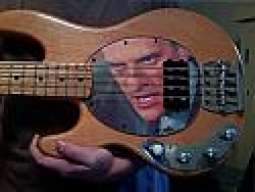
I was frustrated by my left-handedness, because at the time Ernie Ball didn't make lefty MusicMan Sting Rays. So, my bassist friend bought me a right-handed Sting Ray and had the store luthiers build a left-handed body for it. The neck, pickup, bridge, and electronics from the rightie bass were put on it, and thus I had my own Sting Ray.

I taught her to slap, and she became much better at it than I was, probably because of her experience as a percussionist. We slapped together day and night. She also loved the song "Close to the Edit" by Art of Noise. Though we tried for years to learn the sampled bass line for that one, we agreed that no human could ever play it.

We never had much money, but eventually I bought her a Sting Ray of her own. She was flabbergasted. I don't know why; I would've bought her the world if I could. Life being what it is, we parted ways in 1994.

In 1997, I was obligated to call her to tie up a loose end. She'd married a very wealthy man and was pregnant. I myself was still struggling and single. I didn't look forward to the call, because our parting was hideously acrimonious.

When she answered the phone in her deep, creamy voice, I said, "It's Tom Wictor," and she gasped.

"Tom," she quavered. "It's so good to hear from you!" She then shocked me by starting to cry and laugh at the same time. She was always deeply emotional. She'd cry listening to music, reading novels, and watching movies; even TV commercials made her cry.

"How've you been?" she sniffled.

I told her I was fine and asked her how she'd been. In a rush, she told me that the last concerts she'd been to were with me; the last time she'd gone to a music store was with me; she never played her instruments anymore; and she never wrote songs anymore.

I said I was sorry, because music had been her life.

"It was," she said.

We concluded our business and hung up. Over the years, we'd occasionally connect by e-mail, but never again by phone. Even the e-mails dwindled into nothingness. In 2009 I joined Facebook (under a pseudonym) and found her account. I sent her a message, telling her I was still around and giving her my new e-mail address.

She answered and told me that the cat we'd had together had recently died at the age of 23. I sent her a poem I wrote in honor of our cat's passing. It described the way the cat and I would play with a rubber tarantula on a string for hours at a time. The cat would do amazing five-foot leaps and fighter-plane twists in midair. It was unbelievable.

"Did she do that?" the bassist responded. "I don't remember."

About a year later I sent her a link to Trevor Horn playing Art of Noise's "Close to the Edit" live on bass. I said, "Look, it was humanly possible to play this song after all!"

The bassist wrote back, "Did I like this song? It's such a strange, painfully foggy sensation, like having a word on the tip of your tongue. I don't remember liking it."

When I finally admitted to myself that I could no longer play the bass, I sent her a link to my farewell video. I thanked her for buying me the Sting Ray and told her it had given me years of pleasure. To commemorate the bass, the way I used to be able to play, and her, I'd posted the video and I wanted her to watch it.

She sent me the following reply: "Hey Tom. I was just thinking about you last week! I was listening to a radio station and the monologist's observations/humor reminded me so much of you. Thank you for sharing your YouTube performance with me. How very sad that you no longer have your prize bass. And even sadder that you no longer play. Good to hear from you. __________"

As I said before, I must always open the door and see what's on the other side. I must have my answer, regardless of what that answer will be.

I must have that coda, because clarity depends on it.
 
Best interview yet. ST is really growing on me.
He is a spectacular human being and musician. He hates it when I say that, but too damn bad. Now that he's given me my coda, I'm free to say anything I want about him. He's got no hold over me anymore.

Hey, Scott! YOU'RE ONE OF THE FINEST BASSISTS WHO EVER PLAYED!

Chew on that, pal.

Go tell your wife on me. I'll take her on, too. I'm not afraid of either of you now.
 
Just to let you know - I`ve first read the Scott interview, oh, about 10 years ago. To this day I often give it to my musician friends and consider it the best interview about music I`ve read.

The thing about bassplayers being morons by default spoke to me, and it actually made me think and play differently. I actually left bands because no one cared what I played as long as it sounded like a basic boom-baa-boom ba-boom-bambam that anyone could play.

It took a while but I found people that actually said "dude, play something already...". Stuff I play right now is a big part of the songs we make - thanks, in part, to that interview.

What you to did actually made a difference for me. Thanks!
 
Just to let you know - I`ve first read the Scott interview, oh, about 10 years ago. To this day I often give it to my musician friends and consider it the best interview about music I`ve read.

The thing about bassplayers being morons by default spoke to me, and it actually made me think and play differently. I actually left bands because no one cared what I played as long as it sounded like a basic boom-baa-boom ba-boom-bambam that anyone could play.

It took a while but I found people that actually said "dude, play something already...". Stuff I play right now is a big part of the songs we make - thanks, in part, to that interview.

What you to did actually made a difference for me. Thanks!
You're very welcome. We must give the real credit to Scott, though. He joined the forum; find his name, thank him, and cross your fingers!
 
Nah, I`m even tougher and more mean than he is AND I still have hair... well, some of it anyway.

There is a unwritten rule - men with nature as vile as ours do not cross paths. We just communicate with cute bundles of love like you.

:D
 
Twenty eight pages of entertainment (not all read in one go, I hasten to add!!) with no trolling, back stabbing or ankle biting... Bass=community. You, Tom are the Bard of Bass Players.
 
I must schedule this thread in my diary. I've just consumed a whole weekend's worth of material and now I'm feeling bloated. It's the feeling I'd imagine I'd have after a ten-course meal at one of the world's finest restaurants.
 
Tom,

Let me add my own thanks to you (and to Scott and Brian for weighing in and adding large volumes of awesomenesss to a thread already saturated with epic) for providing this wonderful gift to our community. Your amazing stories are priceless and alone are worth the read, but there is so much more here that needs to be acknowledged. This is one of the most touching and emotionally satisfying things I've ever read on the internet - or anywhere, for that matter - because this isn't just tales of the ugliness of the entertaiment industry, the toll it takes on those caught in the meat grinder, and the few stellar individuals who rise above the sewage and manage to be something wonderful. What has captivated me and kept me through 28+ pages is your story; specifically, hearing first-hand about how your thick shell of rage, bitterness, and self-loathing built up by years of dissapointment and failure at the hands of all that ugliness has, after all of these years, dried up and blown away in the wind. I hate to diminish it by referencing typical Hollywood drivel, but I can't help but think about the scene in Forrest Gump when Lt. Dan (played by fellow bass player Gary Sinese) makes his peace with God.

Lt. Dan Makes His Peace - You Tube

It is quite uplifting to hear that you've made your peace. Congratulations. More importantly, it is really nice to think that, someday, I just might be able to feel the same way about myself. Thanks again.

-Y
 
Here are some more specific comments:

Thank you. When the magazine became cookie cutter, as you say, I lost interest. And so did the subscribers. We're in this weird era in which nobody knows how to create a successful business model anymore.

I had plans to interview bassists who played in the weirdest, most unexpected gigs you could imagine. I met a guy who was a bass extra. All he did was be a bass player in movies. Audiences are sophisticated enough now that they don't accept some non-musician pretending to play.

snip snip

Nope. Who cares? Where are his records? The advertisers only wanted people who could sell music and endorse their products, so some genius who figured out how to be a movie star without any of the stress or stalkers never got mentioned.

It was infuriating how self-defeating and short-sighted the approach became, but that was their choice. I bailed.

Yes - you're absolutely right! That is exactly the kind of story that would make a mag like Bass Player stand out from the crowd. It is such a shame that the powers that be can be so short-sighted.

A bassist you all know showed me his godawful collection of photo books full of murder scenes, fatal car accidents, industrial accidents, war atrocities, and so on. He has an original clown painting by John Wayne Gacy, and when he was ostensibly going to play me some music on his computer, a truly monstrous photo appeared on the desktop.

"Whoops! How'd that get there?" he chuckled and deleted it.

I should've reported him to the cops, but I didn't, because I was too depressed by the whole nightmare, too unsure of how to proceed, and the photo looked like a scan from a magazine instead of anything he'd taken himself. I know he doesn't have children of his own, and the image didn't involve adults. It was in that careful legal gray area, but the intent was unmistakable.

I've never listened to his music again.
snip snip

I'm pretty sure I know who this is (I recall reading something about him owning a John Wayne Gacy painting). When this person was younger, he seemed to be very interested in pushing the limits, making me think that he liked the idea of shocking people more than he actually liked to look at pictures of murder scenes, etc.. I recently read something about his home life and family, and I can't help but question if he still feels the same way, or if he looks back on that and wonders what he was thinking. Or the third option - that he really is sick and disturbed, in which case I weep for his family.

-Y
 
TW: You invented your bass lines.

ST: I did not!

TW: You absolutely did!

ST: The difference is, I can see the rocks here. I have the strength to pick up these rocks and throw them into the water. All I had was the strength to play a note that was already there!

TW: Right! Of course the note is there! You’re not inventing notes!

ST: Right!

TW: But you’re inventing bass lines!

ST: No!

TW: Yes!

Tom, I have really enjoyed your writing and insights. However, I must agree with Scott here.

They say that great chess players don't even see bad moves. This gives them more time to concentrate on the best move. Given there are a finite number of possible moves, you can't really say anybody invents a chess move. Yes, they may be attributed as the "first person to play that move", but it was always there.

An amateur chess player reacts to moves, a chess master is not only reacting, but looking deep into a complex set of future moves to choose the best.

I believe bass lines are much like this. An amateur may struggle to find a bass line and possibly come up with a great line almost by accident. However a great talent like Scott can see a much more complex set of lines to play and can come up with a better line. Did he invent the line? No, it was there... it just took a great talent to see it.
 
  • Like
Reactions: mrSaxonAcres
An amateur may struggle to find a bass line and possibly come up with a great line almost by accident. However a great talent like Scott can see a much more complex set of lines to play and can come up with a better line. Did he invent the line? No, it was there... it just took a great talent to see it.
Edgar Allen Poe said the same thing about his stories. He said they preexisted in the ether, and he merely accessed them.

If so, It would mean Poe and Thunes are even more talented than any of us can even begin to imagine, because each in his own field is such an original voice that he must be the only one with this particular ability.

What I struggled for years to communicate to Thunes was that I found his playing unique for its emotional content. He'd argue back that all he was doing was applying his knowledge of music theory, which anyone could learn and thus duplicate what he played.

We've achieved a truce. FOR NOW. I may fix his wagon by writing a best-selling novel in which the hero is a bassist named Skott Tunis. Just imagine all the words I could put in his mouth!

Skott Tunis: "The smartest guy I ever met was a music journalist named Nom Victor. He described in perfect detail what my playing meant, and I'm forever grateful to him for setting me on the right path."
 
Status
Not open for further replies.