A San Francisco story:
I knew a bassist who was one of the best slappers on the planet. When we met, I was the one devoted to the bass, and she was a singer, keyboardist, and percussionist who had a bass just to add the bottom to her compositions. She was a former professional child musician. I introduced her to King Crimson, and she fell in love with Tony Levin. "Sleepless" was her favorite.
King Crimson-Sleepless - YouTube
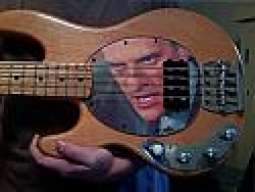
I was frustrated by my left-handedness, because at the time Ernie Ball didn't make lefty MusicMan Sting Rays. So, my bassist friend bought me a right-handed Sting Ray and had the store luthiers build a left-handed body for it. The neck, pickup, bridge, and electronics from the rightie bass were put on it, and thus I had my own Sting Ray.
I taught her to slap, and she became much better at it than I was, probably because of her experience as a percussionist. We slapped together day and night. She also loved the song "Close to the Edit" by Art of Noise. Though we tried for years to learn the sampled bass line for that one, we agreed that no human could ever play it.
We never had much money, but eventually I bought her a Sting Ray of her own. She was flabbergasted. I don't know why; I would've bought her the world if I could. Life being what it is, we parted ways in 1994.
In 1997, I was obligated to call her to tie up a loose end. She'd married a very wealthy man and was pregnant. I myself was still struggling and single. I didn't look forward to the call, because our parting was hideously acrimonious.
When she answered the phone in her deep, creamy voice, I said, "It's Tom Wictor," and she gasped.
"Tom," she quavered. "It's so
good to hear from you!" She then shocked me by starting to cry and laugh at the same time. She was always deeply emotional. She'd cry listening to music, reading novels, and watching movies; even TV commercials made her cry.
"How've you been?" she sniffled.
I told her I was fine and asked her how she'd been. In a rush, she told me that the last concerts she'd been to were with me; the last time she'd gone to a music store was with me; she never played her instruments anymore; and she never wrote songs anymore.
I said I was sorry, because music had been her life.
"It was," she said.
We concluded our business and hung up. Over the years, we'd occasionally connect by e-mail, but never again by phone. Even the e-mails dwindled into nothingness. In 2009 I joined Facebook (under a pseudonym) and found her account. I sent her a message, telling her I was still around and giving her my new e-mail address.
She answered and told me that the cat we'd had together had recently died at the age of 23. I sent her a poem I wrote in honor of our cat's passing. It described the way the cat and I would play with a rubber tarantula on a string for hours at a time. The cat would do amazing five-foot leaps and fighter-plane twists in midair. It was unbelievable.
"Did she do that?" the bassist responded. "I don't remember."
About a year later I sent her a link to Trevor Horn playing Art of Noise's "Close to the Edit" live on bass. I said, "Look, it was humanly possible to play this song after all!"
The bassist wrote back, "Did I like this song? It's such a strange, painfully foggy sensation, like having a word on the tip of your tongue. I don't remember liking it."
When I finally admitted to myself that I could no longer play the bass, I sent her a link to my farewell video. I thanked her for buying me the Sting Ray and told her it had given me years of pleasure. To commemorate the bass, the way I used to be able to play, and her, I'd posted the video and I wanted her to watch it.
She sent me the following reply: "Hey Tom. I was just thinking about you last week! I was listening to a radio station and the monologist's observations/humor reminded me so much of you. Thank you for sharing your YouTube performance with me. How very sad that you no longer have your prize bass. And even sadder that you no longer play. Good to hear from you. __________"
As I said before, I must always open the door and see what's on the other side. I must have my answer, regardless of what that answer will be.
I must have that coda, because clarity depends on it.