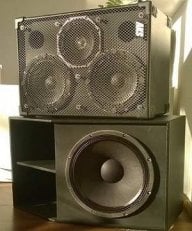
Okay, back...we'll see how far I can go in getting caught up.
georgestrings,
"...Low end monsters..." "...I regularly slam..." "...and believe me when I say..."
Wow! The clarity of your reasoning has shown me the error of my ways.
Not.
Uh, have you got any carefully reasoned thoughts to share with us? What you've said sounds pretty subjective/emotive/emotional so far.
CL400Peavey,
I haven't said anything about sensitivity. At least not yet. I'm not sure where you're going with this.
Your example using headphones doesn't hold water. Headphones are nearfield devices. If you don't think that matters, then...well...I suggest you try an experiment. Try holding the headphones away from your head. No bass, right? Just tinkly sounds. Track that experiment through to its conclusion.
Likewise, your argument regarding large drivers vs. smaller drivers being due to economy, while true at least some of the time, ignores the fact that larger drivers generally have lower Fs. Load up a cabinet simulation program and play with the Eminence BP 102 compared to the Eminence Omega Pro 18.
Several posters have tried to say that there's nothing about larger format drivers that inherently leads to lower response. Hmmm...I live in a different reality. In my universe, we have this property called "mass." Larger drivers have larger cones, which have more mass, which, all things being equal (spider, surround, etc.), lowers Fs. Lower Fs, being the resonant frequency of the driver itself, leads to lower response.
That said, if someone has access to an alternate universe where mass doesn't exist, I propose that we set up a tweeter import business, as hi-fi designers in my universe have been dying to get their hands on massless tweeters.
Hot damn, we're gonna be rich!
Note that I'm not against 10" drivers. I currently have the Eden cabinet (any takers?) and intend to replace it with more 10s. I just don't rely on them to produce anything below 50-60Hz. Particularly at volume.
In passing, I'd like to point out that not one person has addressed the Xmax problem I raised. Once you exceed Xmax, you lose your low frequencies. Xmax figures are generally metric and that throws a lot of people here in the US, but just for the heck of it, pretend that your driver has about 1/4" linear travel, then start playing and see how long it takes your driver to bounce farther than that. Multiply driver travel by the area of the cone(s) and you'll go a long way towards understanding why large drivers can do the things they can do, relative to smaller drivers, at higher volumes. Sure 10s can do a fair job of getting down to...60Hz, easy...50Hz, doable...40Hz...uh, 40Hz? Yeah, that's a toughie. And they can only do it at low volumes, because once doubling sets in, the effective lower limit for your cabinet rises because the frequencies you're putting in aren't being reproduces faithfully. If the tone you get satisfies you...great. I spent years trying to get my tone where I wanted it. If you're there, then don't change a thing. But don't try to tell us that you're getting a low B at 120dB out of 10s. It ain't happening.
chadds,
A Steinway, eh?
Is that what they mean when they talk about "piano bass?"
(Ahem...)
RS66LB,
Funny you should mention triamping. That's something I've been itching to try, but I haven't yet gathered the hardware I want for the experiment.
ejonn,
People tend to overlook the fact (there's that word again...) that all the "classic" tones came from cabinets (Marshall, Fender [jeez, a Twin is a nightmare, speaker cabinet-wise], old Ampegs...) that were pre Thiele-Small. And, no, it's not that people just "got used" to what they were hearing. Look at all the stuff that didn't make it. Why didn't it acquire "classic" status, too? People preferred certain sounds, but it didn't have a thing to do with perfectly designed cabinets.
I'm not suggesting that we go back to the old ways. I prefer to have more control over what's going to happen if I build a cabinet. But still, it's something to think about.
I was going to skip the rest of the banter, but decided at the last minute to throw this in:
JimmyM,
Yeah, I've learned along the way. Made mistakes. I bought the 371 because it had an 18" Cerwin Vega, so I figured that it must go low. Found out otherwise. The low frequency limit of a horn is governed by the size of the mouth of the horn. Period. A cabinet the size of a 301 (or the V4B, or an SVT 810--they're all about the same frontal area) cannot ever, ever, ever even approach the fundamental of a low E, much less a low B, and anything you do to try to force it to do so (like turning up the bass), only causes the cabinet to distort. Someone may like that tone, but it's not getting any deeper, just "growlier." For me, it was a wrong turn. The V4B, as long as I accepted the low end limitation, had this thick, creamy tone that I fell in love with, but it was a booger to move. Biggest cabinet I've ever owned, though not the heaviest. The SVT took that honor.
Grey
I bet dr. McCay from Stargate Atlantis will approve your excellent point regarded mass.

 was that there is more than just a thud vibrating from a B or E string. There are beautiful overtones that the cab could if well designed reproduce without mud.
  ...
...