• TalkBass has been independent since 1998. Add your voice.
    Create a free account to reply to discussions, view embedded media, and browse with fewer display ads.
    Join freeLog in
    Want zero display ads or expanded classifieds tools? Compare plans.

Let's spread some musical misinformation

That C bass is the reel deal. :rollno:
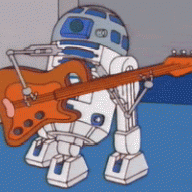
C Bass?.
latest?cb=20150724060842.jpg
 
IMG_0077.JPG


I didn't see Elvis but I saw his car. It was parked in a parking ramp next to Voxman Music Building, the building that houses the University of Iowa School of Music. Curious about seeing this license plate I checked the school's faculty directory. It appears the elderly Dr. Presley teaches music history and is a member of the faculty jazz ensemble.

Oh, and he drives a Prius.
 
Djent? That's African metal, isn't it?

That's right. The African metal is known for it's acoustic properties and is unique to a small African nation called Wakanda. By taking advantage of this metal's unique properties the nation has enjoyed incredible wealth and technological development. Locally the metal is known as "djent" but foreigners will often know this metal by the name given to it by European explorers that discovered the metal independently, "vibranium". The confusion between the metal and the style of music comes from a misinterpretation, as locals of Wakanda use vibranium in the construction of musical instruments based on designs from ancient tribes.

How do I know this? I just found one of the papers written by Professor Elvis Presley on African music history.
 
The Seinfeld theme was played on a P-bass with flats.


That's what was originally thought, until someone finally revealed it was not an actual electric bass at all, nor was it even electrified.

Here's the actual musician performing on the actual instrument on the rejected 'Take 1' of the track, which was nixed, do the the sloppy ending.

Take 2 (not available) was the keeper we all know and love.


Take 1:

 
(From a recent Hezo Doffman/Terek Daylor/Shil Pector interview):

Paul’s "Let It Be" classic was originally titled “Let It Bea”, and was written specifically for Ron Howard to showcase in the ‘Opie’s Group’ episode of ‘The Andy Griffith Show’ (Season 8/Episode 9).

It was actually written in 1966 during their first trip to India.

The original intent of the song was a vehicle to feature Mayberry’s finest contributing the supporting innocent/angelic-sounding ‘Oohs and Ahhs' background harmonies underneath Opie’s band, which was supplying a Hendrix-inspired backing track, for the upcoming episode’s industry-standard lip-synced performance.

It took a marathon 17½ hour session to reach the first acceptable version of the song, which had high hopes of possibly being released as a single as well.

Unfortunately, pitch correction or audio extraction technology wasn’t available in 1967 to correct or remove Deputy Fife’s notorious feeble attempts at falsetto, which of course got slightly worse with every take, so a decision was made before the session ended, to scrap the song entirely.

Although everyone was a little saddened, they all took it in their stride and continued to treat Deputy Fife with all the class and respect one would expect from the citizens of Mayberry.

After a brief Craft Service-wrap party, they decided to have one more go at it (thanks in part to the bubbly), but this time they would all be a little more relaxed and have more fun with it, since it would be for their ears only, and not released to the public.

Fun with it they all did, including a now inebriated Otis, who could be heard whispering "Ernest and the Darlings, Ernest and the Darlings, Ernest and the Darlings", repeatedly during the songs instrumental intro.

Upon playback, everyone thought that was pretty funny and had a good laugh over it.

Everyone…with the possible exception of an unhappy Otis, who held it against Deputy Fife (for sabotaging what he hoped would launch the start of his musical career), originating from the taping of episode #9, until somewhere towards the end of season 8.

Fast-forward a few weeks later, when late one night proud as a peacock-Goober was again previewing the acetate on Mayor Roy Stoner’s phonograph, when he accidentally stumbled over the record player, unintentionally changing the speed of the recording from 45 rpm to 33⅓ rpm, and its rotation from forward to reverse.

What was first interpreted as a loving tribute to Ernest and the Darlings, via the "Ernest and the Darlings" mutterings, now revealed the message "Turn me on, Dep man…Turn me on, Dep man…Turn me on, Dep man", obviously aimed at an unsuspecting Deputy Fife.

Perhaps that is the main reason the acetate soon disappeared, and has only just recently resurfaced on E-Bay, boasting a starting bid of $909,000, thus making it the most expensive Beatles-related recording ever.
 
Last edited:
The Beetles were actual beetles, piloting giant (to them) robots. At first they planned on conquering the world, but then they realized it was a lot less riskier to start a band.

This was a follow on from The Crickets gaining success in the 1950s with their being insectoids in mechanical humanoid constructs. The competition for the conquering of the world between the crickets and beetles ended with a mutual appreciation for music and hostilities ending. The two species collaborated with the formation of The Buggles in the 1970s.

Paul McCartney did in fact die. He was the one human member of the band. When he discovered the secret of his insect bandmates then he was killed and replaced with a look-a-like robot. Buddy Holly didn't die in a plane crash, he just went home and left his mechanical shell at the crash site.

The music industry is crawling with these insect controlled robotic constructs. It's quite possible that every band that (former Buggle) Trevor Horn has produced records for has at least one band member that came from the insect underworld.
 
  • Like
Reactions: Shannon
That's right. The African metal is known for it's acoustic properties and is unique to a small African nation called Wakanda. By taking advantage of this metal's unique properties the nation has enjoyed incredible wealth and technological development. Locally the metal is known as "djent" but foreigners will often know this metal by the name given to it by European explorers that discovered the metal independently, "vibranium". The confusion between the metal and the style of music comes from a misinterpretation, as locals of Wakanda use vibranium in the construction of musical instruments based on designs from ancient tribes.

How do I know this? I just found one of the papers written by Professor Elvis Presley on African music history.

Wakanda is also known for the eponymously named bass, a fish called Wakanda. Not to be confused with the instrument called bass, of course, as Dr. Presley notes.
 
  • Like
Reactions: Jay2U
This was a follow on from The Crickets gaining success in the 1950s with their being insectoids in mechanical humanoid constructs. The competition for the conquering of the world between the crickets and beetles ended with a mutual appreciation for music and hostilities ending. The two species collaborated with the formation of The Buggles in the 1970s.

Paul McCartney did in fact die. He was the one human member of the band. When he discovered the secret of his insect bandmates then he was killed and replaced with a look-a-like robot. Buddy Holly didn't die in a plane crash, he just went home and left his mechanical shell at the crash site.

The music industry is crawling with these insect controlled robotic constructs. It's quite possible that every band that (former Buggle) Trevor Horn has produced records for has at least one band member that came from the insect underworld.

Don't forget the label Chrysalis - a total giveaway if ever there was one, that music was infested with invertebrates, such as the Spiders from Mars.
 
  • Like
Reactions: Shannon
Wakanda is also known for the eponymously named bass, a fish called Wakanda. Not to be confused with the instrument called bass, of course, as Dr. Presley notes.

I assume you must have read the unabridged edition of Dr. Presley's notes on his expedition through Africa. I was only able to see the abridged edition the professor uses as a textbook for one of his history classes, where mention of non-musical cultural aspects like their food, dance, sculpture, and other art has been largely stripped. This month is African American history month so the unabridged edition is popular and all printings that the university owns were mistakenly lent out. One was to remain in the library for people to see at the display this week.

I have not read the entire text yet so maybe I have not come to this section yet or if this section does not exist in the abridged edition I have, but I wonder about the materials the Wakandans used in the construction of the instrument called either "gee-tan" or "tan-gee". This is believed to be the single instrument that evolved into both the modern guitar and banjo, and the modern names derived from the mispronunciation of these ancient African names.

Dr. Presley notes the frets on Wankandan instruments were often made of small animal bones, typically a sea bass for the larger variant. This lead to them being called a "bass gee-tan". Were bones from this fish called Wakanda used to fret the "bass gee-tan"? Was the name instead inspired on how the shape of the instrument approximated that of the fish?

The last person that checked out the book I have now left a photocopy of a page from the unabridged edition inside. On that page Dr. Presley speculated on the meaning of the words "gee" and "tan". Like many languages the Wakandan language has homonyms and synonyms. The words "gee" and "tan" can be translated to "stick" or "limb" and "gourd" or "body", referring to the instrument appearing like a melon on a stick, or a seated person with an arm extended. The words could also translate to "seated" or "chair" and "foolish" or "unskilled". This would mean that a "gee-tan" or "tan-gee" is not far from the modern vernacular of "fool on a stool". Which means this joke goes back at least 500 years, to when European explorers first encountered the Wakandans.

I can see how this insight allowed Elvis to gain his honorary doctorate in music history, and become a professor. It also might explain why Elvis is rarely seen sitting while playing the guitar. The Wakandans may have seen the Europeans try to play while sitting and was calling them foolish or unskilled for doing so.
 
I assume you must have read the unabridged edition of Dr. Presley's notes on his expedition through Africa. I was only able to see the abridged edition the professor uses as a textbook for one of his history classes, where mention of non-musical cultural aspects like their food, dance, sculpture, and other art has been largely stripped. This month is African American history month so the unabridged edition is popular and all printings that the university owns were mistakenly lent out. One was to remain in the library for people to see at the display this week.

I have not read the entire text yet so maybe I have not come to this section yet or if this section does not exist in the abridged edition I have, but I wonder about the materials the Wakandans used in the construction of the instrument called either "gee-tan" or "tan-gee". This is believed to be the single instrument that evolved into both the modern guitar and banjo, and the modern names derived from the mispronunciation of these ancient African names.

Dr. Presley notes the frets on Wankandan instruments were often made of small animal bones, typically a sea bass for the larger variant. This lead to them being called a "bass gee-tan". Were bones from this fish called Wakanda used to fret the "bass gee-tan"? Was the name instead inspired on how the shape of the instrument approximated that of the fish?

The last person that checked out the book I have now left a photocopy of a page from the unabridged edition inside. On that page Dr. Presley speculated on the meaning of the words "gee" and "tan". Like many languages the Wakandan language has homonyms and synonyms. The words "gee" and "tan" can be translated to "stick" or "limb" and "gourd" or "body", referring to the instrument appearing like a melon on a stick, or a seated person with an arm extended. The words could also translate to "seated" or "chair" and "foolish" or "unskilled". This would mean that a "gee-tan" or "tan-gee" is not far from the modern vernacular of "fool on a stool". Which means this joke goes back at least 500 years, to when European explorers first encountered the Wakandans.

I can see how this insight allowed Elvis to gain his honorary doctorate in music history, and become a professor. It also might explain why Elvis is rarely seen sitting while playing the guitar. The Wakandans may have seen the Europeans try to play while sitting and was calling them foolish or unskilled for doing so.

I also read that another theory that banjo means "a bloody awful racket" in Wakandan. Apparently Dr. Livingstone pointed to someone playing a banjo and asked his guide "What's that?".. Similarly guitar may mean "only fit for firewood".
 
Yoko Ono is an incredible vocalist with an octave range witch is relatively unknown in the recording industry, in fact its so incredible and unique that Celine Dion credits her as an inspiration to become a famous vocalist. Yoko once said that she didnt need the money, fame and illustrious careers such as Tiffany or Toni Basil since her lifestyle was funded by her late husband John Lennon. Yoko is also known for her psychiatric bowel movement therapy sessions as illustrated in this video.

What a bunch of fn' pansies man, nobody started a mosh pit. I would have been throwin' down hard punches in Yoko's direction BIGtime!.
 
Last edited:
Genesis was formed by a group of privately educated schoolkids and called Geniuses. When they realised they needed a drummer they hastily changed the name.

Wait, so Phil Collins attended a public school to learn singing, acting, and dance. He was self taught on the drums, and earned an honorary doctorates in history, fine arts, and music. But his bandmates saw him as unworthy to be a member of "Geniuses"? Well, Mr. Collins... I mean Dr. Collins, possibly didn't appear too bright at the time the band formed. I assume Dr. Collins found out eventually, and had the last laugh.

His time at acting school does explain his appearances on Miami Vice, beyond just his music being used in the series. I vaguely remember him on the show and didn't think much of his acting. Maybe I need to find those episodes again to review.
 
Jaco Pastorius was the greatest bass guitarist to ever have lived. He greatly influenced all bass players that came after him. Every present-day bassist owes him a debt of gratitude for completely defining the instrument. His playing changed the playing of the bass guitar in all genres all over the world for all time.
 

Latest posts