• TalkBass has been independent since 1998. Add your voice.
    Create a free account to reply to discussions, view embedded media, and browse with fewer display ads.
    Join freeLog in
    Want zero display ads or expanded classifieds tools? Compare plans.

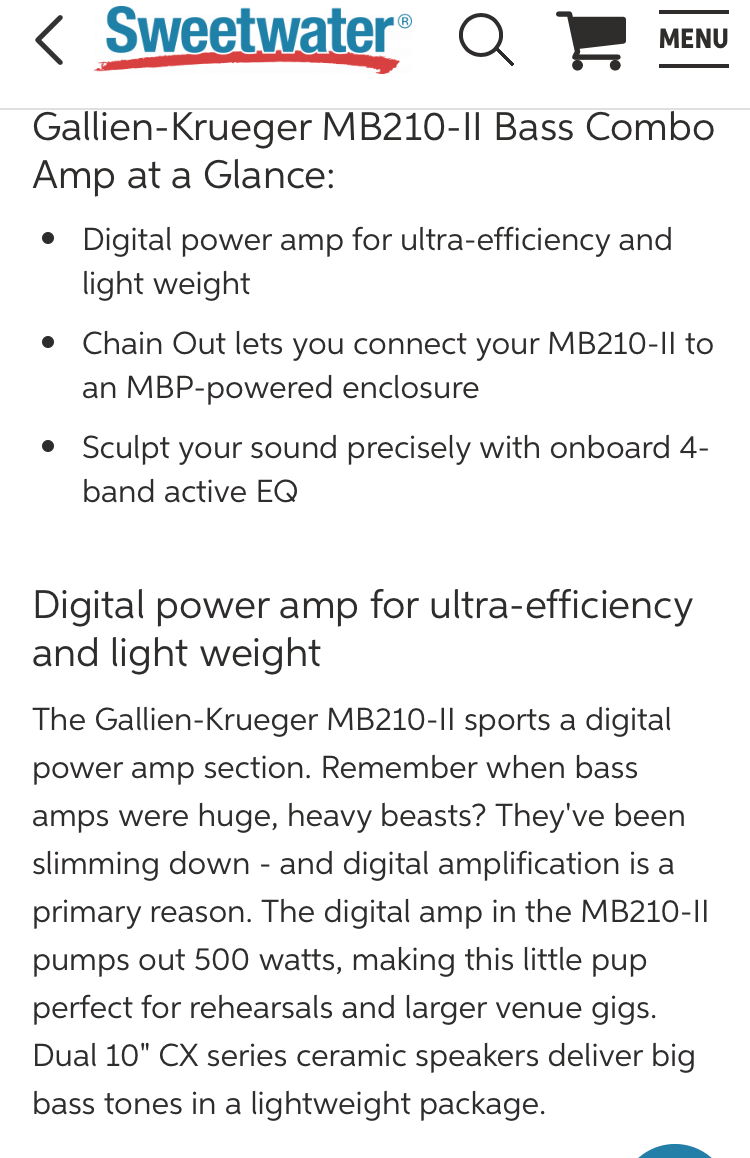
Manufacturers have given up

Oct 13, 2010
11,124
14,244
Appleton
Manufacturers have given up and are now calling Class D amps ‘digital’. :rollno:

E4B30823-8AE4-47ED-BD16-C8139814A335.jpeg
 
Are you sure this is copy from GK or is it something that Sweetwater came up with? I ask this because I browse Sweetwater frequently and some of their descriptions are not something that manufacturer provided. For example, look up Rickenbacker guitars on their website. The 330 is listed as a “thinline” and 620 is a “deluxe” and the 360 is a “deluxe thinline.” I’ve been a Rick enthusiast for 25 years (guitars and basses) and I’ve never heard those instruments described as that. I would guess that Sweetwater has taken liberties with the description you’ve posted and probably with 1,000s of other items they sell.
 
Are you sure this is copy from GK or is it something that Sweetwater came up with?

I wouldn't be surprised if that came from GK. They use this type of language to describe their class D offerings on their website:

"All heads feature aluminum enclosures, digital power supplies and power amplifiers as well as unique signal management circuitry, allowing them to deliver high volume while retaining punch and dynamics."

I don't think they're doing themselves any favors by it, especially as it pertains to TB discussions, but personally I'm a bit of a fence-sitter on the whole digital debate. Technically, and given my understanding of the etymology of the word, I believe its use to be incorrect in this context, but in this day and age "digital" is apparently used as a synonym for "binary" by many which I think is where the issue lies.

I guess digital may sound more "high-tech" as far as the marketers are concerned, though I wonder how much of that @rag has a hand in.
 
Last edited:
  • Like
Reactions: Misfit Wookiee
If musicians were ham radio operators this might matter, but they aren't and it doesn't. I don't know any musician unless they are also an amp designer, EE, or radio junkie that can actually define class A, A/B, D, H, B or any of the other many configurations an output section can take. So call it digital. it's wrong but most people here refer to all micro SMPS style amps as "class D" even though half of them aren't. It's wrong but nobody even cares enough to understand what output class is or means in the first place.

My MB500 amps sound fantastic and that's all any musician cares or needs to know about.
 
If musicians were ham radio operators this might matter, but they aren't and it doesn't.

I'd argue that it does matter, but probably in the opposite direction of it being a selling point.

I know that as processing speed has improved, lag associated with analog/digital/analog conversion has also greatly improved, but there's still some part of me that unfairly associates DSP with latency.

I'm sure I'm not the only one, and I'm probably more open-minded and self-aware of that residual bias than most.

And yes, none of that has anything to do with class-D or SMPSs aside from potential unintended effects of marketing them as "digital".
 
I hope @agedhorse won't mind me quoting him, but this is one of the best "class D vs digital" explanations for the common man I've ever seen:

Excerpted from a recent @agedhorse post - "...Using digital techniques does not mean a digitally processed signal.

Class D is a non-linear analog process, the generation of the PWM signal uses a process similar to digital in that there is a clocked pulse train, but not the same as the digital signals used in digital audio where each audio value is represented by a digital word that can have computations performed on. PWM is a series of time variant pulses that do not have any computation capability.

There are 3 types of signals:

- Linear analog
- nonlinear analog
- digital

Nonlinear analog signals share properties with both analog and digital but is a purely analog process...."
 
Yep as a musician, Class D to means small and light. I have no idea what it actually means. Digital, I would take to mean some sort of emulator. A/B means it was made in the 90s.

Not a single shred of fact anywhere, but I am not inclined to know the truth at all.
The letters simply designate the class (or type) of amplifier. All these letters and many more have been around in the engineering world for many decades and there is no mystery to them at all. Despite being well understood by engineers, sometimes marketing departments take artistic license to appeal to the latest fads in consumer technology by implying something that is often not only technically misleading, but totally irrelevant in terms of product performance or being a noteworthy feature.

 
Despite being well understood by engineers, sometimes marketing departments take artistic license to appeal to the latest fads in consumer technology by implying something that is often not only technically misleading, but totally irrelevant in terms of product performance or being a noteworthy feature.

Cloud-based Class-C sure is taking forever to work itself into the MI market. I expect it to completely disrupt the ecosystem when it does.
 
Engineers do the hard work to develop a product. Marketing can tend to take shortcuts to sell it.

When the people who invented HD radio (Digital Radio) were asked what HD stood for, they said it didn’t stand for anything. As it turns out High Definition (HD) TV was just hitting the airwaves about the same time. The HD radio folks were just riding the HD wave of excitement that was creating a buzz in the television market.

If marketing understood that digital is not superior to analog, but just different and has it’s own set of unique problems, maybe they wouldn’t be so quick to use it inappropriately?
 
My understanding is that there's a huge gulf between "digital power *supply*" and "digital power *amplifier*", but that may be a subtlety too far for the average copy writer...

I'm sure it's obvious that most of this stuff is way over my head, but in this instance I'm personally not able to see how either of those would be correct.
 
If musicians were ham radio operators this might matter, but they aren't and it doesn't. I don't know any musician unless they are also an amp designer, EE, or radio junkie that can actually define class A, A/B, D, H, B or any of the other many configurations an output section can take. So call it digital. it's wrong but most people here refer to all micro SMPS style amps as "class D" even though half of them aren't. It's wrong but nobody even cares enough to understand what output class is or means in the first place.

My MB500 amps sound fantastic and that's all any musician cares or needs to know about.

Owned a MB500 a while back; probably GK's best overall sounding and bang for the buck in their "digital" line.
 
  • Like
Reactions: Spidey2112
...and another thing...tons of companies market/label "1/4" Speak-on" allowing the consumer to believe it IS a legitimate 1/4" and or Speak-on capable interface...which they are NOT...Speak-on ONLY. Unless it is labled "dual use" it is not.
Signed,
A guy who believed the hype in his early days (or is it daze?) and actually removed the cover to investigate what, if anything was preventing full insertion of a 1/4" lead when he forgot a Speak-on cable once...once.
 
My understanding is that there's a huge gulf between "digital power *supply*" and "digital power *amplifier*", but that may be a subtlety too far for the average copy writer...
Those power supplies aren't digital either, they are switching power supplies. They do not convert anything into a digitally encoded stream of data.
While digital involves specified states of "switching" something ON or OFF, or more specifically above or below a pre-designated threshold, switching isn't necessarily digital.

And why do they call it a digital exam when it clearly is analog? :atoz:
 
I am a bit surprised they are pushing the "digital" amps. As shown by multiple threads on TB, digital has a bad connotation for a lot of people. I would think that the marketing research would have found this. However, maybe the research shows the general public loves digital.

I would think twice about buying a real digital amp even though most of my listening is through digital devices. It isn't really a rational decision, although I would worry a bit about latency, which doesn't matter for pure listening. I have no problem with class D though. My main gigging amp is class D.
 
Those power supplies aren't digital either, they are switching power supplies. They do not convert anything into a digitally encoded stream of data.
While digital involves specified states of something being ON or OFF, or more specifically above or below a pre-designated threshold, switching isn't necessarily digital.

And why do they call it a digital exam when it clearly is analog? :atoz:

Pray for small digits. LOL
And why do they call it a digital exam when it clearly is analog?
 
  • Like
Reactions: Old Garage-Bander
If musicians were ham radio operators this might matter, but they aren't and it doesn't. I don't know any musician unless they are also an amp designer, EE, or radio junkie that can actually define class A, A/B, D, H, B or any of the other many configurations an output section can take. So call it digital. it's wrong but most people here refer to all micro SMPS style amps as "class D" even though half of them aren't. It's wrong but nobody even cares enough to understand what output class is or means in the first place.

My MB500 amps sound fantastic and that's all any musician cares or needs to know about.

I agree with a lot of what you say here. At the end of the day it's how the gear sounds that counts to the musician - it's simply one of their tools for making the music. And you certainly don't have to understand how to design, build, or repair an amplifier to use one.

However, I've always felt like people in a profession (or hobby) should at least use the associated lexicon properly even if they don't have a deep understating of the technology. I guess in the big picture maybe it doesn't matter, but for me I like to have some rudimentary understanding of the things I use and how to refer to them correctly.