
Would "neutral EQ" be a better term?

 Hey, if we couldn't overthink all this stuff, there would be nothing left to post about after 'I dig SVT's and PBass's', etc.

TalkBass has been independent since 1998. Add your voice.
Create a free account to reply to discussions, view embedded media, and browse with fewer display ads.
Join free Log in
Want zero display ads or expanded classifieds tools? Compare plans.
Would "neutral EQ" be a better term?
Hey, if we couldn't overthink all this stuff, there would be nothing left to post about after 'I dig SVT's and PBass's', etc. 


Nice Skjold!!!Less talk, more yellow...I was afraid the low end of the 15 might be a little much for the little mouse, but once again the controlled low end of the Berlin combo makes this rig outstanding.
 How's it treating you?



If you're ever in Maryland by all means come to one (or more) of my non-private gigs and I'll be more than happy to show you.
I did it for more than ten years with my AMP BH420 amps, did the same with the Thunderfunk TFB420 and the LMII works the same. The most I used the Timbre control was to show people how it works
It's pretty simple. While most of my basses have preamps, the funny thing is that I usually don't have to tweak the preamp either. I start out by sending a pretty full (or "hot") signal to the amp. I set the amp's gains to the max I'll need. I typically leave my bass' volume control wide open. By and large I can adjust my volume and tone with my hands (not that I want to open that can of worms again but it's important). I can go from bright to thuddy, loud to soft without touching a knob or switch. My overall touch is very even so I don't have to worry about peaky output. It all plays a role in getting the results I do.
I understand what you're saying, but the point I was making is that I don't tweak the amp during a gig, I tweak it before hand, with the basses tone and volume wide open/flat to get the desired sound. Different venues do affect the tone and it needs to be compensated for. Our rehersal space is soundproofed and quite dead, then a recent gig was in a dance studio with highly polished wooded floors, wall panels and huge mirrors. Barely a piece of cloth in sight. I tweak the amp to get rid of any overly resonant frequencies to get a 'flat' response.
I too then will tweak eq on the bass itself, more as an effect than anything. For instance, I'll roll of the tone on my passive to get a more vintage sound. Or I'll boost the bass on my active for disco tunes.
I personally like to have 'my' sound with the bass set 'flat', then tweak for effect like I say. I don't particularly like the idea of leaving the amp preset and adjusting for the room on the bass, I need to know where my neutral sound is.

This raises an interesting question...And the point I'm making is that pretty much without fail any compensating I have to do is done with a combination of my touch and my bass' controls... I don't have to tweak the amp, period.
...my sound is my sound, period and I tweak it manually (my hands).
This raises an interesting question...
This means, that, if you never ever use any of the amp's eq, unless you've always used the same amp for your entire career, "your sound" has changed, unless you maintain that, with any amp, you can get exactly the same sound by using only your hands and the bass eq.
I find it hard to believe you could play thru, for example, an Ampeg, and then just by tweaking your right hand and bass eq, you could get the same exact sound when playing through an Eden or something equally "modern" sounding.
That said, the question I have is, it sounds like you don't really ever need anything except a straight amp. Why wouldn't you just omit the extra unnecessary stuff in your signal chain and just go direct to a straight/plain amp with just gain/master control and maybe a DI out?
 .
.
This answers a lot of the question.Every amp I've used since has been from the same camp... stay out of the way tonally. The LMII does that IMO.
Cool. This, of course, makes sense, and is my approach, as well. In fact, I celebrate it by being a huge gear nerd with a lot more stuff than I really need, but that's another story.That's why I don't use Eden or Ampeg amps
I also get different sounds with different cabs. My Schroeder, Epifani, Flite Sound and SWR don't sound alike. So how do I make my bass sound the same with all of them?
I don't.
...
I figured that out a long time ago. I don't try to make basses sound like other basses, I let them do what they do. That's probably why I has so much fewer problems with instruments and gear in general than most people I know. I put the combinations together and then it's up to me to decide whether or not I like it.
Stuff I like, that fits how I do things, I keep and use. Otherwise, see ya.
Yeah, exactly, and this is one of my favorite things to do, and why I have so much fun at GTG's when other people play my stuff and I get to hear more new sounds from it....have you ever handed a bass around to other players and without touching anything, the bass sounds different in their hands? In a nutshell, that's all this is about. Control on a personal level.
I agree that some amps may sound more like a bass thru a DI box into some reference cans, which is what I take you to mean by "blank palette". However, I think some folks consider their tonal baseline or reference point to be a combination of an amp that does do some coloring along with certain basses, and then they vary from there. I think that's what some folks are referring to when they talk about getting "their sound" from one amp, but not another. A component of "their sound" may very well be some amp colorization.Start with more or less a blank pallete amp wise and go from there. Plug 'n play can and does work.

I celebrate it by being a huge gear nerd with a lot more stuff than I really need, but that's another story.

This answers a lot of the question.
The way you wrote the one post, it seemed to me like you were saying that your sound is your sound and can always be the same no matter what you played through, given some technique and bass eq adjustment (or compensation, as it were). Clearly, if you keep all your amps more or less the same, that's not the case.
Cool. This, of course, makes sense, and is my approach, as well. In fact, I celebrate it by being a huge gear nerd with a lot more stuff than I really need, but that's another story.
Yeah, exactly, and this is one of my favorite things to do, and why I have so much fun at GTG's when other people play my stuff and I get to hear more new sounds from it.
I agree that some amps may sound more like a bass thru a DI box into some reference cans, which is what I take you to mean by "blank palette". However, I think some folks consider their tonal baseline or reference point to be a combination of an amp that does do some coloring along with certain basses, and then they vary from there. I think that's what some folks are referring to when they talk about getting "their sound" from one amp, but not another. A component of "their sound" may very well be some amp colorization.
Personally, I love the MB amps, but I also like Eden's stuff and some others. I just like to have even more variety than one amp plus bass eq can offer, and to some other's points, many amps can not be made to sound like many other amps, and IMHO, the MB is no exception, even if it is closer to some sort of flat reference model than others.
. My main concern is getting the sound of my bass out there, not my amp. I get variety with all of the basses I have to choose from, my cabs and my technique. That's plenty.
I think this is also true for folks that also vary their amp types, assuming they DON'T try to make one sound like another (in other words, they don't do that much tweaking, 'cause the colorization is desired). At least in my case, I don't, so my setup time is equally fast whether I'm in the Eden mood or the LMII mood.And for those folks, they can tweak to their heart's content. I'm not against that. But there's a peace of mind that comes from knowing I can show up, setup, tune up and be ready to play usually in 10 minutes or less on most of my gigs and rest assured that my basses will sound as good as the situation allows.
...and at least in my case, being VERY careful with the lower frequencies in particular.Some rooms suck... and I usually attack that problem by bringing my volume down first.

I love my Little Mark!
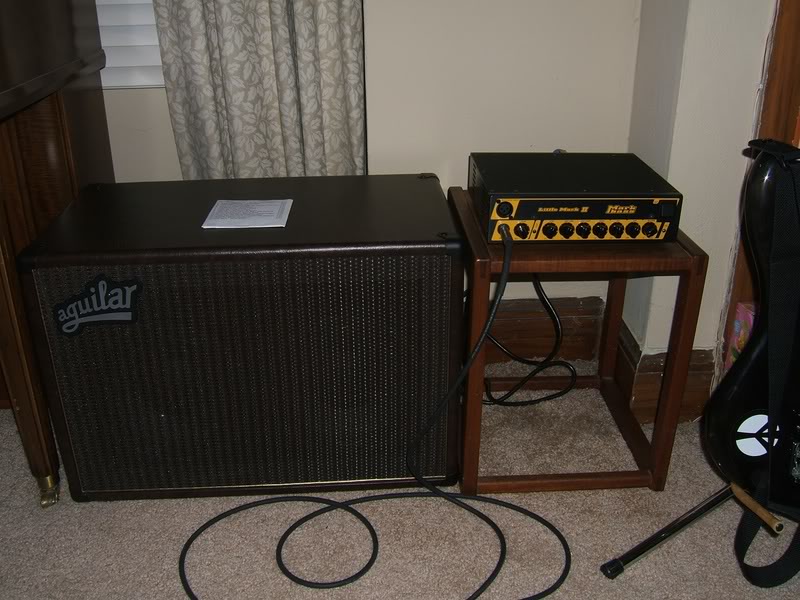
And the point I'm making is that pretty much without fail any compensating I have to do is done with a combination of my touch and my bass' controls... and that's been working for me for almost twenty years of steady gigging. I don't have to tweak the amp, period.
And do varying degrees of muting to acheive the same "vintage" sound or change where I strrike to string to affect the overall tone.
And that's cool if that's what you want to do. OTOH what works for me has worked for me extremely well over a long period of time. I don't use effects so my sound is my sound, period and I tweak it manually (my hands).
Well neither of us is right and neither is wrong.
Both ways are a means to an end. I can strike the string in different areas and achieve different tones and dynamics with my hands but I choose not to. I have a technqiue that is 'me' built up over the past 15 years. I like to go for consistency, I use my pickups as a ramp so I can strike the string evenly and consistently to get a solid sound. As as mentioned before I like to set my bass 'flat' and dial in my sound on the amp. that way i have an easily findable neutral point if i do tweak the basses controls. The way I see it if you weren't meant to tamper with the amp's eq you'd only have a volume control on it.
I meant to mention before, part of eq'ing for the room includes gelling with the rest of the band. The room acoustics also effect other instruments so I think it's essential that every instrument has it's own space to breathe. A drummer can't easily alter the tones of his drums (it can be done, but not at the flick of a switch), so the bass, guitars, vocals etc all need to be tweaked to fit around the drums. Yes you're right this can be done solely with the basses controls but I choose not to.
Bearing in mind I sing a lot of backing vocals and sometimes lead, and am a rather energetic performer the less I have to think about, the better IMO. I constantly get comments that my tone is 'awesome' (even from the amazing Rob Balducci once) so I must be doing something right!
But hey, if what you're doing works for you then fine. What I do works for me and my playing style.
Okay... tell me how I'm wrong about what works for me?
MUCH SNIPPAGE
I never questioned what you do, why would I... I've never heard you. If you find what I'm saying to be unbelievable, cool. People have seen and heard me for years. I used to do what you do and spent loads of time trying to fight amps and dial in a tone I could stand... then I figured out a better way FOR ME.
This one's getting a bit heated, and I did not mean it to go down this route. Just wanted to discuss differing opinions.
Let me start by clarifying. Maybe I chose the wrong words, but I did not mean to infer you are wrong and I am right. We both have differing opinions which are right for us. Nothing going to change that.
Now you have explained your methods in detail I do understand what you do and that it works very well for you. It would not however work for me.
You asked why I would leave my bass flat as it doesn't seem logical. Maybe I wasn't clear in my hasty writing. I start with my bass flat which is a neutral 'reference' point. I know what that point is supposed to sound like on each bass. I then tweak the amp, not very much mind, but just enough to dial out any nasty frequencies or the occasional muddyness, so I'm in effect, 'flattening' the eq to a balanced, even tone. As has been mentioned elsewhere, the LMII has a very (for want of a better word) uncolored sound and sensitive tone controls so not a lot of tweaking is necessary. Any further tone shaping on the basses is for effect, not special effects mind you, just tone shaping to fit particular tunes. A bit of high end zing here, or a vintage thud there. I don't wildly alter the tone, you can still hear my sound.
Like I said before I go for consistency in my playing.
I like to be able to play the bass the same way at every gig. That's where I would have trouble compensating for tone shifts with playing position. I would find it harder to perform well if I have to think about where I need to strike the string. It would feel different everytime I played the same tunes.
I also think that what and where we all play affects our needs in terms of gear and how we use it.
My main gig basses are Warwick Thumb with 2 band active EQ and a passive Yamaha RBX4-A2. The yammy only has a single tone control (along with the 2 vols), so not a lot of scope for tone tweaking soley with controls.
I would be intrigued to know what sort of control you have on your basses that makes them so flexible for you.
I play in a function/pub rock band. I find that smaller venues where I do not use PA support for the bass, tweaking the amp is a lot more critical. Perhaps with a lot of nearby flat surfaces for the sound to bounce off the amp doesn't have room to breathe, so to speak. Big venues I can leave the eq near neutral, but still might need a little tweak. When I'm playing a set that includes rock, disco, soul, indie pop and funk I need to be able to tweak my tone and get back to a reference neutral point quickly and easily. As I sing as well, and have to put on a show I need to be able to take as much brain work out of playing as possible. I also play a few technically challenging tunes (DLR, Vai, Mr Big type stuff) from time to time too with some other guys. For me, consistency is key here too. I can get rather anal about this, even down to the length of my strap!
I do use a few effects too, mainly a dual band compressor (that consistency thing again). The other are bread and butter effects for a few songs that don't wildly alter the eq (chorus and drive - the drive is set with a clean low end to retain a solid bottom end and is blended with my clean tone) along with a synth/filter pedal for one or two special disco numbers.
To summarise:
I have some great sounding basses too. They don't need fixing either, but room acoustics do. I'd just rather do this on the amp rather than the bass.
PS. Maryland is a bit far for me. But likewise, if you're ever in Southend-on-Sea in the UK, I'd be happy to demonstrate how it works for me.


