• TalkBass has been independent since 1998. Add your voice.
    Create a free account to reply to discussions, view embedded media, and browse with fewer display ads.
    Join freeLog in
    Want zero display ads or expanded classifieds tools? Compare plans.

MIJ Fender Precision bass - no serial number

Having a serial and future resale value
That's exactly the problem. Just buy it and enjoy it. There was time when the term 'resale value' was never ever used with regard to basses. Why? Bacause it's something you buy for personal enjoyment. And for a measly $385, you should not expect any kind of 'resale value'.
 
  • Like
Reactions: dutchwife
That's exactly the problem. Just buy it and enjoy it. There was time when the term 'resale value' was never ever used with regard to basses. Why? Bacause it's something you buy for personal enjoyment. And for a measly $385, you should not expect any kind of 'resale value'.
I disagree but that's cool, if you buy a "used fender bass" there's a good chance you'll get all or most the money back in a sale later on, but definitely not if it's not "real". And let's be real who buys a sub-400 dollar bass and never considers upgrading later on?
 
  • Like
Reactions: Smooth_bass88
Despite what many are telling you here, seeing a serial somewhere visible on an 80s Mij Fender is not always the case. Many Japanese made Fender’s in the 80s were marked differently due to the various factories they were made in. Many can only be identified by stamps and dating in the pocket or on the bottom of the heel. This was very common with the Vintage Reissue stuff. For instance, I own a 62RI Tele, made in the No-US Production year, that has the “Made in Japan” Decal on the bottom/back of the neck with no serial underneath. It has a date, model code (TC62), color code (3TS), etc. in the pocket. Looking at this bass, I can’t say for sure (and I’m definitely not saying it is), but if it was a reissue model, it very well could have either a serial or build date stamp along with other various markers like I mentioned for the color or model. Might wanna take the neck off and check. Whatever is in there will tell you more than anything.
 
Last edited:
It sure looks close to my E Serial P Bass, minus the serial and the "made in japan" under the precision bass (also it kind of looks like the space is there for them to have been there and was rubbed away). But mine had the truss rod adjustment at the heel.
4019323203_696c77daee_c.jpg
4020084466_aa725117f8_c.jpg
 
  • Like
Reactions: Elusive1

It sure looks close to my E Serial P Bass, minus the serial and the "made in japan" under the precision bass (also it kind of looks like the space is there for them to have been there and was rubbed away).

It could be my imagination but the wood under the logo looks slightly different to the rest of the headstock. Just conjecture but is it possible that someone removed the serial number due to it being stolen?

Whatever the case it is strange that there is no Made In Japan on it anywhere.

I just asked him to disassemble the neck & more pics of what is there.
From what little I know there should be some number stamps on the body in the neck pocket if it is a Japanese made body.
 
  • Like
Reactions: dragojl and knigel
I’ll try and help. I took a few pictures of some of my Japanese instruments. They are my favorite due to quality vs price.
While there are variances, many still hold a certain consistency. I personally have never owned a Japanese Fender that had the trussrod adjustment at the headstock. I hope this helps.

This is an older Made in Japan neck for a Jazz Bass. I can’t remember year, but 90’s I’m guessing. Smaller tuning pegs, closer to MIM style. Silver logo. No truss rod adjustment at headstock.
6C54FD20-1254-4A2D-9D35-5223474262C7.jpeg

Back of the neck. No skunk stripe
2F57E126-8A76-46ED-9119-D33B41206114.jpeg

Serial number at base of neck.
76A493C1-CC8D-4152-A827-B04101635E72.jpeg


My well worn E series. I bought it new in 86-87. Quality as good as American. Large tuners without logo on back. Made in Japan with E series serial on headstock. Rosewood plug. Truss rod adjustment at heel.
E113C8C2-601E-49EB-86F5-09124E23EBD5.jpeg

Skunk stripe on back of neck.
EB111C2B-73BD-42DC-BB7D-4858F5A3422F.jpeg

2000’s PB-70. Large tuners, TVStyle logo. Truss rod at heel.
6BAE7471-4709-4AAF-A4B8-F1FC1E9512EE.jpeg

No logo on tuner plates or skunk stripe.
486D7C80-65CA-40D3-A9BD-57A9C07F50E2.jpeg

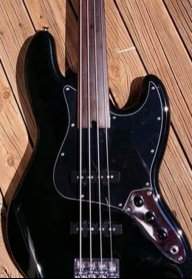
Serial number and CIJ on heel.
0F04BB3A-446E-4BA3-BDB2-34EEAEAF2D7F.jpeg

Getty Lee. Large tuners. Rosewood plug.
ED2AFF5C-6FDE-41AC-855C-F16123D627EC.jpeg

3741BA37-4101-4C6D-AF32-141A2A578D7D.jpeg

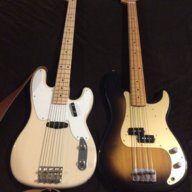
Serial number and CIJ on heel.
B13DAC3B-8AB9-40DA-909E-E2CF1FB2C756.jpeg
 
Part-O-Caster, and I'd pass on this one in a hot minute, and I'll tell you why:

First, there's lots of nice, used, authentic basses around $400, even new ones, with no questions attached, and . .

Second: OK, you buy it, play it for a while, then it's time for something else and that turkey has to sell: You get to repeat every question in this post, except you'll be answering them for whoever the new owner is going to be, for however long that takes.

I do my best to not buy basses with built-in aggravation. Life . . . . is too short.
 
  • Like
Reactions: wraub and FranF