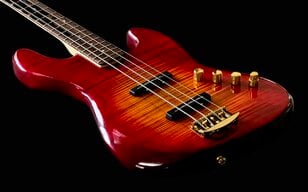
Warmoth has a really sweet roasted maple tele neck on their Facebook page today. I really like the looks, but ymmv.

TalkBass has been independent since 1998. Add your voice.
Create a free account to reply to discussions, view embedded media, and browse with fewer display ads.
Join free Log in
Want zero display ads or expanded classifieds tools? Compare plans.

Just to be clear
Since you did quote me.
I did say "one of the MOST IMPORTANT aspects." I did not say it is the most important...BUT it is up there.
Sure I could route a pickup right up against the neck or right up against the bridge and that is going to over ride a lot of tonal characters sure...But you don't see to much of that...Not when you mostly see P J and slight variation of soapbar positions.
IMHO I think its word is generally more consistent then not and for that matter so don't the people over at Warmoth. (who might have a little experience with this kind of thing...)
As far as most people who cannot tell the difference between maple and rosewood...Well all I can say is that I'm jealous, I go with cheaper materials.
I wish that was me, because l can tell the difference right away when its in my hands.
I'm sorry you got defensive, it was not my intent.
I like how the tonewood debate just creeps in wherever wood is discussed. Some folks just can't help but try to assert their opinions on others.

Even irrefutable proof cannot remove confirmation bias. Any controlled test would simply be an exercise in futility. You'd have to sample a half million necks to satisfy the psuedo-scientists on this board. Even then, somebody would find something wrong with the control.I've said it before, and I'll say it again. we should all chip in a few bucks and hire an experimental physicist to design and run a series of tests to answer the question of tone woods and electric instruments in a definitive fashion, til then we are all just guessing, since removing your own confirmation bias, in either direction, is pretty impossible.
Shouldn't we be able to save those arguments for when they apply to the discussion? This OP asked a very specific question, he wasn't using the broad brush approach you allude to. He simply wanted to know what wood folks thought would be similar to maple. He even begged out of a tonewood debate. However, some posters just can't help from using any discussion of woods potential tonal qualities to launch into a diatribe of how absurd it is. If the OP says he doesn't want a debate, then be polite and honor that request... its just common civility.Tonewoods can be compared each other in an electric instrument when all the other variables are identical.
Take 10 Sadowsky basses, for example. Give them identical fingerboards, hardware, preamps, pickups/placement, body woods, and only change ONE of the variables. Same with Ken Smith, or an MTD. This is where players can start to detect differences. The preamps and pickups and hardware elements are ALWAYS constant from bass to bass, so the builders can make more informed assessments of what the woods are doing.
Unfortunately, the TB perspectives about tone woods often seem to exist in a vacuum of comparison, without regard for all the other elements of an instrument that dictate its sound. I always raise my eyebrows a little whenever I read things like "this bass sounded better than that one because of the fingerboard" despite the fact that one was a bolt-on and the other was a neck-through, and one had a one-piece neck and the other had a five piece neck, and the neck-through happened to have a chambered body. Unfortunately this is all too common on TB - it's where the tonewood debates start to get really ridiculous- and loses credibility for the concept of tonewood in the first place.
Lonnybass

I'd say it's a bit more like religion;belief is the key.It's like the politics that we're allowed to argue about. ;-)
Also, like religion, there's plenty of stodgy individuals that believe that they are bestowed with the absolute truth and the ability...no, the obligation to convince others that they have the answers.I'd say it's a bit more like religion;belief is the key.
Shouldn't we be able to save those arguments for when they apply to the discussion? This OP asked a very specific question, he wasn't using the broad brush approach you allude to. He simply wanted to know what wood folks thought would be similar to maple. He even begged out of a tonewood debate. However, some posters just can't help from using any discussion of woods potential tonal qualities to launch into a diatribe of how absurd it is. If the OP says he doesn't want a debate, then be polite and honor that request... its just common civility.


I appreciate that you are being both gentle and tactful. You post is a self fulfilling prophecy though, where you state that the unfortunate result of this type of question is that guys will go on about this and that, then you go on about this and that.I am entirely polite, and honored that request, and am completely civil.
I repost the OP's question that he re-stated earlier in the thread - and my input on his question follows that below.
Regards,
Lonnybass
-----------------↑
I need to try this again: What wood has the closest sound qualities of Maple but isn't Maple?
I just saw this post. I'm not going to try to answer it.
Talkbass can be great with finding answers to certain things. In my experience though, questions like the one above inevitably lead to an endless series of individual anecdotes about this guy's bass, or that guy's bass that - while interesting on their own - tells you absolutely nothing about what you're looking for.
As you probably know, among the builder community, there are a ton of variables that come into play with instruments...construction techniques, structural considerations, wood combinations for both aesthetics and tonal properties, how the coloration or neutrality of the pickups and electronics will come into play, and so forth. All of them are factored into the process. And all of these considerations must be considered when answering the question about the sound qualities of a particular wood in a particular bass. To read a lot of the tonewood anecdotes on TB that a bass sounded really "bright" or really "open," for example, and attribute it to one particular variable (like a maple fingerboard or something), is a tough sell - at least to me. I wish I had golden ears like a lot of these guys, but I don't.
I think you'll have much better luck doing some research on what folks like Mike Tobias and Roger Sadowsky have to say in the various interviews and discussions they've participated in. One of the most interesting quotes I've ever read about tonewood came from Roger Sadowsky.
To paraphrase, "I am basically building the same bass over and over again, and I can tell you that the kind of wood makes a difference." Mike Tobias has alluded to similar things.
They're building a volume of stuff where there are a LOT of constants - electronics, preamps, construction philosophies - and the only real variable is the woods. I think you'll find much more credible information this way. There's a lot of good tonewood stuff to be learned from volume upper-end acoustic builders as well (Martin, Taylor, etc.)
Lonnybass
Shouldn't we be able to save those arguments for when they apply to the discussion? This OP asked a very specific question, he wasn't using the broad brush approach you allude to. He simply wanted to know what wood folks thought would be similar to maple. He even begged out of a tonewood debate. However, some posters just can't help from using any discussion of woods potential tonal qualities to launch into a diatribe of how absurd it is. If the OP says he doesn't want a debate, then be polite and honor that request... its just common civility.
Yeah, I agree to an extent but I have never seen a piece of maple that felt or looked like mahogany or wenge or ash. Clearly there is enough similarity between different samples of maple to call it all maple.There is no simple answer to his question. When even within the species of maple there is so much structural variance. If wood effects the tone it does so because of the structural makeup of the wood. I have seen maple that was so hard I could barely sand out tool marks and I have had relatively soft piece of maple that was rather easily dented. I have seen tight grain patterns and relatively wide grain patterns in maple, and pretty extreme weight differences. If the tonal effect is real, what other characteristics of wood influence it other than the woods structural make up? So there is no clear cut, straight forward answer, which is my problem with the whole tonewood thing to begin with. You cant have consistent tonal qualities when the material is so inconsistent, so the tonal aspects should be described form board to board, not species to species.
I am sure most people browsing the luthier's section at least have an idea of what woods may share some of the physical characteristics of maple. I don't think it's too big a leap of faith to assume that wood with similar characteristics might sound the same even if you feel that those similarities or differences don't amount to much.
Is one of those examples of maple typically preferred for building a neck?Again, this is an assumption that wood is a consistent material. A hard rock maple board is going to be very different structurally to a wider grained soft maple board.
Yeah, I agree to an extent but I have never seen a piece of maple that felt or looked like mahogany or wenge or ash. Clearly there is enough similarity between different samples of maple to call it all maple.
For instance, I am sure you'd be able to pick up several different types of maple and identify it as maple...any good woodworker can identify a wood by sight, touch and smell. So a simple answer that would satisfy the OP would be to suggest a type of wood that most consistently has physical characteristics similar to maple.
Is one of those examples of maple typically preferred for building a neck?
I appreciate that you are being both gentle and tactful. You post is a self fulfilling prophecy though, where you state that the unfortunate result of this type of question is that guys will go on about this and that, then you go on about this and that.
If you don't have a specific answer or at least an educated guess as to the answer of the OP's question, it is more helpful to stay out of the discussion and not take it in a different direction.
I am sure most people browsing the luthier's section at least have an idea of what woods may share some of the physical characteristics of maple. I don't think it's too big a leap of faith to assume that wood with similar characteristics might sound the same even if you feel that those similarities or differences don't amount to much.
Then you could answer the question using your preference as the point of reference.I can look at multiple pieces of maple and tell its maple because I know what I am looking at. But I guarantee that I could pull two pieces of maple out of my pile that someone with no knowledge of wood would never guess were the same species.
Of course there is individual preference, but industry wide, both are used pretty much equally.