• TalkBass has been independent since 1998. Add your voice.
    Create a free account to reply to discussions, view embedded media, and browse with fewer display ads.
    Join freeLog in
    Want zero display ads or expanded classifieds tools? Compare plans.

Necks Shimmed by the Factory? WTH?

I just never heard of manufacturers doing this before. I suppose it is a good thing that they take the extra effort to make it play right.
Personally, I've played some US made basses at Guitar Center that were borderline unplayable they were set up so poorly. I wish more manufacturers and retailers would care enough about user experience to set them up, either with or without shims, before selling them.
 
I've found factory shims in quite a few high-quality factory-made bolt-ons guitars/basses. Fender, G&L, Musicman, Godin, etc.- even a Lakland Skyline!
I've never seen an issue with the use of them, and they were something Fender utilized from early on so many of the sought-after vintage Fenders people drool about have them too. My Godin Multiacs are some of the nicest factory guitars I've ever played and all 3 (two guitars and one bass) have sandpaper shims in the neck pocket from the factory and in fact that is the only way to adjust the action since they use nonadjustable piezo saddles.
 
I just read that Ibanez uses neck join shims in the manufacturing of some basses. Is this really a thing?
When I buy a new bass, certainly anything approaching or exceeding a thousand USD, I expect it to be designed and built well enough to not need a shim from the factory! Trust me, I am not expecting Lakland USA quality at that price range, but they should be able design and work the wood well enough to avoid needing shims from the word go.
Does anyone know what manufacturers are using this @#&%<$ production process so I can avoid them?
Well...
I can't think of any - other than very low production/ boutique/custom makers. If it's a company that bangs instruments out by the dozens per day? Welcome to the world of mass production... I know it's annoying - and any other perjoratives you care to add -, but honestly?Depending on what they use for a shim (Fender, for example, seems to like well-cut pieces of industrial-grade sand paper), it doesn't actually hurt anything. Well, except for people's feelings... These companies are all run by corporate bean-counters; things like rejected pieces/parts are very bad for the all-important "Bottom Line". So...
The bottom line here? The likelihood of finding a neck shim in a new bass, is pretty much inversely proportional to it's cost. Sorry... :whistle:
 
Last edited:
  • Like
Reactions: Watchootognbout
I’m glad any time a manufacturer or builder takes the time to setup a bass well before shipping. Wood shifts which is why we have truss rods and adjustable saddles on the bridge.

Every Guild Pilot I’ve come across has a small shim in the neck pocket, I’ve only ever taken this to mean the team really took the time to dial in each instrument.

A lack of a shim doesn’t mean perfect geometry, it may actually mean “good enough” in some cases.
 
  • Like
Reactions: Bassdirty and pcake
I've heard it said that a strip shim that disrupts full heel contact with the pocket can cause all kinds of weird tone and sustain and dead-note issues, because the neck and body are no longer vibrating as a unit. So if a shim is needed, it's best to use one that totally covers the neck heel, like the ones Stewmac sells. Can anyone confirm or deny this? Anything to it?

FWIW, at least 15 and maybe 20 Fenders have come my way since the mid 1970s, and I have yet to see one that had a shim.

Yeah. I heard that too, from the old coots sitting around the pickle barrel in front of the general store.

That was the pre-Internet version. Now anyone can post any thought, and if it's half-plausible, millions will accept it as gospel. See the endless shelves of bottled water in every supermarket everywhere.
 
All I can say is OP is getting all up in arms over something he doesn’t understand. So common these days. Jumping to so many bad conclusions. Reminds me of my days working at a music store and people being upset that their bass shipped across the country and now might need a setup. “Well, it’s a new instrument! It shouldn’t need a setup!”… If only we could convince wood to not behave the way wood does in the face of humidity and temperature (and string tension) changes…

(Shims are very much NOT a big deal at all and no indication of the myriad of other things you think it’s an indication of in the production process. It’s often needed on expensive and cheap basses)
 
I bought a brand new US G&L option build JB-5 (empress body) and discovered that it had been shimmed with a mess of tape. There was also some sort of note about replacement that was impossible to fully read when the tape was taken out. I eventually replaced the tape with a carved piece of a plastic Apple gift card which did a nice job.

Interestingly, two other of my US-made G&Ls have needed to be shimmed (by me, maybe they ran out of tape...) because the G-string saddle was bottomed out in order to get the relief and string height on the instrument where it needed to be. This is just one piece of the G&L QC feature set—add the little or no electrical shielding in the cavity and other goodies—but the tape was such a crap job I couldn't help but be impressed (empressed?).

[N.B. It's a really nice bass, though. And super light for a 5-string jazz-type bass.]

JB-5 Neck Disassembly 08-12-19 - 1.jpg
G&L_JB5_ShimJob - 1.jpeg
G&L_JB5_ShimJob - 2.jpeg
 
Last edited:
Thanks for the response.

I get that it's perfectly fine, and common to use them during set up. Phobia? Not quite, but it does make me doubt the quality of instruments coming out of a factory if they have to use shims to compensate for design or workmanship flaws on a regular basis.

Sometimes the shim is part of the design, and luthiers use them as well. Those don't worry me. I am referring, for example, to a standard J-bass copy, designed to have the neck bolt directly into the pocket in a perfect fit, and the assemblers are having to add shims on the regular. That speaks to a process flaw.

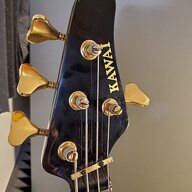
I have owned Kawai, Fender, FGN, Michael Kelly, Ibanez, Squier, and Offbeat bolt-on basses. I prefer bolt-on necks specifically because they can be replaced, shimmed, modified, and removed during refrets and more serious work. I have removed the necks on all of those, except the Offbeat, and never once did I find a shim. I have had a shim added (the Kawai) but none of them were shimmed by the manufacturer.

So, like I said, not anti-shim, but assemblers having to use shims to compensate for design or workmanship flaws - that makes me wonder what else they couldn't get quite right.


But that's the design.

Bolt-on instruments were Fender's idea to reduce costs: a body and a neck are joined, and to adjust the neck angle for the best setup a shim is used. Between the shim and the height-adjustable saddles you get a very easy to way to make adjustments, separating the building from the setting up of a guitar.
 
Shims don't bother me, many guitars play and sound amazing with a shim - but I sympathize with OP.

I would expect high end guitars to be made with a level of precision that does not require a shim. They have CNC machines. They have micrometers and calipers that can measure .0001". Neck through guitars can be made with perfect (or close) alignment. (Maybe that's an apples to oranges comparison.)

A factory shim indicates 2 things:
1) Someone at the factory cared enough to add the shim.
2) Someone at the factory couldn't produce a neck and pocket with enough accuracy that a shim wasn't needed.

Shims were needed 50 years ago when craftsmen were cutting neck pockets with chisels. I suspect they're needed today because a bean counter calculated that it's cheaper.
 
  • Like
Reactions: Nenor and ajkula66
I took my 10 year old Bongo to my local bass shop for a setup a few months ago. Had a buzz I couldn’t get rid of, but my setup skills aren’t great so I was ready to let the professional handle it. He was having trouble too, ended up removing the neck and found a factory shim in there. I know it was from the factory because I bought the bass new and had never taken the neck off before. He removed the shim and then had a hard time dialing in the setup. Those factory guys generally know what they’re doing, and I never thought there was something wrong with the neck because it needed a shim.
 
  • Like
Reactions: mcnach
In a perfect world, they would hand sand the neck or neck joint to the perfect angle and you wouldn't need a shim, but wood is imperfect and that wouldn't mean you would never need a shim. Just wish they would use something other than sandpaper or a random business card. I had a Steinberger XM-2 as my first real bass. It had a shim, even though I didn't know what a shim was at that time. Anyways, they used a chunk of a feeler gauge that was cut to length, rounded off and then had holes drilled that aligned with the neck bolt holes, so the shim was always in the right spot to do the job correctly.
 
I wrote a similar post several months ago and got a mix of responses. Including responses where some TB members seemed to be offended that I felt as you do.

I agree with you. Manufacturers of any product build tolerances into their design, production, and quality control. If a bass cannot be properly setup without a shim (i.e. without intervention), especially considering that bridge saddles are designed to adjust (compensate), it is by definition “out of spec”. “Out of spec” in this context is a “defect”.

The fact that this may be common among mass-produced instruments does not and cannot change the fact that it is still a defect. Anything else is simply a discussion about how much of a defect is still considered acceptable.

Having said all this, a shim is not always a bad thing.