
Enjoy the benefits of a premium membership!
Upgrade Account
-
TalkBass has been independent since 1998. Add your voice.
Create a free account to reply to discussions, view embedded media, and browse with fewer display ads.
Join free Log in
Want zero display ads or expanded classifieds tools? Compare plans.
You are using an out of date browser. It may not display this or other websites correctly.
You should upgrade or use an alternative browser.
You should upgrade or use an alternative browser.
New Bass. (16 Pics)
- Thread starter Overflow
- Start date
More options
Who Replied?

That's the way they were originally -- without the rout, too.Maybe taking the pickguard off would do the job, rather than dissassembling the whole thing?
If you truly HAVE to unbolt the neck for a truss rod adjust ment, that is a very unsmart design...



Engine207
Losing faith in humanity...one call at a time.
Only thing I dislike about the bass is the fact you need to unbolt the neck to adjust the truss rod.
I might be all wrong about this on your bass, but on my Jazz Bass with the heel adjustment, my tech just cut a small semicircular hole out of the pickguard. It's just large enough that an adjustment can be made without removing the neck or the pickguard...

I might be all wrong about this on your bass, but on my Jazz Bass with the heel adjustment, my tech just cut a small semicircular hole out of the pickguard. It's just large enough that an adjustment can be made without removing the neck or the pickguard...
Overflow
Very nice bass
 and a great choice BTW. Now about the neck adjustment thing. It's a pain to have to bevel those aluminum PG's to gain access for adjustments.
 I've played P's forever and here's how I can do minor adjustments "without" having to remove the neck, PG, or even beveling the PG for that matter.
I find a good quality flat blade screwdriver and then file the edges to make the flat blade narrower where I can slip it in the slot and get about a 1/4 turn at a time without hitting the PG. Sometimes I cut the length back somewhat so the blade end is thicker and just fits snugly in the slot. No play that way and you won't slip or mar up the slot. I go with a slight angle on the screwdriver and it works just fine. I always loosen the strings for neck adjustments so the nut turns easily.
If I have a Fender bass with a vintage adjustment screw at the heel, and it's one of those necks that I need to adjust constantly, there's another way I do it.
I shim up the back of the neck pocket "slightly" to raise the end of the neck up and gain more access to the nut using the above mentioned modified screwdriver. For me the shim is usually about as thick as a business card or just a little less and as wide as the pocket and runs from the back of the neck pocket to just shy of the two back neck screws.
I use brass shim material that comes in various thicknesses that you can get at most model or craft stores.
You will have to do a complete setup after you shim because you're changing the neck angle somewhat. It's really not a big deal. If you don't feel comfortable doing your own setups, any competent shop can do it for you.
Keep Low


I ordered this model P bass from MF a few months ago. Mine's black and looks better than the pics on Fender's website. Great wood and flawless build. It's a real player too. All the old-school P-bass mojo you need at a reasonable price. I did replace the tuning machines with 3 Hipshot HB3's and a BT3 extender key on the low E. These machines are a direct replacement for this bass, but they're much smoother and lighter. I now have the extended range and no neck dive. Bonus. Did my first recording session with this bass the other day, it sits in the mix perfectly. I'm loving mine, enjoy yours.
"Very classy, although I'd personally prefer a Satin finish on the neck. Enjoy!"
Luckily a satin finish is just a little steel wool or scotch brite pad and few seconds of work!
What exactly is a satin finish?
Overflow
Very nice bass
I've played P's forever and here's how I can do minor adjustments "without" having to remove the neck, PG, or even beveling the PG for that matter.
I find a good quality flat blade screwdriver and then file the edges to make the flat blade narrower where I can slip it in the slot and get about a 1/4 turn at a time without hitting the PG. Sometimes I cut the length back somewhat so the blade end is thicker and just fits snugly in the slot. No play that way and you won't slip or mar up the slot. I go with a slight angle on the screwdriver and it works just fine. I always loosen the strings for neck adjustments so the nut turns easily.
If I have a Fender bass with a vintage adjustment screw at the heel, and it's one of those necks that I need to adjust constantly, there's another way I do it.
I shim up the back of the neck pocket "slightly" to raise the end of the neck up and gain more access to the nut using the above mentioned modified screwdriver. For me the shim is usually about as thick as a business card or just a little less and as wide as the pocket and runs from the back of the neck pocket to just shy of the two back neck screws.
I use brass shim material that comes in various thicknesses that you can get at most model or craft stores.
You will have to do a complete setup after you shim because you're changing the neck angle somewhat. It's really not a big deal. If you don't feel comfortable doing your own setups, any competent shop can do it for you.
Keep Low
That's a great idea, thanks! I guess setups shouldn't be too hard, but I'd be more comfortable giving it to a shop, at least until there are a few dings on this thing.
at least until there are a few dings on this thing.
Just remember first ding =

Many dings = MOJO
Keep Low

Engine207
Losing faith in humanity...one call at a time.
Cor... I think that naming basses and calling them her is silly however.
Oh, really...then don't name your bass. I guess BB King is silly.


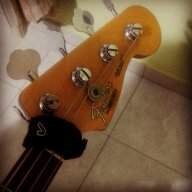

Those pics hit me right in the gut!
I've been 'jonsin' for one of these for a long time. Probably my next bass purchase.
I've been 'jonsin' for one of these for a long time. Probably my next bass purchase.
Just remember first ding =
Many dings = MOJO
Keep Low
I'll keep that in mind!

Yep! That bass is worth the 16 pics!
I can only count 15 pics...I've never been good at counting
 .
.


