• TalkBass has been independent since 1998. Add your voice.
    Create a free account to reply to discussions, view embedded media, and browse with fewer display ads.
    Join freeLog in
    Want zero display ads or expanded classifieds tools? Compare plans.

New Keeley Bass compressor

It'll be about a week before I post a proper review on my site. Here's my initial impressions:

--Very low noise, almost none
--no loss of lows, in fact the lows are slightly boosted
--Easy to use
--fairly transparent tone
--looks great, well built
--pretty good peak limiting

There are some minor negatives:
--highs, while not significantly rolled off, are attenuated a bit and sound kind of congested
--text around the knobs is so tiny you need a magnifying glass
--threshold LED is just over/under, no gradation for amount of compression

Overall it will almost certainly go in my "top picks" list, though I actually still prefer the tone of the M87.


if you did a top 5 overall. . . .what would they be(you are allowed to include yours if desired)?
 
It'll be about a week before I post a proper review on my site. Here's my initial impressions:

--Very low noise, almost none
--no loss of lows, in fact the lows are slightly boosted
--Easy to use
--fairly transparent tone
--looks great, well built
--pretty good peak limiting

There are some minor negatives:
--highs, while not significantly rolled off, are attenuated a bit and sound kind of congested
--text around the knobs is so tiny you need a magnifying glass
--threshold LED is just over/under, no gradation for amount of compression

Overall it will almost certainly go in my "top picks" list, though I actually still prefer the tone of the M87.


Thanks Bongo!
How would you compare it to the Aguilar TLC?
 
i'm surprised to hear that it cuts the highs a little, and boosts low end. IMO, the comps that use the THAT comp chip are generally super transparent.
I haven't tried the Keeley yet, but the one that I built with the 4301 chip is completely transparent. I checked it with a real time analyzer and it is dead flat from 10Hz- 20Khz.
 
Every type of compression technology can be designed to have a flat full spectrum audio frequency response. This is true for every one of the popular audio compression technologies … OTA, VCA, FET and Opto. But not every individual design using the same compression technology will sound the same, even if they all have full spectrum response.

There are just too many variables on how the compression circuit operates in each individual design that allows for each to have its very own characteristics (here are just a few):

*Distortions generated during the compression process within the gain cell or by the sidechain circuit.
*Hard knee vs soft knee.
*Linear vs non-linear compression.
*Peak vs RMS detection, or a combo of both.
*Frequency specific sensitivity curves designed within the sidechain.
*Possible filter effects during the compression process.
*Supporting audio circuit around the compression cell… group delay, headroom, distortions... etc.

Test equipment cannot detect the perceived human hearing response. Our brains are always ‘interpreting’ what our ears are hearing and are constantly adjusting for what we think we hear.

-Frank
 
I can't do a really good comparison to the TLC because I no longer have one of those on hand. I'll have to dig through my notes later this evening. But off the cuff, from memory, I'd say they are pretty similar in sound and function. The Keeley has the advantage of the threshold LED.
 
The specs on the Keeley site says that it has a bandwidth greater than 20KHz. Are you measuring with no compression applied?
Oh it definitely exceeds 20 KHz, no question, but at about 6 dB below its peak in the lows. The overall spectrum shape is a long, very shallow slope down from lows to highs.

Note: I'm away from my computer until tonight, so I may edit the 6dB amount after I can look at the RTA again.
 
I can't do a really good comparison to the TLC because I no longer have one of those on hand. I'll have to dig through my notes later this evening. But off the cuff, from memory, I'd say they are pretty similar in sound and function. The Keeley has the advantage of the threshold LED.
Thanks Bongo!!!
The TLC is my current favorite compressor, it's just does what I need it to do (when set right), so I am hoping that I will like the Keeley equal or better and based on your comments it sounds like I will.
Mine arrives tomorrow, so pretty excited!
:bassist:
 
Do any of you have dimensions of the pedal handy? I can't find them online. It seems to be a pretty standard size, but I'm working with a very cramped pedalboard and if I were to pick one up, it would have to fit exactly where my EBS Multi-Comp is now.

Love the demo video and I'm stoked to hear bongo's very positive initial reactions.
 
It'll be about a week before I post a proper review on my site. Here's my initial impressions:

--Very low noise, almost none
--no loss of lows, in fact the lows are slightly boosted
--Easy to use
--fairly transparent tone
--looks great, well built
--pretty good peak limiting

There are some minor negatives:
--highs, while not significantly rolled off, are attenuated a bit and sound kind of congested
--text around the knobs is so tiny you need a magnifying glass
--threshold LED is just over/under, no gradation for amount of compression

Overall it will almost certainly go in my "top picks" list, though I actually still prefer the tone of the M87.

Hi there!
Thanks for the feedback!
I am completely surprised by any loss of highs, there is no roll-off on our oscilloscopes at the shop to well over 20KHz. I can't detect any high frequency loss by ears either. I wonder if there is a way you can describe it more or demonstrate the loss? I want to make this simply the best product for bass limiting available. Nothing will be overlooked.
Thanks sir!
rk

PS - Goodness 6db down!?!?! Well, I can't wait to get to work to check inventory and production. That would be unacceptable for this design.
 
Do any of you have dimensions of the pedal handy? I can't find them online. It seems to be a pretty standard size, but I'm working with a very cramped pedalboard and if I were to pick one up, it would have to fit exactly where my EBS Multi-Comp is now.

Love the demo video and I'm stoked to hear bongo's very positive initial reactions.

The case dimensions are:
1590B Diecast Aluminum Enclosure
4.39" x 2.34" x 1.06" (112 x 60 x 27mm)
 
I did find this great note from THAT Corp about the operation of the compressor. Doesn't show frequency response of course, but I'll check that out here shortly and post.
rk

From Joe:

BTW, I also ran some basic I/O curves at various threshold settings with the comp knob set to infinity and things look very good. Nice job.


Invalid Link Removed

I’ll keep you posted on any progress.


Best regards,


Joe Lemanski

Applications Engineering Manager


THAT Corporation
 
  • Like
Reactions: Exploiter8
Thanks very much for your responsiveness Robert!

A general note to everybody about my comment about the highs sounding "congested": this is absolutely typical of many VCA designs and especially the dbx designs. Every dbx I've tested, as well as most dbx-type products from other brands, has had the same perceived issue. It is not inherently related to the RTA/spectrum, but is instead a result of the way the signal gets compressed. The stronger the compression, the more I hear the highs being sucked down or muffled.

Also note this is true of single-band compression in general, but I'm referring to a particular quality I hear that isn't exactly the same as what I hear with some other single-band designs.

To spin it a little differently, almost everybody loves dbx compressors on bass. So what I'm describing won't be a "negative" for most people.
 
  • Like
Reactions: HereIGoAgain
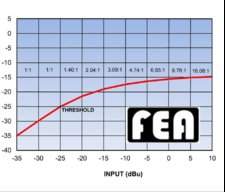
Here was the graph that I wanted to post earlier but didn't insert it correctly.
This shows one I/O measurement related to full compression at differing thresholds.

Keeley%20Prototype%20Compressor%20at%20THAT%20CORP.png
 
I made a (poor quality) video of the frequency response of the Bassist for YouTube. I'll try to make a better one someday soon!


I'd really enjoy any feedback. See anything I'm doing wrong or that you'd like to see clearer, PLEASE let me know. I'm going to have Jack Orman do a RTA analysis of it next week with his gear.
Thanks,
RK
 
Hi Robert,

First, I have to thank you for an interview article of you that was published around 2005 in a smaller musician magazine (I can’t remember the name of the magazine, because I had only read it this one time). You were discussing the history of how you started building pedals. That interview was part of the inspiration for me to try this out for myself in 2009, after many years of building many pedals for myself and friends.

On your site the description of the attack and release reads:

Attack and Release

There is a certain figure that just sounds good as far as compression goes; and that’s 125 dB/second. With feed forward compressors that use this type of true-RMS detector you use a single time constant parameter. The timing capacitor gives you attack and release times that are adaptive to your playing level or the signal input to the compressor. Bottom line: Attack and Release times vary on program content. Attack times are generally speaking, about 100 times faster than release times.

Attack Time: typically 15ms for 10dB, 5ms for 20dB, 3ms for 30dB

Release Time: typically 8ms for 1dB, 40ms for 5dB, 80ms for 10dB, 160ms for 20dB, 240ms for 30dB”

I have a few questions about this:

How did you come to the figure of 125dB/sec? I am curious as if this was something that you had settled on from trying different rates or if there are some compressor studies that I need to read.

Is that 125dB/sec an attack figure, release figure or a sum of dynamic change using both the attack and release rates? And how does that 125dB/sec figure relate to the typical times you have published?

Thanks!
-Frank